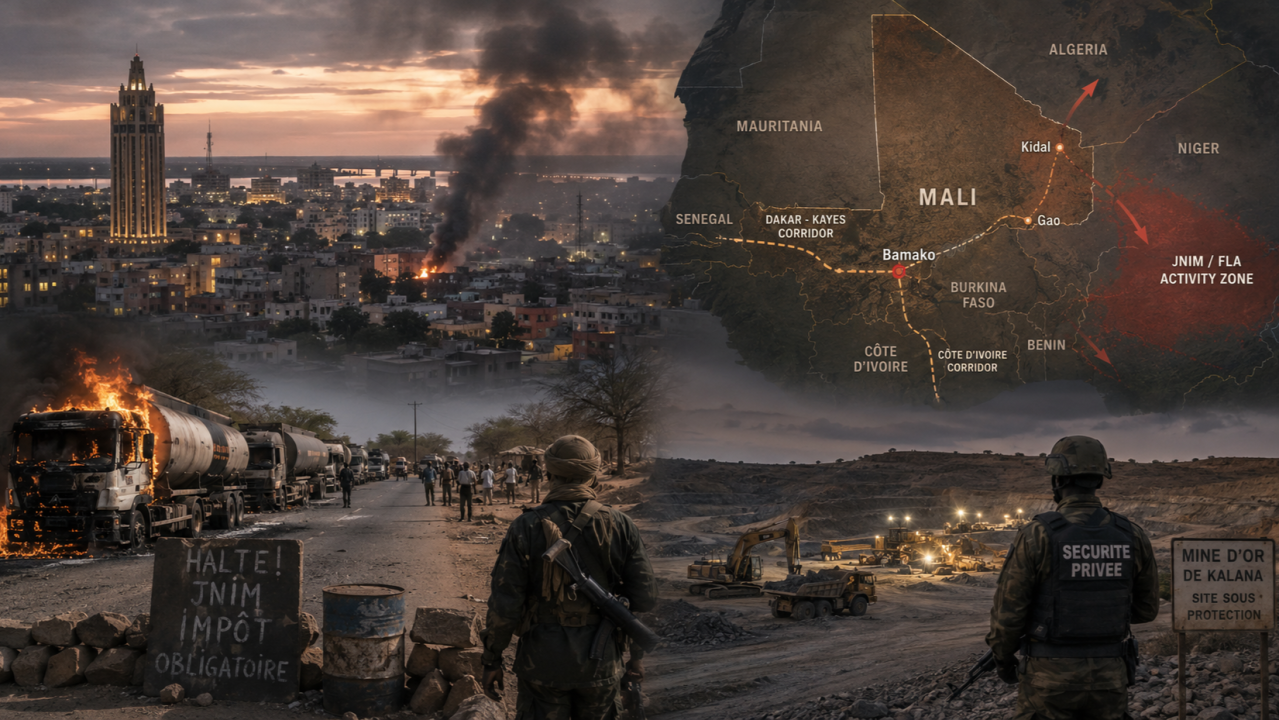
On April 25, 2026, Tuareg separatists allied with al-Qaeda-affiliated JNIM launched coordinated attacks across Mali including in Bamako itself — while Russia's Africa Corps negotiated its exit from Kidal rather than fighting.
When French troops left Mali in August 2022, they left behind a vacuum — and a narrative. The narrative, carefully constructed by Russian disinformation operations and eagerly amplified by Malian junta leaders, was simple and emotionally resonant: France was a colonial oppressor that had used the Sahel as its private security playground while doing nothing to stop the jihadist insurgencies tearing the region apart. Russia, by contrast, was an honest partner that asked for nothing but friendship and delivered real security in return.
Hundreds of thousands of Malians believed it. Crowds gathered in Bamako to wave Russian flags and burn French ones. Polls showed overwhelming public support for Russia’s Wagner Group in Mali. The junta — military rulers who had ousted an elected government in 2021 — presented Wagner’s arrival as liberation.
On April 25, 2026, the liberation narrative collapsed in real time.
Tuareg separatists of the Azawad Liberation Front (FLA), allied with the al-Qaeda-affiliated JNIM insurgency, launched coordinated attacks on military positions across Mali — including in Bamako itself, the capital. Columns of black smoke rose above the city’s Tower of Africa monument. Russian fighters from the Africa Corps — Wagner’s successor, now operating under direct Kremlin control — were seen driving out of the seized town of Kidal in trucks, reportedly after negotiating their own exit through Algerian mediation. Some Malian soldiers were disarmed and captured. The Russian forces departed without fighting.
The junta that chose Russian mercenaries over French troops and Western security frameworks watched its capital attacked while its Russian partners negotiated their personal exit. The security guarantee that cost Mali its Western relationships, its ECOWAS membership, and its international aid was not honored when it was needed most.
This is the story of Russia’s Africa Corps in 2026 — and it is a story of strategic overreach meeting operational failure.
How Russia Replaced France: The Disinformation Playbook
Understanding the April 2026 Bamako crisis requires understanding how Russia inserted itself into the Sahel in the first place.
The Sahel — the semi-arid belt stretching across Africa from Senegal in the west to Sudan in the east — has been Africa’s most intense conflict zone for over a decade. Jihadist insurgencies affiliated with al-Qaeda (JNIM) and the Islamic State (ISGS) have exploited weak governance, ethnic tensions, and rural economic marginalization to expand their territorial control across Burkina Faso, Mali, Niger, and into neighboring states. French Operation Barkhane — deploying up to 5,500 troops across the region — was the primary international security response for nearly a decade.
It struggled. The jihadist insurgencies were not defeated. Civilian casualties from counter-insurgency operations generated resentment. African governments grew frustrated with conditions attached to French security assistance — democratic governance requirements, accountability for human rights violations, restrictions on operational methods.
Russia identified this frustration precisely and exploited it systematically. Through a coordinated disinformation campaign across Facebook, Telegram, and local media — documented by the Stanford Internet Observatory, EU DisinfoLab, and the Africa Center for Strategic Studies — Russian-linked accounts amplified anti-French narratives, portrayed Macron as a neo-colonial aggressor, and presented Russia as the only power that respected African sovereignty. The campaign was extraordinarily effective.
Between 2020 and 2023, military coups toppled elected governments in Mali, Burkina Faso, Niger, Guinea, Sudan, Chad, and Gabon. In each case, Russian disinformation supported the coup plotters and undermined international efforts to restore civilian rule. In Mali, Burkina Faso, and Niger — which joined together in the Alliance of Sahel States (AES) in 2023, formally withdrawing from ECOWAS — the juntas expelled French troops and invited Wagner in their place.
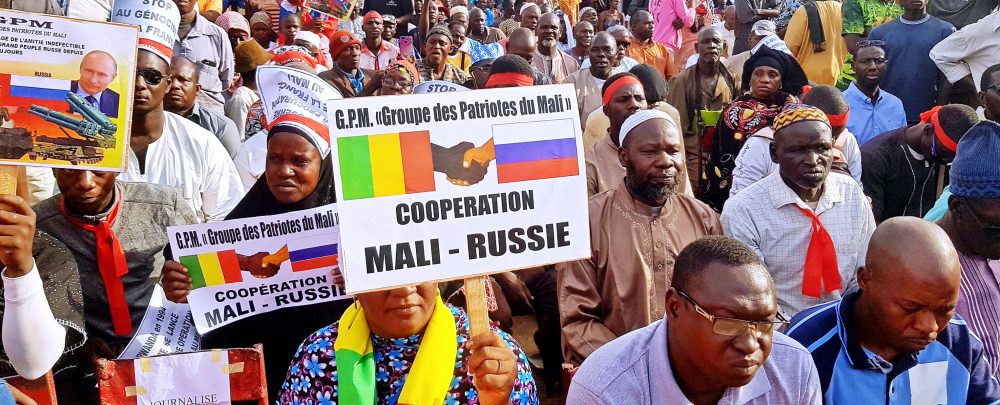
France withdrew from Mali in August 2022, Burkina Faso in February 2023, Niger in December 2023, Chad in January 2025, and the Ivory Coast in February 2025. By July 2025, when French forces left Senegal, France’s permanent military presence in West Africa — maintained since independence — had entirely ended. Russia’s Wagner Group, subsequently rebranded as the Africa Corps under direct Kremlin control, had moved into the breach across six countries.
The replacement was sold as liberation. The reality has been more complicated.
What Africa Corps Actually Does — and Doesn’t Do
The Africa Corps — unlike Wagner’s earlier operations in Syria and Libya — operates under the Russian Defense Ministry’s direct command structure. It consists of elite combat commanders from Russia’s regular army, with priority recruitment given to former Wagner fighters. It is not a mercenary force operating on its own profit motive; it is an arm of Russian state strategy.
That strategy, as the Carnegie Endowment’s March 2026 report makes clear, is primarily geopolitical rather than security-oriented. Russia’s goal in the Sahel is not to defeat jihadist insurgencies — it is to displace Western influence, create client relationships with African regimes, access mineral resources, and build an anti-Western geopolitical coalition. Security outcomes for African civilians are an incidental consideration, not the objective.
The operational consequences of this misalignment are visible and documented.
In Mali, Africa Corps forces have been repeatedly implicated in civilian massacres alongside Malian army units. A Tuareg convoy returning from a wedding was reportedly struck by joint Malian-Wagner forces, killing at least 20 civilians including children and elderly people. Human rights organizations have documented dozens of similar incidents. UN investigators have used the phrase “hallmarks of war crimes” in describing the conduct of Malian army and Russia-aligned forces in multiple districts.
Africa Corps has been more defensive than Wagner in its operational posture — less willing to take the battlefield risks that occasionally produced Wagner’s tactical successes. The jihadist insurgencies that Africa Corps was supposed to defeat have not been defeated. In Mali, JNIM and ISGS attacks have continued at high levels throughout the period of Russian presence. In Burkina Faso, the security situation has arguably deteriorated since Wagner/Africa Corps arrived. The Georgetown Journal of International Affairs concluded bluntly: “Wagner’s model promised unconditional security assistance… Far from mitigating violence, Wagner’s operations often intensified conflict dynamics.”
The April 25 Bamako Attack: A Breaking Point
The April 25–28, 2026 attack on Bamako was the most significant jihadist assault on a West African capital in the modern era — and the most damaging single event for Russia’s credibility in the Sahel.
The coordinated operation, conducted jointly by the Azawad Liberation Front and JNIM, targeted military positions across the country simultaneously. The attack on Bamako — the first direct assault on the Malian capital in the modern conflict period — demonstrated that three years of Russia’s security partnership had not created the protected environment it promised. The jihadists had grown more capable, not less.
The moment that will define Africa Corps’ legacy in Mali came when its fighters were filmed leaving the seized town of Kidal in trucks, having negotiated their withdrawal through Algerian mediation. Some Malian soldiers were disarmed by jihadist fighters and taken captive. Russia’s elite paramilitary force, positioned as Mali’s ultimate security guarantee, chose negotiated exit over combat when the chips were down.
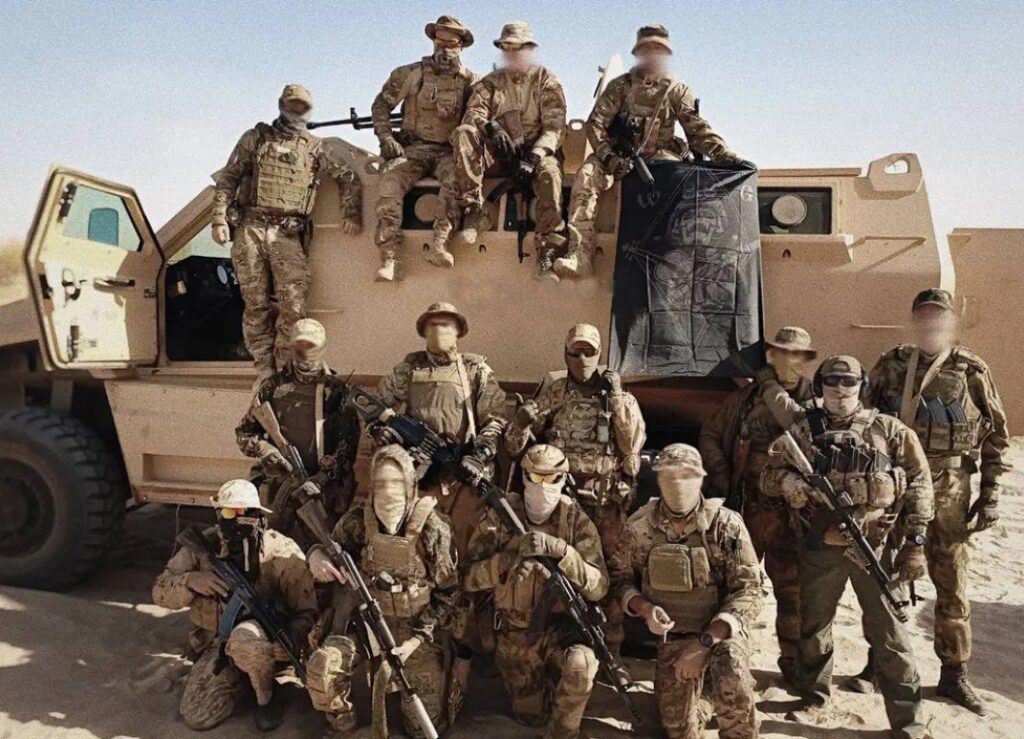
Military ruler Junta leader Assimi Goita visited wounded civilians and military personnel in Bamako in the aftermath. His government has not revealed how many troops are prisoners. Africa Corps issued a Telegram statement saying its decision to withdraw was “taken with Bamako” — language that obscures whether the Malian government was informed or presented with a fait accompli.
The Carnegie Endowment’s assessment — published before the April attack but prescient in its warnings — noted that “Russia may already have reached the high-water mark” in the Sahel, identifying political distrust, tensions over atrocities, and the limits of Russian operational capacity as the key warning signs. In Mali specifically, it noted that public sentiment, while still broadly favorable to Russia, could turn — as it did toward France — if security failures accumulated.
The April 25 attack is precisely the kind of accumulated failure the Carnegie report anticipated.
Russia’s Resource Extraction: What It’s Really About
The Africa Corps’ presence in the Sahel cannot be understood without understanding the economic architecture that underpins it.
In the Central African Republic — Russia’s longest-running and most deeply embedded African operation — Wagner/Africa Corps has extracted gold, diamonds, and timber under opaque concession arrangements that funnel resources to Russian-connected intermediaries while providing minimal benefit to CAR’s government or population. By 2019, more than a thousand Wagner mercenaries were operating in CAR, having infiltrated the political, economic, and social structures — securing control over both the state apparatus and natural resources simultaneously.
In Mali, gold mining operations by Wagner-connected entities — though less extensive than in CAR — have been documented by UN investigators. In Sudan, Wagner backed the RSF paramilitary force partly to access gold mines in Darfur, switching to the SAF only after the SAF offered a naval base on the Red Sea. In November 2025, the Kremlin suspended plans for that base due to Sudan’s instability — a sign that Russia’s commitments in Africa depend entirely on whether they continue to deliver material benefit to Moscow.
The resource extraction model is the structural core of Russia’s Africa strategy — security assistance and political support in exchange for mining concessions and resource access. It is not development. It is extraction with different branding.
The Alliance of Sahel States: A Confederation Built on Negative Identity
In 2023, Mali, Burkina Faso, and Niger formalized their solidarity in the Alliance of Sahel States (AES) — withdrawing from ECOWAS (the Economic Community of West African States) and establishing a separate confederation based on shared rejection of Western conditionality and shared embrace of Russian security partnership.
The AES has adopted a joint military force — still being built — and a common external communication strategy. What it lacks is a coherent positive vision for the region it represents. The AES was built on what it opposes (France, ECOWAS conditionality, Western democratic governance requirements) rather than what it offers. Its economic integration ambitions remain nascent. The security outcomes its member states promised have not materialized.
The AES’s landlocked geography — all three core members are among Africa’s least-developed and most geographically isolated countries — means the confederation cannot survive economically without external partnerships. Togo has expressed interest in joining, partly to give the AES sea access. ECOWAS has tasked Senegalese and Togolese presidents to negotiate with AES juntas to prevent permanent regional fragmentation.
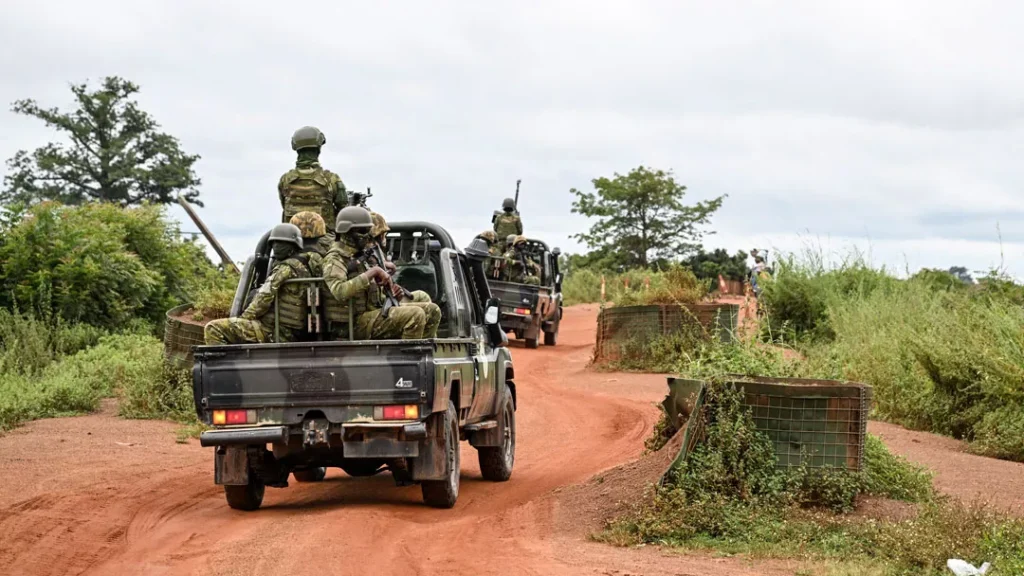
The Small Wars Journal’s January 2026 analysis identified what it called “warning signs of Russia’s coming failure in Africa” — pro-democracy protests in CAR against a third Touadera term backed by Wagner, pro-democracy demonstrations in Mali, and the growing pattern of Gen Z protests across the continent that have already toppled Russian-backed preferences in Senegal. The April 2026 Bamako attack has given those protests a concrete failure to point at: three years of Russian security partnership, and jihadists are attacking the capital.
What the West Is — and Isn’t — Doing
France’s departure from the Sahel has left a vacuum that neither the US nor the EU has adequately filled.
The United States has been episodically engaged — conducting special operations missions against senior ISGS commanders in several countries, providing humanitarian assistance, and maintaining intelligence relationships with governments that have not yet fully expelled American personnel. But Trump’s “America First” posture, combined with drastic cuts to USAID and State Department democracy funding, has reduced American engagement in Africa to a level that critics describe as functionally absent from the region’s most acute crises.
The EU has maintained some presence through training missions and development assistance, but the expulsion of EUCAP Sahel and EU training missions from Mali, Niger, and Burkina Faso has reduced European security engagement to peripheral countries. The EU’s €150 billion SAFE rearmament fund is focused entirely on European defense — not African stability.
The Critical Threats Project has noted that Russia is increasing Africa Corps deployments to the Sahel, “partially due to the failure of Russian forces to degrade the strengthening Salafi-jihadi insurgencies, which has left their partners increasingly vulnerable and in need of greater regime security.” More Africa Corps troops are being sent to compensate for failures — not to address the underlying causes of those failures.
The Carnegie Endowment’s conclusion is the right one: “The United States has a strategic opportunity to counter Russian influence by pairing immediate humanitarian assistance with long-term investments in social, economic, and political development.” That opportunity is real. The political will to seize it, in Washington’s current posture toward Africa, is not.
Key Facts: Africa Geopolitics — Russia in the Sahel, May 2026
| Countries with Africa Corps presence | Mali, Burkina Faso, Niger, CAR, Libya, Sudan (varying levels) |
| French military withdrawals | Mali (Aug 2022), Burkina Faso (Feb 2023), Niger (Dec 2023), Chad (Jan 2025), Ivory Coast (Feb 2025), Senegal (Jul 2025) |
| Alliance of Sahel States (AES) | Mali, Burkina Faso, Niger — withdrew from ECOWAS 2023 |
| April 25 2026 Bamako attack | Joint FLA-JNIM assault; Africa Corps negotiated exit from Kidal |
| CAR resource extraction | Gold, diamonds, timber under Wagner/Africa Corps concessions since 2018 |
| Russian-backed coups (2020–2023) | Mali (x2), Burkina Faso (x2), Niger, Guinea, Sudan, Chad, Gabon |
| Africa Corps troop increase (Feb 2026) | Deployments increased due to failure to degrade jihadist insurgencies |
| Pro-democracy protests | CAR (against Touadera 3rd term), Mali (against junta), spreading |
| Russia Kremlin naval base (Sudan) | Suspended November 2025 due to Sudan instability |
| EU/US engagement level | Significantly reduced — training missions expelled, USAID cuts |
What Comes Next
The April 25 Bamako attack is not the end of Russia’s Sahel strategy. It is a severe setback — one that may mark the beginning of the end of the narrative that brought Africa Corps to the region in the first place.
Russia’s Africa Corps will remain in Mali. The junta has no alternative security partner it can credibly turn to in the short term. France is not coming back. ECOWAS peacekeeping capacity is limited. The US is not engaged. Africa Corps’ continued presence will be presented by the Malian junta as an ongoing security partnership — whatever the reality on the ground.
But the Carnegie Endowment’s warning is now validated by events: “Public sentiment is another variable to watch. Russia enjoys strong support inside Mali according to polls, but France benefited from a similar dynamic before its failures triggered a backlash.” France was expelled after years of security failure. The same trajectory is now clearly visible for Russia.
The question for the Sahel — and for Africa more broadly — is not whether Russia’s influence will eventually decline. It is what fills the space when it does. If the West does not develop a coherent, adequately resourced alternative to Russian security engagement — one that respects African sovereignty while actually delivering improved security — the vacuum will be filled by other actors: China, Turkey, Gulf states, or simply more jihadist expansion.
The Sahel’s crisis is not Russia’s creation. It predates Russia’s arrival. What Russia’s Africa Corps has done is delay the genuine political and security solutions the region requires, while extracting resources, enabling atrocities, and blocking accountability for them. The April 25 attack on Bamako is the latest evidence that the delay is not working — and that the region is paying a catastrophic price for it.
Sources: Carnegie Endowment for International Peace (Russia in Africa, March 2026), Al Jazeera (Mali, April 2026), Critical Threats Project (Africa File, February 2026), Small Wars Journal (Russia’s Coming Failure in Africa, January 2026), Georgetown Journal of International Affairs, CNN (Africa Corps, August 2025), GIGA Hamburg (Ten Things Latin America 2026)
About the Author