On April 13, 2026, Ukrainian forces captured a Russian position using only ground robots and UAVs — no Ukrainian soldiers present, no Ukrainian casualties. It is the clearest marker yet that land warfare has entered a new era.
For most of recorded history, land warfare has been fundamentally human. Armies moved on foot, on horseback, then on tracks and wheels. The tank changed the pace. The helicopter changed the depth. Precision artillery changed the range. But the soldier — the person physically present on the ground — remained the irreducible unit of land combat.
That assumption is being dismantled in real time, in the mud and rubble of eastern Ukraine.
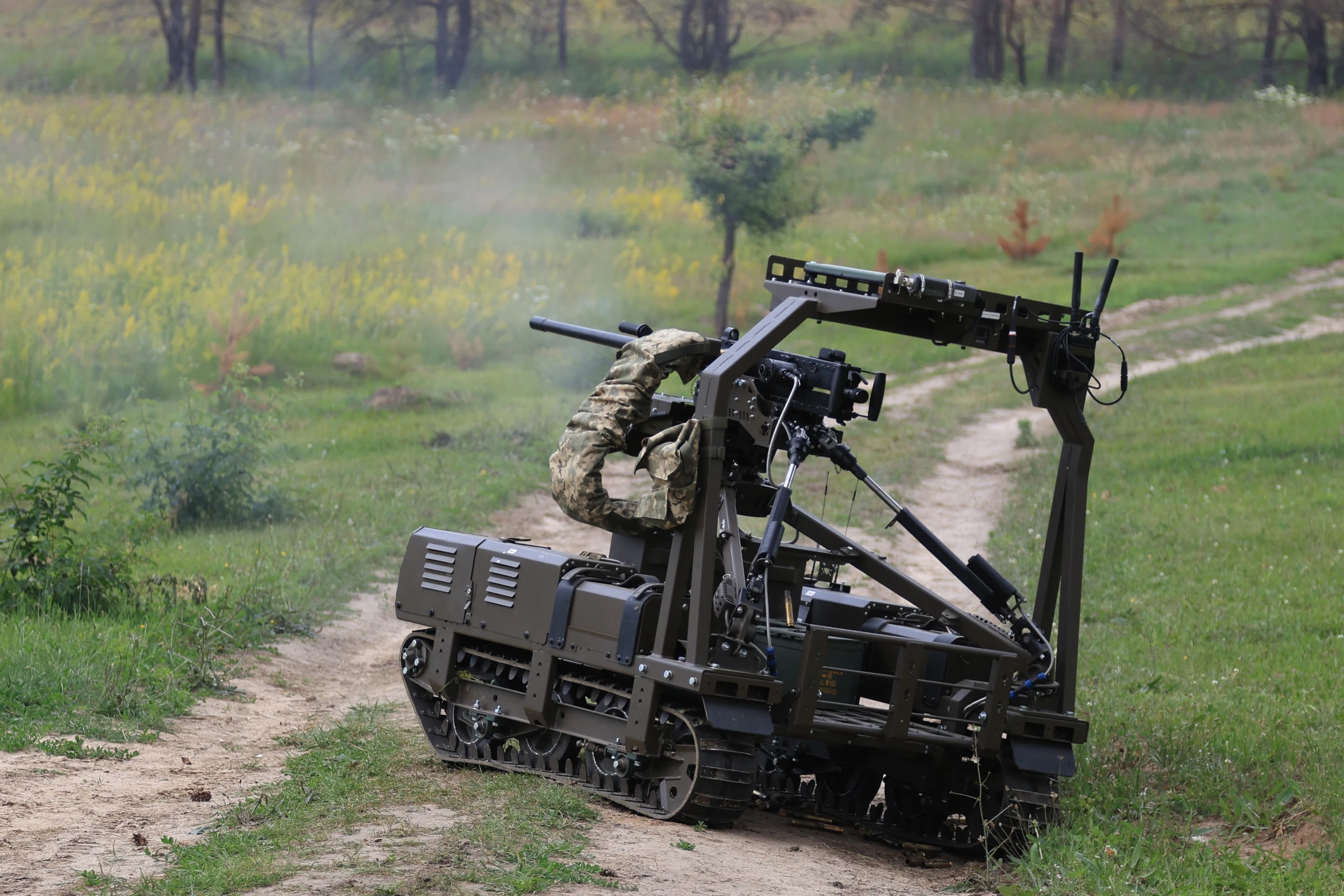
On April 13, 2026, Ukrainian President Zelenskyy announced that Ukrainian forces had captured a Russian position using only ground robots and UAVs — no Ukrainian soldiers present, no Ukrainian casualties. “Lives were saved more than 22,000 times when a robot went into the most dangerous areas instead of a warrior,” he said in a speech marking the achievement. Commander Mykola Zinkevych, whose unit operates ground-based robotic strike systems, told CNN: “The position was taken without a single shot being fired.”
Two Russian soldiers surrendering to machines controlled by a pilot miles away. It is the clearest possible statement that land warfare has entered a new era.
What Ukraine Has Proved — And What It Hasn’t
The conflict in Ukraine is the most consequential real-world laboratory for military technology since World War II. Every NATO army, every Chinese defense ministry, every think tank with a defense brief is studying its lessons with doctoral intensity.
The central lesson about land warfare is this: the battlefield has become transparent. Drones operating overhead — cheap commercial quadcopters, military FPV systems, fixed-wing surveillance platforms — mean any significant formation of soldiers or vehicles moving in the open is seen almost immediately. Being seen means being targeted. In an environment saturated with loitering munitions and precision artillery, being targeted means being killed.
The consequence is stark. The traditional massed infantry assault — the tactic that has won and lost wars for centuries — is now suicidally expensive in human terms when conducted against a peer adversary with drone coverage. Ukrainian robotic platforms completed more than 22,000 frontline missions in three months alone, with systems including the Ratel H, TERMIT, Droid TW 12.7, KRAMPUS, Ardal, Rys, Zmiy, Protector and Volia handling logistics, reconnaissance, fire support, and assault roles. According to the Ukrainian General Staff, robotic platforms have reduced personnel casualties by up to 30 percent — a figure that, if sustained, represents one of the most significant force protection advances in modern military history.
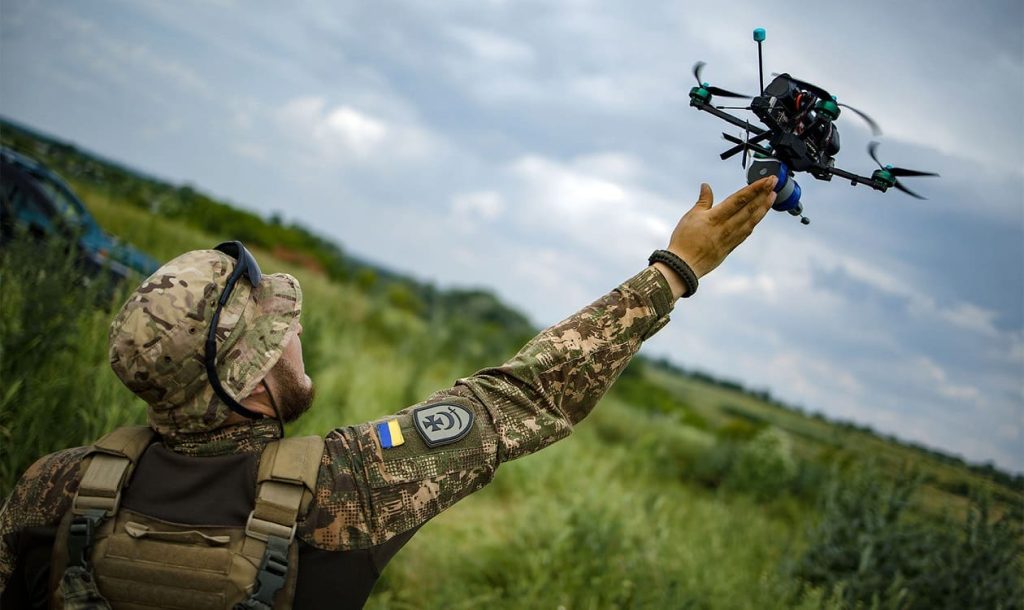
According to CSIS, Ukrainian drones have been responsible for more than 65 percent of destroyed Russian tanks — a figure that fundamentally disrupts the economics of armored warfare. A $500 FPV kamikaze drone destroying a $3–5 million main battle tank is an exchange ratio no defense budget can sustain indefinitely.
But the Atlantic Council’s assessment is an important corrective: Ukraine’s robot army, for all its advances, cannot replace infantry. When small groups of Russian troops infiltrate Ukrainian positions and push into urban terrain, soldiers are still needed to clear and hold ground. Ground robots struggle with complex environments, unpredictable obstacles, and the fluid ambiguity of close-quarters combat. The lesson from Ukraine is not “robots replace soldiers.” It is “robots keep soldiers out of kill zones whenever possible.” The distinction matters enormously for how armies are redesigned.
The Ground Drone Ecosystem: From $26,000 Mini-Tanks to Robot Mules
Ukraine’s battlefield has produced an ecosystem of unmanned ground vehicles spanning an enormous range of capability and cost.
DevDroid’s TW 12.7 — a small tracked mini-tank armed with a NATO-standard 12.7mm heavy machine gun — costs approximately $26,000 to produce and can be delivered in under two months. It represents the low end of what is now operationally viable: cheap, disposable, and sufficiently lethal to change tactical outcomes. Ukraine has deployed more than 15,000 unmanned ground vehicles since 2025.
At the other end of the spectrum, the US Army’s Small Multi-Purpose Equipment Transport (S-MET) — sometimes called the “robot mule” — carries 1,000 pounds of equipment, follows infantry troops over 60 miles in 72 hours, recharges batteries, relays communications, and can evacuate wounded soldiers from the gray zone under fire. More than 500 S-MET units have been delivered to Army units.
The West Point Modern War Institute’s April 2026 analysis of Ukraine’s ground robot lessons is clear about what makes systems actually work on the battlefield: they must be expendable in extremis, simple enough for exhausted soldiers to operate, and tightly networked with existing drone, electronic warfare, and fire support systems. Software costs — not hardware — killed the Army’s Robotic Combat Vehicle program. Cheap platforms mean nothing without fielded, reliable autonomy.
The Tank Is Not Dead — But It Is Being Redesigned
Every decade or so, a military theorist declares the main battle tank obsolete. Every decade or so, they are proved wrong. No other platform combines protected firepower with terrain-crossing capability in the same package.
But the drone age is forcing a redesign of how tanks operate — not what they are.
The British Army’s Challenger 3 — 148 units planned under the Rheinmetall BAE Systems Land programme — is the clearest Western example. A smoothbore gun replaces the rifled barrel, dramatically improving ammunition interoperability with NATO allies. Improved thermal sights with automatic target detection, digital fire control, and upgraded turret protection give it a genuine first-look-first-kill capability against peer adversaries. Most significantly, it is designed to operate as part of an integrated system: Ajax reconnaissance vehicles find and classify targets, Challenger 3 destroys them, Boxer Mechanised Infantry Vehicles move troops, and autonomous ground vehicles reduce human exposure at the most dangerous contact points.
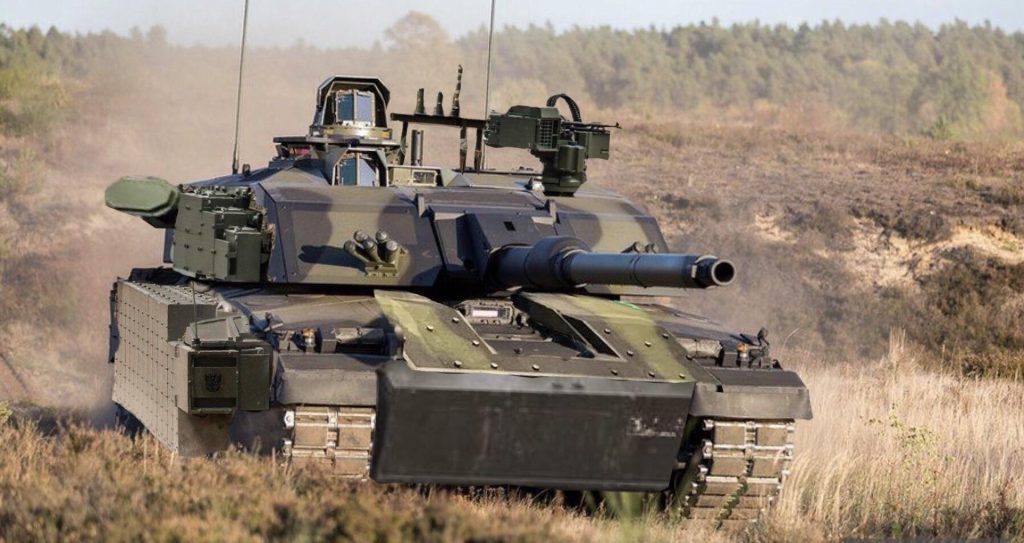
The British Army’s Armoured Exposition 2026 at Salisbury Plain in late April demonstrated this integrated concept publicly — autonomous armored ground vehicles, drones, and soldiers working together. A drone resupply scenario was conducted under Challenger 2 cover. Unmanned vehicles moved ahead of infantry to support breach operations. This is not a demonstration for public relations. It is the emerging template for how NATO intends to fight.
Russia has drawn the same lesson from Ukraine, deploying its own unmanned ground vehicles on the front lines. In March 2024, a platoon of Russian UGVs equipped with AGS-17 automatic grenade launchers conducted the world’s first frontline assault by unmanned ground vehicles near Berdychi. The systems were crude. The concept was validated. Every major military is now in an arms race to make it work better, faster, and at greater scale.
Loitering Munitions: The Weapon That Rewrote the Economics of Land Combat
No development in land warfare has been more consequential than the proliferation of cheap loitering munitions.
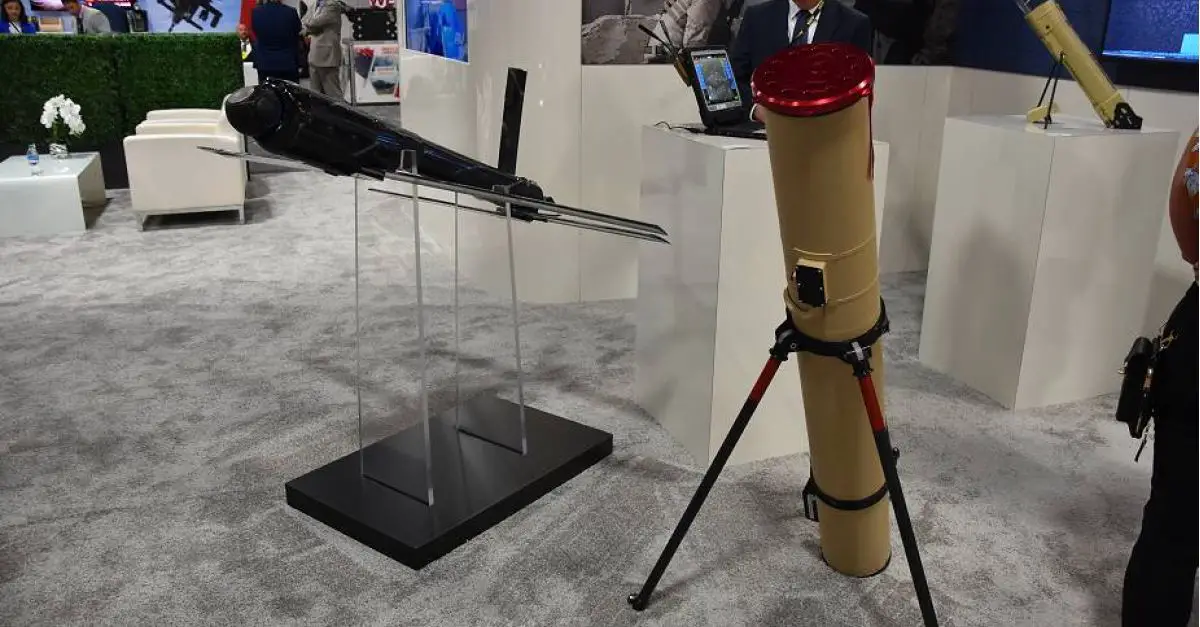
A loitering munition is launched like a missile but behaves like a drone — circling the battlefield for minutes or hours, identifying its target with onboard sensors, then diving into it. The operator has time to assess. The munition has patience. The target rarely has warning.
In Ukraine, loitering munitions costing a few hundred dollars have destroyed main battle tanks worth millions. In Sudan, both the SAF and RSF are using commercial drones to strike markets, power stations, and military convoys with similar logic. In the May 2025 India-Pakistan confrontation, Pakistan launched drone strikes against 15 Indian military installations in a single night — the first drone battle between two nuclear-armed states — demonstrating that loitering munition capability is no longer the exclusive domain of tier-one militaries.
The US Army’s Launched Effects program fields AeroVironment’s Switchblade 600 loitering munition — at approximately $170,000 per unit — equipping infantry brigades with long-range anti-armor capability without physically exposing the soldier. In 2025, a Switchblade 600 was successfully air-launched from an MQ-9 Reaper, extending its effective strike range dramatically.
The countermeasure war — electronic jamming, kinetic interceptors, laser systems, AI-powered detection radar — is the fastest-growing segment of defense electronics in 2026. No solution works reliably against all drone types in all conditions. The attack side remains decisively ahead of the defense.
The Human-Machine Integration Problem
The most important unresolved challenge in land autonomy is not the hardware. It is the network — and the question of when autonomous systems can be trusted to make lethal decisions without a human in the loop.
The US Army has stated an ambition of fielding “a million air drones” integrated with ground forces. Senior Army leadership is explicit: the network — the communications infrastructure that allows autonomous systems to share information and coordinate — is where the largest share of current R&D funding is going. “If you do not get the network right, the autonomous ground fleet will never work,” one senior official told National Defense Magazine.
Ukraine’s front-line commanders reflect the caution that real combat produces. Zinkevych: “The final decision must always be made by a human. Would you entrust weapons to artificial intelligence? How can we be sure it will be able to distinguish a friend from a foe?” Ukraine has partially implemented autonomous targeting in some systems — but the final engagement decision still requires a human operator.
That position may not be sustainable indefinitely. As drone swarms scale from dozens to hundreds to thousands of simultaneous agents, the compression of engagement timelines makes human approval a bottleneck. A swarm of 96 drones attacking 96 targets in under two minutes cannot realistically have a human approving each kill. The military and ethical implications of removing that approval loop are profound — and largely unresolved, both doctrinally and legally.
China’s Approach: Scale as Strategy
China is pursuing the same trajectory as the West — but at a characteristically larger scale and with a different strategic purpose.
In March 2026, Chinese state media presented the ATLAS drone swarm system: a single Swarm-2 ground combat vehicle capable of launching 48 fixed-wing drones, with one command vehicle controlling up to 96 drones simultaneously in a coordinated strike chain — from target identification through launcher activation, drone deployment, in-flight target lock, and precision strike.
Reuters reported in March 2026, citing the Mitchell Institute for Aerospace Studies, that China had positioned more than 200 obsolete J-6 fighters converted into attack drones at six air bases near the Taiwan Strait. These are not comparable to Ukraine’s ground robots — they are aircraft-scale expendable systems — but they reflect identical planning logic: low-cost or depreciated unmanned assets that absorb enemy missiles, expose air defense networks, and create pressure in the opening phase of a conflict at exchange ratios that favor the attacker.
For NATO armies drawing lessons from Ukraine, the correct conclusion is therefore not simply to buy more robots. It is — as the West Point MWI analysis puts it — to redesign units, communications, logistics, counter-drone defenses, and procurement rules around machines that may be lost quickly but can preserve trained personnel and impose costs on the enemy. That is a doctrinal revolution, not just a procurement one.
Key Facts: Land Warfare Technology, May 2026
| Ukraine UGVs deployed (2025) | 15,000+ |
| Frontline robot missions (3 months) | 22,000+ |
| World’s first all-robot assault | April 13, 2026 — no Ukrainian casualties |
| World’s first UGV frontline assault | March 2024, Berdychi (Russian forces) |
| Personnel casualties reduced (Ukraine) | Up to 30% via robotic platforms |
| Russian tanks destroyed by drones (Ukraine) | 65%+ (CSIS) |
| DevDroid TW 12.7 cost | ~$26,000 |
| US S-MET robot mule payload | 1,000 lbs / 60 miles / 72 hours |
| Switchblade 600 cost | ~$170,000 per unit |
| China ATLAS Swarm-2 | 48 drones per vehicle; 96 per command node |
| Challenger 3 planned units | 148 |
What the Next Decade Looks Like
The US Army’s own timeline is clear-eyed: large-scale autonomous ground operations are still years away. Ground autonomy remains the least mature of the three main robotic domains — air, sea, and ground. The network infrastructure needed to make autonomous ground swarms reliably functional in complex terrain does not yet exist at operational scale.
But the direction is irreversible. Ukraine has proved the concept at 15,000 UGVs and counting. China is demonstrating operational swarm systems. NATO is redesigning armored formations around integrated autonomous nodes. The Army’s African Lion 26 exercise in Morocco in May 2026 — the first time US airborne troops conducted robotic warfare and counterattack operations using autonomous ground vehicles alongside conventional forces in a live exercise — marks a specific doctrinal milestone in that journey.
The soldier of 2036 may look less like an infantryman storming a position and more like an operator managing a network of machines that do the storming on their behalf. Whether that soldier still gets killed at the same rate as today’s — or whether autonomous systems absorb enough of the lethality to genuinely protect human life at scale — is the question that will define land warfare for the next generation.
Sources: CNN (April 2026), CSIS, West Point Modern War Institute, Army Recognition Group, National Defense Magazine, Atlantic Council, IFRI, Inside Unmanned Systems, UK Ministry of Defence
About the Author