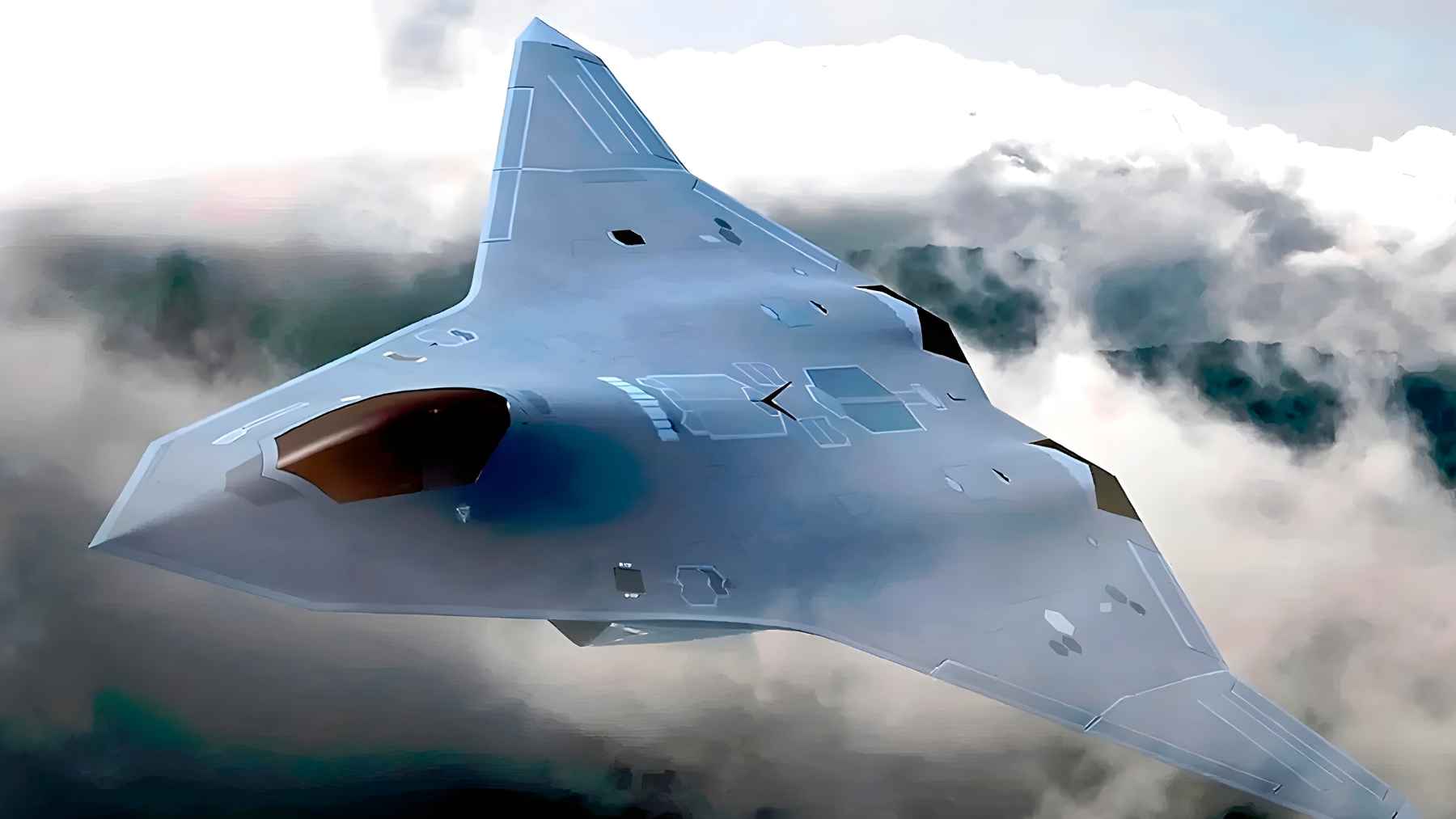
The F-47 NGAD will not fight alone — it will command formations of AI-controlled Collaborative Combat Aircraft into contested airspace. It represents the biggest shift in US air combat doctrine since stealth in the 1980s.
The last time military aviation underwent a truly generational shift was the introduction of stealth in the 1980s. The F-117 Nighthawk, then the B-2 Spirit, then the F-22 and F-35 redefined what air power meant — invisible aircraft that could enter defended airspace, strike, and depart before an adversary’s radar understood what had happened.
That era is now closing. What is replacing it is simultaneously more ambitious and more disorienting: sixth-generation crewed fighters commanding swarms of autonomous AI wingmen, hypersonic missiles that outrun every existing defense system, directed energy weapons that fire at the speed of light for pennies per shot, and satellite-linked battle networks that give a single pilot a god’s-eye view of an entire theater of war.
The weapons entering service between now and 2030 represent the biggest generational shift in military aviation since stealth debuted. And several of them are already flying.
The F-47 and the Sixth-Generation Race
The centerpiece of the United States’ next-generation air strategy is the F-47 NGAD — Next Generation Air Dominance. Details remain classified, but what is publicly known reflects a dramatic departure from the F-22 and F-35 philosophy.
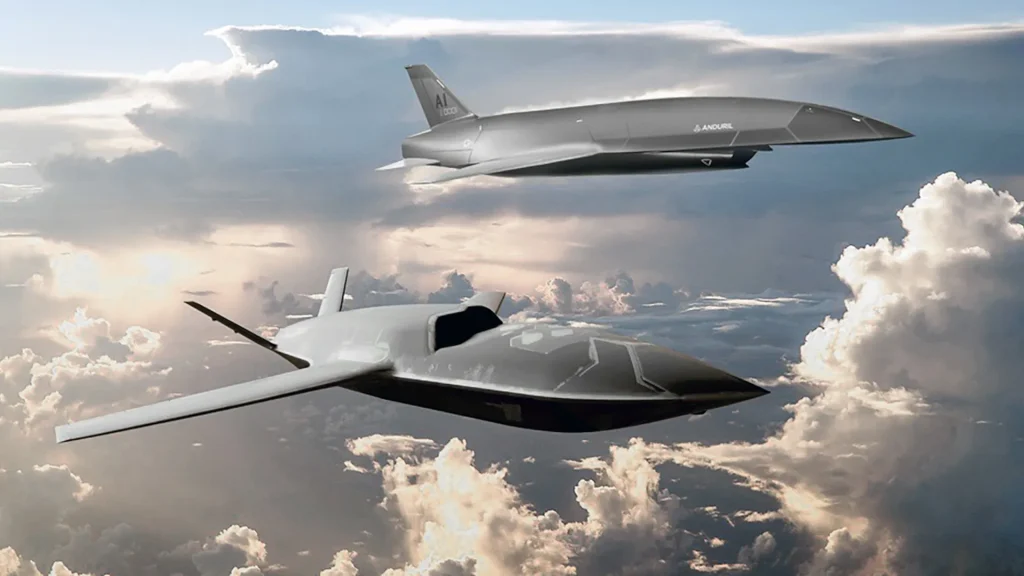
Where the F-35 was built around sensor fusion and network connectivity, the F-47 is built around a fundamentally different operational concept: it will not fight alone. It will command formations of AI-controlled unmanned aircraft — called Collaborative Combat Aircraft (CCAs) — that fly ahead of it into contested airspace, absorbing enemy fire, jamming enemy radar, carrying additional weapons loads, and executing strike missions the human pilot assigns from a safer position.
The Air Force has selected Anduril Industries and General Atomics Aeronautical Systems to build the first CCAs — stealthy, jet-powered unmanned aircraft in the $3–10 million range. The Pentagon uses the term “attritable” — cheap enough that commanders can accept losing them in combat without it being strategically significant. The concept is sometimes called “loyal wingman.” It represents the most significant shift in American air combat doctrine since stealth.
China is pursuing the same concept in parallel. The J-20S — a twin-seat variant of China’s J-20 Mighty Dragon — is specifically designed to command drone swarms in combat. Its second seat hosts a dedicated systems operator managing the AI wingman formation. The new J-20A variant, powered by the WS-15 engine, now gives the aircraft supercruise capability, closing one of its remaining performance gaps with the F-22.
South Korea’s KF-21 Boramae entered mass production in 2025 and is drawing attention as a near-stealth 4.5-generation platform that multiple countries are planning to buy — offering F-35-adjacent performance at substantially lower cost. Europe’s GCAP (UK, Japan, Italy) and FCAS (France, Germany) are targeting service entry around 2035. Neither is flying yet.
The F-35: Still the World’s Most Capable Multirole Fighter — For Now
Despite all the sixth-generation noise, the F-35 Lightning II remains the world’s dominant combat aircraft in 2026. Over 1,300 F-35s serve in more than 15 countries. No other fifth-generation aircraft has been deployed at this scale.
What makes the F-35 decisive is not raw performance — it is the aircraft’s ability to fuse data from its own sensors with information from allied aircraft, ships, ground stations, and satellites into a single coherent picture shared across the entire network. In US military doctrine, the F-35 is not just a fighter. It is an airborne sensor node that shapes how every other asset in the battlespace operates.
The F-22 Raptor, no longer in production, retains the benchmark for pure air-to-air dominance — supercruise, stealth shaping, and thrust-vectoring agility that no other fighter fully replicates. Fewer than 190 operational aircraft exist. Upgrades — improved sensors, conformal fuel tanks — are keeping it relevant until the F-47 arrives.
Pakistan’s combat employment of the JF-17 Thunder armed with Chinese PL-15 air-to-air missiles during the May 2025 India-Pakistan conflict demonstrated that 4.5-generation platforms with advanced missiles can down Western aircraft including the Rafale. The episode drew intense analysis from NATO militaries worldwide and accelerated discussions about beyond-visual-range missile superiority as the decisive air combat variable.
The Hypersonic Revolution: Missiles That Outrun Everything
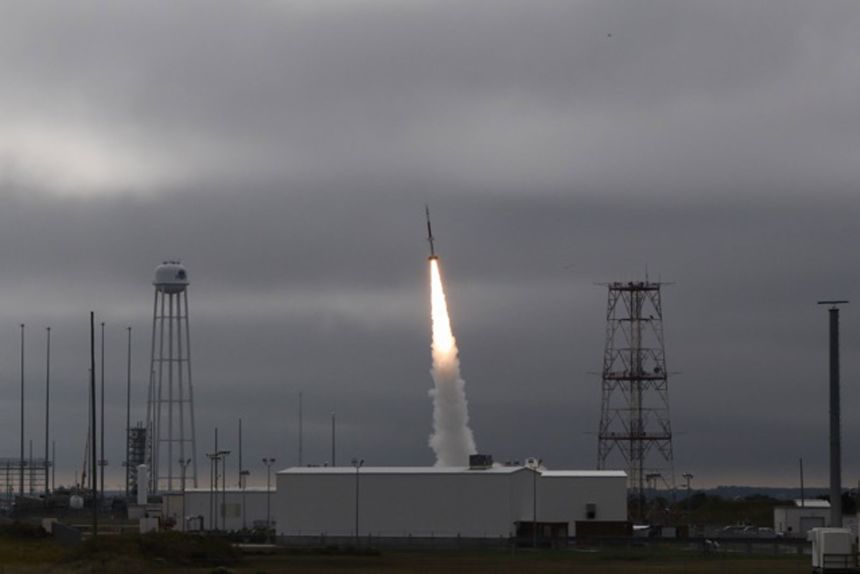
No capability has attracted more spending — or generated more strategic concern — than hypersonic weapons. Missiles traveling at Mach 5 and above, maneuvering unpredictably, flying trajectories that existing radar systems were not designed to track.
Russia was first to field operational hypersonic weapons — the Kinzhal air-launched missile and the Avangard hypersonic glide vehicle, claimed capable of Mach 20 and already deployed on operational ICBMs. China’s DF-27 — capable of striking maritime targets up to 8,000 kilometers away — is specifically designed to threaten US carrier strike groups in the Pacific.
The United States is closing the gap. The Army’s Long Range Hypersonic Weapon (LRHW) is progressing toward limited operational capability. The FY2026 National Defense Authorization Act grants multiyear procurement authority for low-cost hypersonic strike systems. The Navy is repositioning Zumwalt-class destroyers as the primary delivery platform for shipborne hypersonic strikes.
The defensive problem remains largely unsolved. Only Russia’s S-500 Prometheus is specifically designed for hypersonic interception — engaging targets at up to 600 kilometers and altitudes approaching space. Israel’s Iron Beam directed energy weapon reached operational status in early 2026 at 100kW, engaging slower threats at the speed of light for approximately $3.50 per shot. The Golden Dome initiative targets 300kW-class laser systems capable of intercepting fast-moving cruise missiles.
The Drone War: Cheap, Attritable, and Reshaping Everything
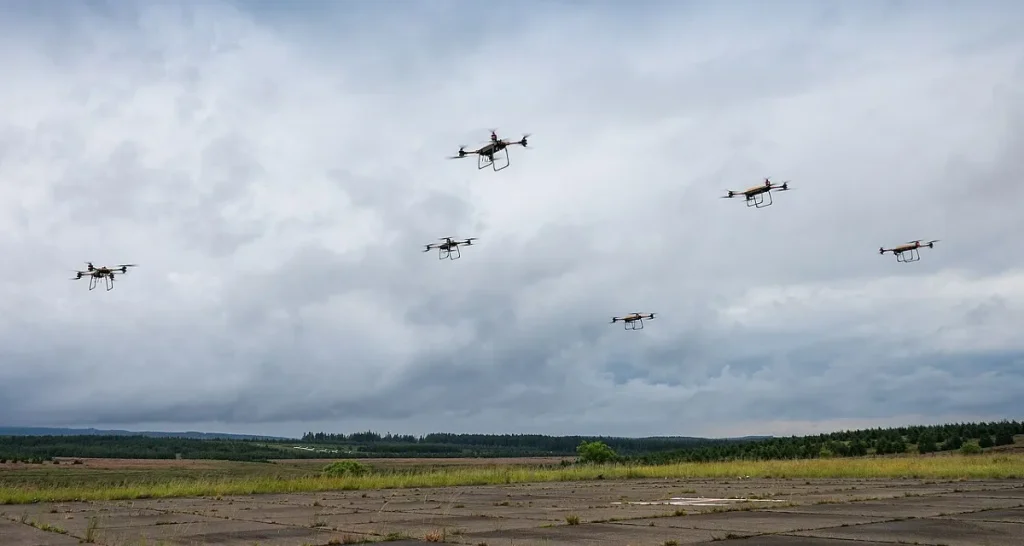
Ukraine produces roughly 1.7 million drones per year. A $500 FPV kamikaze drone achieves comparable tactical effect to a $78,000 Javelin anti-tank missile. The Pentagon’s Drone Dominance Program targets 200,000 drones by 2027, with Anduril’s Arsenal-1 factory as the industrial centerpiece.
DARPA’s April 2026 research program envisions autonomous drone constellations launched from containerized nodes dispersed across contested theaters — self-sustaining swarm infrastructure that can be hidden, replenished, and regenerated without exposing human logistics to enemy fire. China demonstrated its ATLAS drone swarm system in March 2026: a single Swarm-2 vehicle carrying 48 fixed-wing drones, one command vehicle controlling 96 simultaneously in a coordinated strike package.
This is not the drone warfare of the 2000s. This is algorithmic warfare — swarms of cheap, networked, partially autonomous platforms executing coordinated missions faster than human decision cycles can process.
What the Iran War Proved About AI-Assisted Targeting
The 2026 US-Iran conflict provided the first large-scale real-world test of an AI-integrated military targeting system in a near-peer environment.
More than 13,000 targets were struck under Operation Epic Fury, with 1,000 hit on the opening day alone, per US Central Command. Behind that volume lies a system that compressed targeting decisions from days to seconds — using AI to process surveillance feeds, identify targets, assign weapons, and generate strike packages at a speed no human planning staff could match.
US Space Force and cyber forces were described by Pentagon leaders as the “first movers” in the February 2026 Iran strikes — creating electromagnetic corridors for the joint force before a single conventional weapon was released. The B-2 Spirit bombers that struck Iran’s nuclear facilities in June 2025 flew 18 hours non-stop, with AI-assisted navigation and electronic warfare support managing the complexity of the strike package into heavily defended airspace.
Key Facts: Air Defense Technology, 2026
| US 6th-gen program | F-47 NGAD + CCAs (Anduril & General Atomics) |
| China’s 6th-gen move | J-20S (drone swarm command); J-20A with WS-15 engine |
| F-35 fleet | 1,300+ in 15+ countries |
| Fastest missile in service | Avangard HGV (Russia, claimed Mach 20) |
| China carrier-killer | DF-27 (8,000 km range) |
| Iron Beam milestone | 100kW operational (Israel, early 2026) |
| Ukraine drone production | ~1.7 million/year |
| AI targeting test (Iran op) | 1,000+ targets struck day one |
| Global air defense market | $46B (2024) → $82B projected (2035) |
| PL-15 combat record | Downed Indian Rafale in May 2025 — analysed by every NATO air force |
What Comes Next
The F-47 will enter limited service before 2030. China’s J-36 sixth-generation candidate is reportedly in flight testing. GCAP and FCAS are racing to close the gap before the lead becomes permanent.
But the more fundamental shift may not be in crewed aircraft at all. As CCAs become operational, as autonomous wingmen prove themselves in exercises and eventually in combat, the ratio between crewed and uncrewed platforms will shift — and the question of what human pilots are actually for in a future air battle will need a new answer.
The air war of 2026 is still fought primarily by humans. The air war of 2036 may not be.
Sources: Military Machine (March 2026), IDGA Defense Technology Priorities 2026, Simple Flying, Pediastan, Aviation A2Z, 24/7 Wall St., The Defense Watch, Inside Unmanned Systems, CSIS
About the Author