Europe is rearming at a pace not seen since the Cold War, with combined NATO member spending reaching $559 billion in 2025.
For thirty years after the Cold War, Europe treated defense as an afterthought. Armies shrank. Budgets were cut. The assumption embedded in every NATO defense ministry from Berlin to Brussels was that the United States would always be there — that the alliance’s Article 5 guarantee was effectively unconditional, and that European countries could therefore spend their money on other things.
That assumption is now in ruins.
Russia’s full-scale invasion of Ukraine in February 2022 cracked the foundation. The return of Donald Trump to the White House in January 2025 — and his explicit statements questioning America’s commitment to defend allies who fail to pay their share — finished the job. In 2026, Europe is rearming at a pace not seen since the Cold War’s peak. Budgets are surging. Conscription is returning. New weapons systems are being ordered in quantities that would have seemed fantastical five years ago. And a continent that once defined itself partly by its rejection of military power is now in the midst of a defense transformation that will reshape its politics, its economies, and its strategic weight for a generation.
The Numbers: Historic at Every Scale
Start with the money, because the money tells the story most clearly.
In 2025, the 29 European NATO members spent a combined $559 billion on defense — a figure that, adjusted for inflation, has not been seen since the Cold War era. According to SIPRI’s April 2026 assessment, 22 of those 29 members had military spending of at least 2.0% of GDP, a threshold that just a decade ago fewer than half met.
Global military spending reached $2.89 trillion in 2025 — the highest level ever recorded, driven substantially by Europe’s rearmament surge.
Germany alone accounts for a stunning share of this shift. Europe’s largest economy spent $114 billion on defense in 2025 — a 24% year-on-year increase, the largest single-year jump in modern German history. Its 2026 defense budget is projected at €108.2 billion, including a regular Bundeswehr allocation of €82.69 billion. The medium-term financial plan projects German defense spending rising to €151.7 billion by 2029 and €167.8 billion by 2030 — equivalent to roughly 3.5% of GDP, a target Germany has not approached since reunification.
Poland, meanwhile, is spending nearly $55 billion on defense in 2026 — its largest-ever allocation — representing roughly 4.5% of GDP, the highest proportion of any NATO member. Poland is now NATO’s third-largest army by personnel and is expanding. It has just signed the first loan agreement under the EU’s new SAFE (Security Action for Europe) rearmament fund, receiving an advance of €6.5 billion from a total allocation of €43.7 billion — nearly a third of the entire €150 billion fund.
France has pledged to double its defense budget by 2027 compared to 2017 levels, committing €64 billion for the year. The Baltic states — Estonia, Latvia, Lithuania — are spending at rates that, as a proportion of their economies, exceed Germany and France by significant margins. Estonia plans to spend more than €10 billion on defense between 2026 and 2029. Lithuania has launched year-round conscription beginning in 2026, calling up approximately 5,000 young people annually for mandatory service.
These are not incremental adjustments. These are structural transformations.
Germany’s Zeitenwende: From Pacifism to Power
No country’s transformation is more historically significant than Germany’s.
For most of the post-WWII era, Germany’s foreign policy was defined by strategic restraint — a deliberate choice rooted in the catastrophic legacy of two world wars, enshrined in its constitution, and reinforced by decades of pacifist public opinion. Defense spending was kept below NATO targets. Military exports were tightly restricted. The German word Zeitenwende — meaning “turning point” or “turning of the times” — was coined by Chancellor Olaf Scholz just days after Russia’s 2022 invasion. It described the moment Germany accepted that its post-war foreign policy assumptions had collapsed.
Under Chancellor Friedrich Merz, who took office in early 2025, Zeitenwende has moved from slogan to structural reality.

Merz secured a constitutional amendment exempting defense spending from Germany’s strict debt brake fiscal rule — a political achievement that would have seemed impossible just three years ago. The result was a wave of procurement orders of historic scale: 20 Eurofighter jets, up to 3,000 Boxer armored vehicles, approximately 3,500 Patria infantry fighting vehicles, and — as of May 2026 — revived discussions around acquiring US-made Tomahawk cruise missiles for long-range strike capability.
Germany’s explicit ambition, stated publicly by its government, is to build the strongest conventional army in Europe. By 2029, its defense spending in absolute terms will be approximately twice that of France — a reversal of a relationship that defined European security for decades. For Washington, which spent years pressuring Berlin to spend more, the development should be welcome. In practice, a heavily armed, strategically autonomous Germany pursuing its own interests may prove more complicated for US-German relations than the compliant, under-armed partner of previous decades.
Beginning in 2026, all young German men born in 2008 or later must complete a military suitability questionnaire — a measure that stops short of compulsory service but lays the administrative groundwork for conscription if voluntary recruitment falls short of the target of 270,000 by 2035.
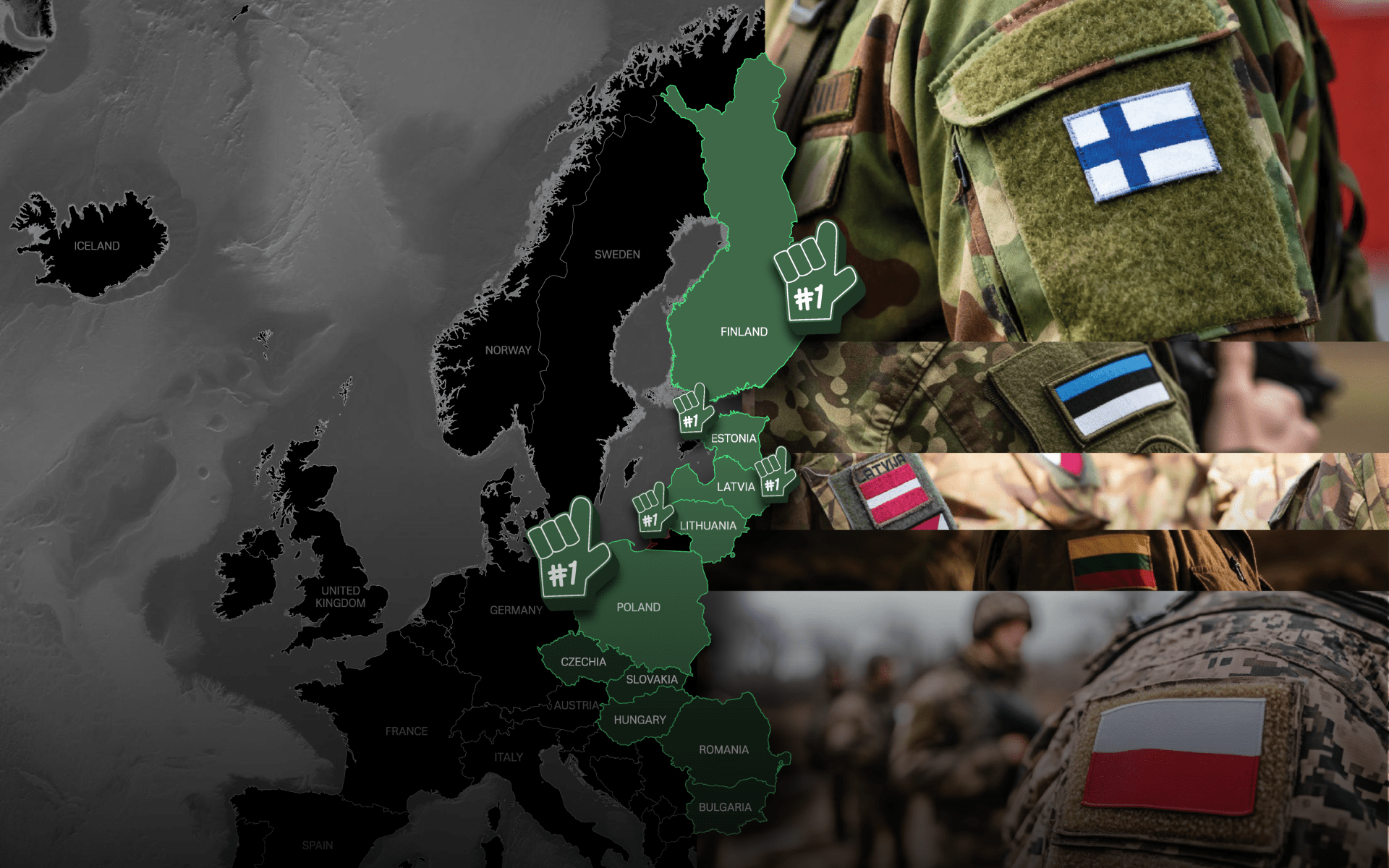
The Eastern Front: Poland and the Baltics Lead the Way
If Germany’s rearmament is historically significant, Poland’s and the Baltic states’ is existentially driven.
For Poland, Estonia, Latvia, and Lithuania, the threat is not abstract. Russia shares borders or near-borders with all of them. The 1939 Molotov-Ribbentrop Pact and Soviet occupation are lived memory for older generations and studied history for younger ones. When Russia invaded Ukraine in 2022, these countries did not need months of debate to understand what it meant. They had been warning their Western European allies for years.
Poland has NATO’s highest military spending as a share of GDP — roughly 4.5% in 2025 — and the largest proportion of that budget devoted to weapons systems (about 54%, rather than salaries and operational costs). It launched its largest-ever voluntary military training initiative in late 2025, aiming to recruit up to 400,000 people through 2026. It fields NATO’s third-largest army and is expanding.

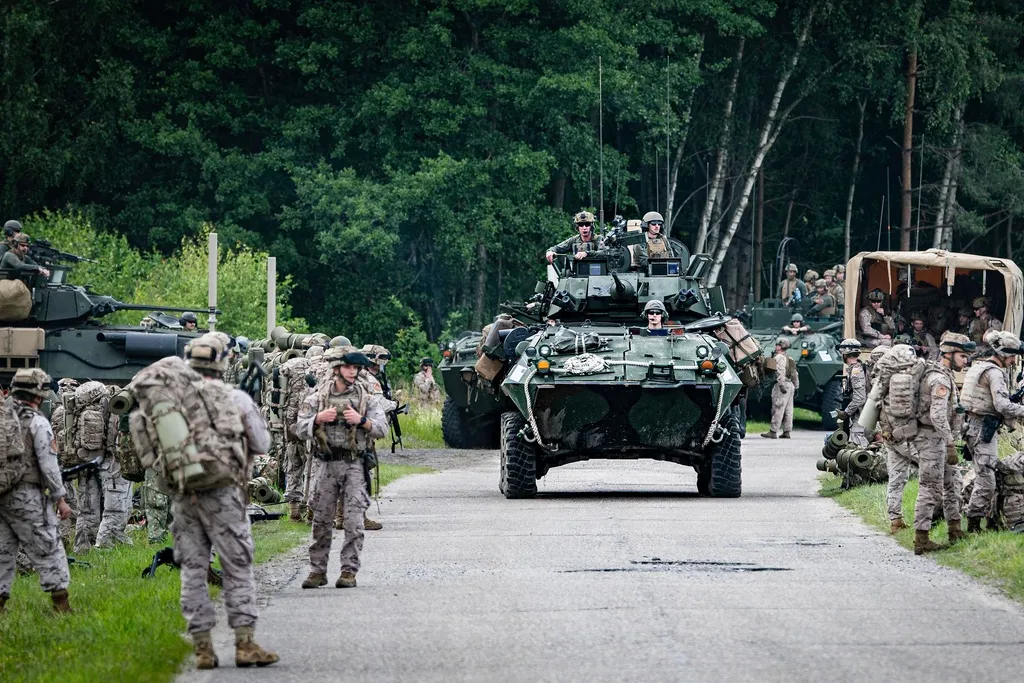
The Baltic states present perhaps the most striking picture of civilian-military integration on the continent. Lithuania has reinstated year-round conscription from 2026, calling up young men straight from high school with fitness assessed at age 17. Latvia is extending its draft to include women by 2028. Estonia is increasing annual recruitment targets and has committed over €10 billion for the 2026–2029 period. Finland — which joined NATO in 2023 after decades of neutrality — has increased annual recruitment and maintains one of the most capable reserve forces in Europe.
The Suwalki Corridor — a roughly 100-kilometer strip of land connecting Poland to Lithuania along the Belarus-Kaliningrad border — has become NATO’s most discussed vulnerability on the eastern flank. Russian or Belarusian forces seizing it would physically cut off the Baltic states from the rest of NATO territory. Poland and the Baltic states have been explicit: they are building forces capable of deterring and if necessary defeating such a move.
The EU’s New Defense Architecture
What is happening at the national level is being reinforced at the European level by a set of institutional and financial mechanisms that, taken together, represent a fundamental shift in how the European Union thinks about defense.
The SAFE (Security Action for Europe) instrument, launched in 2025, provides €150 billion in cheap, long-maturity loans to EU member states for defense procurement — with the specific aim of encouraging joint purchasing and reducing Europe’s 178 different weapons systems (compared to the US’s roughly 30). Poland received the first advance; more countries are in the pipeline.
The European Commission’s ReArm Europe plan, announced in early 2025, created a temporary fiscal exemption allowing EU member states to exceed the 3% of GDP annual deficit limit by a further 1.5% of GDP per year for defense spending between 2025 and 2028. In practical terms, this means European countries can borrow substantially more to finance rearmament without breaching EU fiscal rules — removing one of the key constraints on spending.
EU defense investment exceeded €343 billion in 2024 — up 37% from €250 billion in 2021. The trajectory since then has only steepened.
The deeper structural problem — which European defense planners acknowledge openly — is interoperability. Europe collectively fields roughly 1.4 million active-duty personnel. But those forces operate under different command structures, with different weapons systems, different ammunition standards, and different levels of readiness. Spending more money does not automatically translate into military effectiveness if the forces cannot operate together. Building genuine interoperability — the ability of Polish, German, French, and Baltic forces to fight as a coherent whole — is the central military challenge of European rearmament, and it will take years to solve even with the money now being committed.
The Rearmament Paradox: Not All of Europe Is Moving at the Same Speed
There is a geographical and political fault line running through Europe’s defense revolution.
Countries on or near NATO’s eastern flank — Poland, the Baltic states, Finland, Sweden, Romania — are rearming with urgency and public support. For them, the threat from Russia is visceral and immediate. Defense spending commands democratic majorities. Conscription is broadly accepted.
Countries further from Russia — France, Spain, Italy, Portugal — are moving more slowly, for reasons that are partly geographic (Russia will “never reach the Pyrenees,” as Spanish Prime Minister Sánchez noted), partly fiscal (France is in the middle of a severe budget crisis that limits its capacity to increase defense spending substantially), and partly political (public support for large defense increases is weaker in southern Europe).
France’s situation is particularly uncomfortable. Paris has long styled itself as Europe’s leading military power — the only EU member with nuclear weapons and a permanent UN Security Council seat. But by 2029, Germany’s defense spending in absolute terms will be roughly twice France’s. The strategic and political implications of that shift — for Franco-German relations, for European defense leadership, and for France’s self-image — have barely begun to be processed.
The US Factor: The Threat That Accelerated Everything
It would be wrong to attribute Europe’s rearmament solely to Russia. The other driver, particularly since January 2025, has been Donald Trump.
Trump’s explicit statements questioning whether the US would defend NATO allies who failed to pay their share — and his administration’s reduction of military support to Ukraine — created an acute crisis of confidence in American reliability. A February 2025 YouGov survey found that 51% of EU citizens now view Trump as a threat to Europe — a figure that would have been extraordinary just three years ago.
The political consequence of that perception has been, paradoxically, to accelerate exactly the rearmament that Trump demanded. European governments that might have moved slowly are moving fast, precisely because they can no longer assume the US cavalry will arrive.
Germany is evaluating Tomahawk missiles partly because it wants long-range strike capability that does not depend on American assets. France is pushing its own EU defense industrial agenda partly because it wants European weapons supply chains that do not run through Washington. The Baltic states are building forces designed to hold a defensive line long enough for NATO reinforcements — but also to hold it if those reinforcements are delayed or do not come.
The irony is profound: American pressure to increase spending, combined with American unreliability on the alliance commitment, has produced a Europe that is militarily stronger and strategically more independent than Washington may ultimately want.
Key Facts: Europe’s Rearmament, 2026
| Global military spending 2025 | $2.89 trillion (record high) |
| European NATO members’ combined spending | $559 billion (2025) |
| Germany defense budget 2026 | €108.2 billion (projected) |
| Germany target by 2030 | €167.8 billion (~3.5% GDP) |
| Poland defense spending 2026 | ~$55 billion (~4.5% GDP) |
| EU SAFE rearmament fund | €150 billion total; Poland receives €43.7 billion |
| EU defense spending 2024 | €343 billion (up 37% since 2021) |
| NATO members meeting 2% target | 22 of 29 European members (2025) |
| Conscription reinstated/expanded | Lithuania, Latvia, Denmark, Belgium, Croatia, Estonia, Finland, Sweden |
| Germany’s military target | Strongest conventional army in Europe by 2029 |
What Europe’s Rearmament Means for the World
The transformation underway in European defense will have consequences that extend well beyond the continent.
A rearmed Europe with genuine military capacity and strategic autonomy is a different kind of geopolitical actor. It is an actor that can potentially defend itself — and deter Russia — without depending on American nuclear guarantees and forward-deployed US forces. That is what the Baltic states and Poland want. It is what the eastern flank of the alliance has been demanding for years.
It is also an actor that will eventually want a say in decisions commensurate with its military contribution — in NATO, in relations with Russia and China, in the Middle East, in Africa. A Europe that funds its own defense will not indefinitely accept a subordinate role in the strategic decisions that its forces are being asked to implement.
The rearmament is real. The money is real. The conscription is real. The procurement orders are real. What remains to be seen is whether Europe can convert historic levels of spending into genuine strategic coherence — the ability to act together, under a shared command, toward shared goals, without waiting for Washington to decide.
That is the central question of European security in the next decade. The answer will determine whether this rearmament produces a continent capable of deterring war, or simply a collection of well-funded national armies that cannot act as one when it matters most.
Sources: SIPRI Military Expenditure Database (April 2026), Atlantic Council, Foreign Policy, Breaking Defense, Nordic Defence Review, Atlas Institute for International Affairs, Soufan Center, Centre for European Reform, Brussels Institute for Geopolitics, Anadolu Agency, Charter’97
About the Author