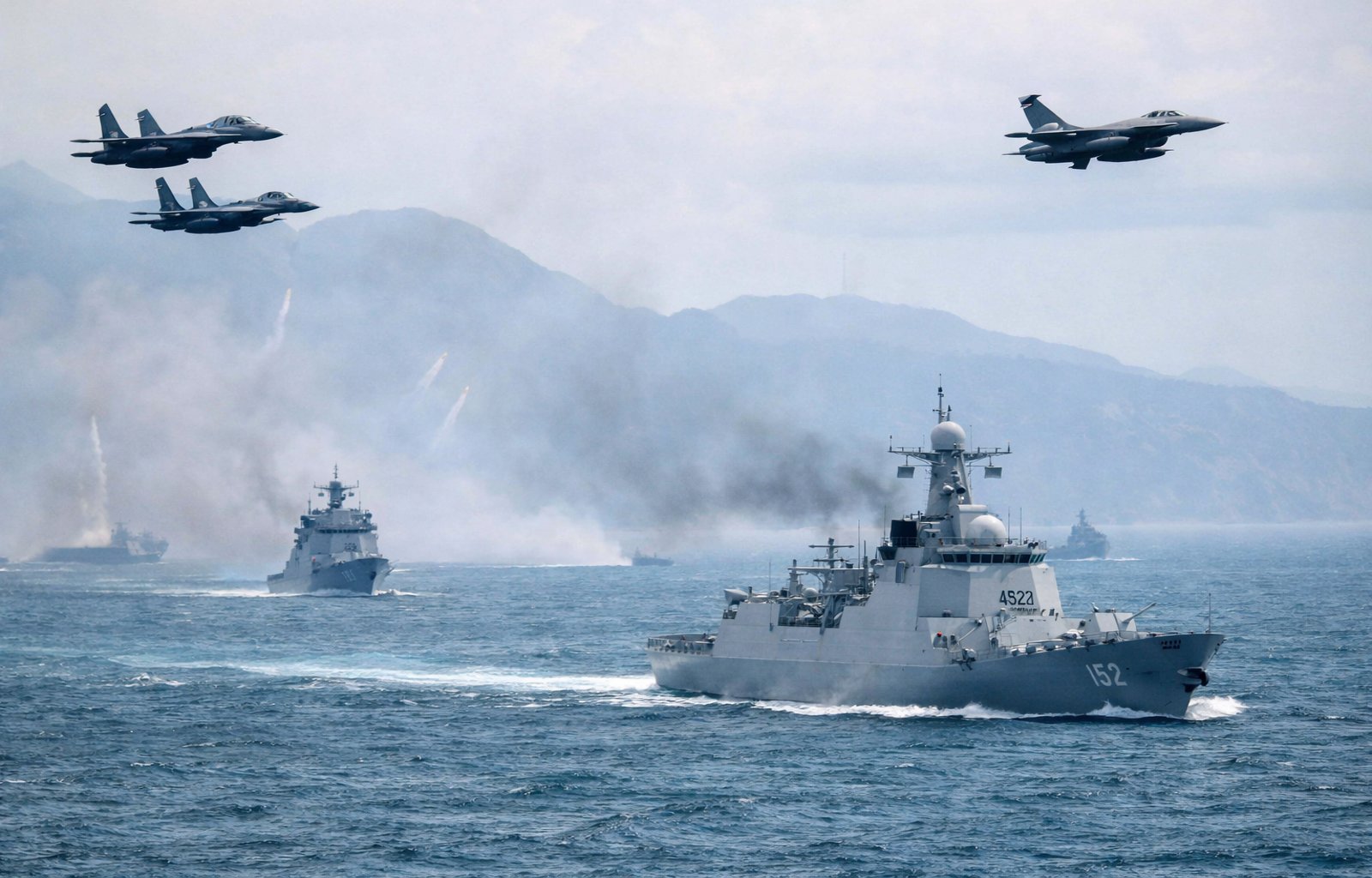
China operates the world's largest navy by hull count and conducts continuous military exercises around Taiwan and throughout the South China Sea.
No conflict in the world carries higher stakes than the one that has not yet happened — the potential Chinese military action against Taiwan.
It would be the largest amphibious military operation in human history. It would involve two nuclear powers, the United States and China, in direct confrontation for the first time. It would almost certainly drag in Japan, Australia, South Korea, and the Philippines. It would disrupt the global semiconductor supply chain — Taiwan produces over 90% of the world’s most advanced chips — in ways that would make every previous supply chain crisis look trivial. And it would mark the definitive end of the post-Cold War international order.
It has not happened. But in 2026, the conditions that could produce it are more advanced than at any previous point in history. China’s military modernization is further along. Its gray-zone pressure campaign against Taiwan and the Philippines is more aggressive. The US alliance system in the Indo-Pacific is under strain from both Chinese pressure and American unpredictability. And Beijing is building the infrastructure — military, technological, and logistical — for a conflict it insists it does not want but is increasingly prepared to fight.
Here is where things actually stand.
China’s Military Posture: Built for Taiwan, Used Everywhere
The People’s Liberation Army’s modernization over the past two decades has been driven by a single primary scenario: seizing Taiwan. Every major capability development — carrier strike groups, amphibious assault ships, long-range ballistic missiles, drone swarms, electronic warfare, cyber capabilities, undersea surveillance networks — has been designed with that contingency in mind.
The results are significant. China now operates the world’s largest navy by number of hulls. Its coast guard is the world’s largest. Its maritime militia — a fleet of ostensibly civilian fishing vessels that operate under PLA direction — numbers in the thousands. The PLA Rocket Force possesses the world’s largest inventory of land-based ballistic and cruise missiles, many of them specifically designed to strike US carrier groups and air bases in the Western Pacific.
In April and May 2026, the scale of Chinese military activity around Taiwan and in the South China Sea has reached levels that analysts describe as normalized high-tempo pressure rather than crisis signaling. The PLA Southern Theater Command conducted two major deployments to the South China Sea and West Pacific in late April, in direct response to the Balikatan 2026 combined exercises between the Philippines, the United States, Japan, Australia, New Zealand, Canada, and France. The PLAN aircraft carrier Liaoning transited the Taiwan Strait heading south on April 20. A Type 055 guided missile destroyer, a Type 052D destroyer, a Type 054A frigate, and an auxiliary replenishment vessel conducted exercises east of the Luzon Strait simultaneously.
This is not a crisis. This is Tuesday.
China has also begun issuing airspace restriction notices covering key approaches to Taiwan — lasting up to 40 days, far longer than typical military exercises — without announcing drills or offering explanations. Satellite imagery has shown thousands of Chinese fishing boats assembling in organized formations spanning over 200 miles in the East China Sea, near major shipping lanes. Chinese research vessels — which the Pentagon assesses are used to map underwater terrain, deploy undersea surveillance drones, and position navigational beacons for submarines — have been operating around Sabina Shoal, Second Thomas Shoal, and Iroquois Reef: all disputed features that China seeks to seize from Philippine control.
Beijing is building the infrastructure for future conflict in the same waters where it insists no conflict is planned.
The South China Sea: A Slow-Motion Seizure
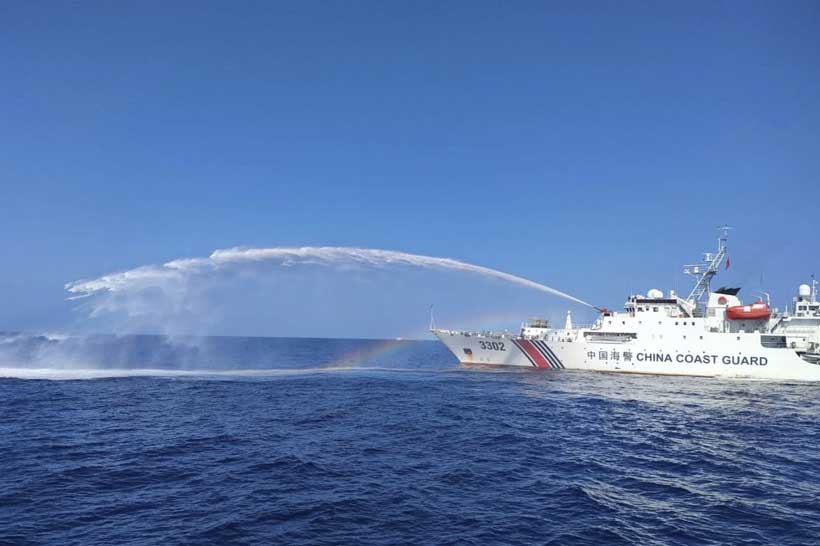
The South China Sea dispute is the clearest example of China’s gray-zone strategy in practice — using coast guard vessels, maritime militia boats, floating barriers, water cannons, and laser systems to assert operational control over contested waters without crossing the threshold into open armed conflict.
China claims approximately 90% of the South China Sea through its so-called Nine-Dash Line — a claim rejected in 2016 by an international arbitral tribunal under UNCLOS and rejected by virtually every other country in the region. The Philippines, Vietnam, Malaysia, Brunei, and Taiwan all have overlapping claims. The United States does not claim territory but conducts Freedom of Navigation operations and treats the security of its treaty allies — particularly the Philippines — as a core commitment.
The current flashpoint is Scarborough Shoal — a disputed fishing reef well within the Philippines’ Exclusive Economic Zone, which Chinese coast guard and maritime militia vessels have controlled since 2012. Satellite imagery in April 2026 showed Chinese vessels erecting a floating barrier at the entrance to the shoal — moving beyond routine harassment toward direct physical restriction of Filipino access.
At Second Thomas Shoal, the Philippines deliberately grounds a rusting warship, the BRP Sierra Madre, and keeps a small marine garrison aboard to assert its territorial claim. China has repeatedly used water cannons, lasers, and vessel-blocking maneuvers to prevent resupply missions from reaching the garrison — actions that have injured Filipino sailors and damaged Philippine Coast Guard vessels. This confrontation has been ongoing for years; it has not yet produced an armed clash. It has come close.
ASEAN’s April 2026 summit called for a legally binding Code of Conduct in the South China Sea in accordance with international law, with Philippine President Marcos expressing optimism about a deal by year-end. China responded that it is having “close consultation” with ASEAN — language that, based on two decades of precedent, signals continued delay. Beijing has no incentive to accept a code of conduct that constrains its actions in waters it already largely controls.
Taiwan: Pressure, Politics, and the 2028 Horizon
China’s approach to Taiwan in 2026 combines military pressure with political strategy — and the political dimension may be the more consequential.
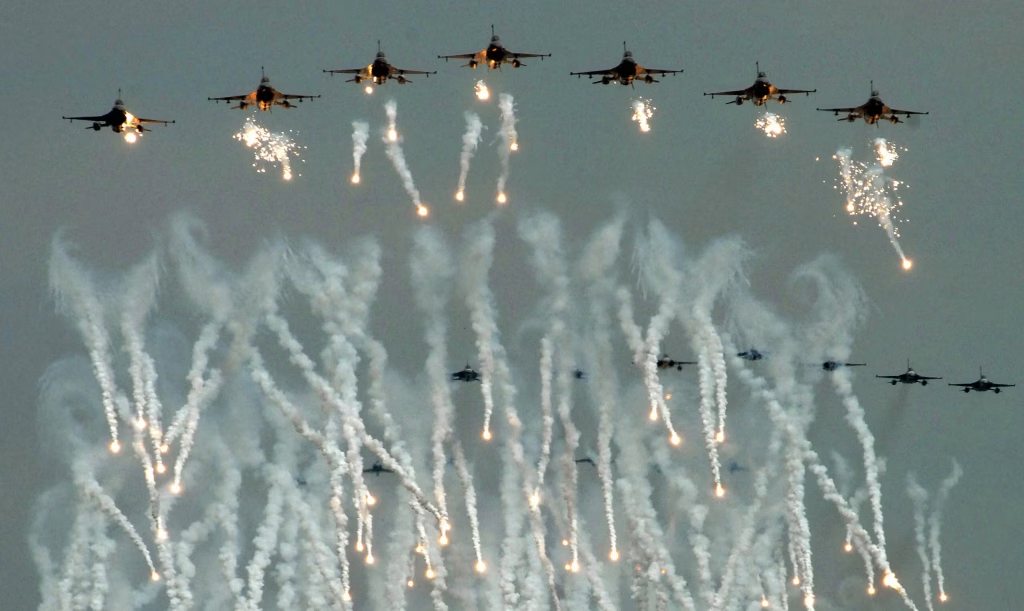
Beijing is pursuing a dual track. On the military side, regular PLA incursions into Taiwan’s Air Defense Identification Zone have become so routine they barely register in the news cycle. Naval exercises encircling Taiwan occur multiple times per year. China blocked Taiwan’s participation in the 2026 World Health Assembly in May, as it does routinely, asserting that the island has no basis or right to participate in international organizations without Beijing’s approval.
On the political side, Beijing is making a sophisticated play for Taiwan’s Kuomintang (KMT) party — historically more amenable to cross-strait dialogue than the ruling Democratic Progressive Party (DPP). KMT vice chairman Cheng participated in a visit to mainland China, which Beijing used to present cross-strait dialogue as representing Taiwanese public opinion — contrasting KMT engagement with DPP defense cooperation with the United States. Taiwan holds local elections in 2026 and national elections in 2028. Beijing is attempting to set information conditions that favor the KMT: positioning the DPP’s defense posture and US cooperation as the principal obstacle to peace, rather than China’s military pressure.
The strategic logic is transparent: if the KMT wins in 2028, it may reduce arms purchases from the US, cool defense cooperation, and engage in cross-strait dialogue on terms more favorable to Beijing. China does not need to invade Taiwan if it can achieve effective political control through electoral influence.
Whether that strategy succeeds depends partly on what happens between now and 2028. Taiwan’s public, for whom democratic governance is not an abstraction but a lived reality, has shown consistent resilience against Beijing’s pressure campaigns. Polls consistently show majorities preferring the status quo — neither formal independence nor unification — over the near term. But public opinion can shift, and Beijing is patient.
The US Alliance System: Strong but Strained
The Indo-Pacific alliance system that the United States has built since the end of World War II — anchored by treaty commitments to Japan, South Korea, Australia, and the Philippines, and extended through security partnerships with Taiwan, India, and others — remains the primary deterrent against Chinese military action.
It is also under strain in ways that matter.
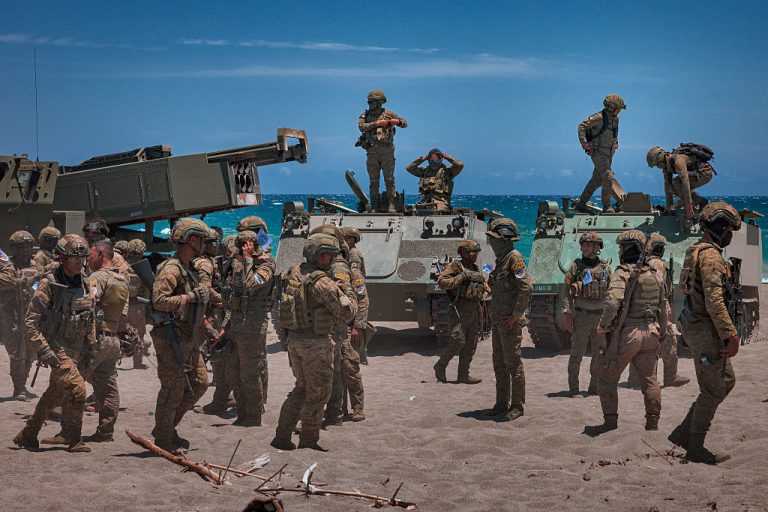
Balikatan 2026, the annual Philippines-US joint exercise, was the largest ever conducted — with Japan participating for the first time, alongside Australia, New Zealand, Canada, and France. The exercise included scenarios for defending the Philippines’ Exclusive Economic Zone and simulated responses to maritime confrontation. China responded with its own naval deployments and deployed H-6 bombers armed with anti-ship missiles near Scarborough Shoal during the exercise.
Japan has undergone its own defense revolution — increasing its defense budget to 2% of GDP, acquiring long-range strike capabilities previously considered unconstitutional, and taking on a more active role in regional security. The Japan-US alliance is arguably stronger than at any point in the postwar era.
But the Trump administration’s approach to alliances has introduced uncertainty. Trump’s personal relationships with authoritarian leaders, his transactional view of alliance commitments, and his administration’s reduction of engagement on multilateral security architecture have raised questions in Tokyo, Seoul, Canberra, and Manila about the reliability of American guarantees. Those questions do not translate into abandoning the US alliance — the alternatives are worse — but they drive independent capability investments and hedging strategies that complicate US-led coordination.
The most sensitive alliance relationship is with Taiwan itself. The US maintains a policy of “strategic ambiguity” — neither confirming nor denying whether it would militarily defend Taiwan against a Chinese attack. This ambiguity is intentional: it deters both Chinese adventurism and Taiwanese moves toward formal independence that could trigger a conflict. But it means Taiwan cannot be certain of American intervention, which is precisely why Taiwan’s own defense investments and asymmetric military strategies matter so much.
China’s Technology Strategy: Chips, Satellites, and Undersea Sensors
Understanding China’s military posture in the Indo-Pacific requires understanding its broader technology strategy, because the two are inseparable.
China is building self-reliance in advanced computer chips — particularly those used for artificial intelligence — after US export controls cut off access to the most advanced semiconductors. This matters for military applications directly: AI-powered targeting, autonomous drone swarms, electronic warfare, and command-and-control systems all depend on advanced chips. China’s progress has been slower than Beijing hoped, but the direction of travel is clear.
China is also pursuing a Low Earth Orbit satellite constellation — a Starlink equivalent — that would give the PLA reliable communications with naval forces operating in the far seas, even under electromagnetic interference. This capability would be essential during any Taiwan contingency, where US cyber and electronic warfare operations would attempt to degrade PLA communications. A Chinese LEO constellation would provide a backup network resistant to those attacks.
Most ominously, China’s “Transparent Ocean” initiative — revealed in detail through analysis of research vessel operations — aims to build a multilayered web of undersea sensors covering the Western Pacific. The goal is to map underwater terrain, track submarine movements, and create navigational infrastructure for PLA submarines operating toward Taiwan and beyond. The research vessels conducting this work operate under civilian cover. The mission is military.
Key Facts: China-Taiwan-South China Sea, May 2026
| Taiwan chip production | 90%+ of world’s most advanced semiconductors |
| China’s navy | World’s largest by number of hulls |
| PLA exercises near Taiwan | Continuous; carrier transit April 20, 2026 |
| South China Sea claim | ~90% (Nine-Dash Line) — rejected by UNCLOS tribunal 2016 |
| Current flashpoints | Scarborough Shoal, Second Thomas Shoal, Taiwan Strait |
| Balikatan 2026 | Largest ever; Japan participated for first time |
| China’s political strategy | Backing KMT ahead of Taiwan’s 2028 elections |
| Key tech investments | Domestic chips, LEO satellites, undersea sensor network |
| Airspace restrictions near Taiwan | Up to 40-day notices issued without explanation (April 2026) |
| ASEAN Code of Conduct | Ongoing negotiations; no binding agreement |
How Close Is War — And What Would It Look Like?
The honest assessment from most serious analysts is that a Chinese military operation against Taiwan is not imminent — but the window of risk is narrowing, not widening.
China’s military modernization will reach a significant benchmark around 2027, when the PLA has assessed it will have the capacity to conduct a Taiwan operation with a reasonable probability of success. That does not mean an operation will be launched in 2027. Xi Jinping has shown consistent preference for achieving Taiwan’s political submission through pressure rather than military force — which is messier, more costly, and internationally isolating. But the capability will exist.
The scenarios most analysts consider plausible before a full invasion include: a naval blockade of Taiwan — which China could sustain using its coast guard, maritime militia, and naval vessels without a single shot being fired, while strangling Taiwan’s economy; a seizure of Taiwan’s outer islands, testing US resolve at lower cost; or a cyber and missile campaign against Taiwan’s infrastructure designed to force political capitulation without a ground invasion.
All of these scenarios share one feature: they compress decision-making time for the United States in ways that favor China. A blockade that begins as a “quarantine” creates pressure on Washington to either escalate militarily or accept a new status quo. A missile strike on a radar installation creates a fait accompli that the US must respond to within hours, not days.
The deterrence equation in the Taiwan Strait is not simply about whether China can defeat US forces in a fight — it is about whether the US can respond fast enough, with enough resolve, to make the cost of action prohibitive. That calculation is what drives every procurement decision in Beijing, every alliance exercise in the Pacific, and every airspace restriction notice filed without explanation.
The war over Taiwan has not started. The preparation for it — on all sides — is very much underway.
Sources: AEI/ISW China-Taiwan Update (May 2026), Foundation for Defense of Democracies, CFR Global Conflict Tracker, SIPRI, Breaking Defense, US Indo-Pacific Command, CSIS, Newsweek, Wikipedia (South China Sea disputes, Cross-Strait relations)
About the Author