Myanmar People's Defence Force — Civil War 2025
Myanmar’s civil war is 78 years old. It is the longest-running civil war in modern recorded history. For most of those decades, it was a collection of isolated, ethnic insurgencies playing out in the country’s mountainous borderlands — too fragmented to threaten the central military, too persistent to be extinguished. The generals who ran Myanmar understood this equilibrium well. They exploited it. They managed it. They thought it would last forever.
They were wrong.
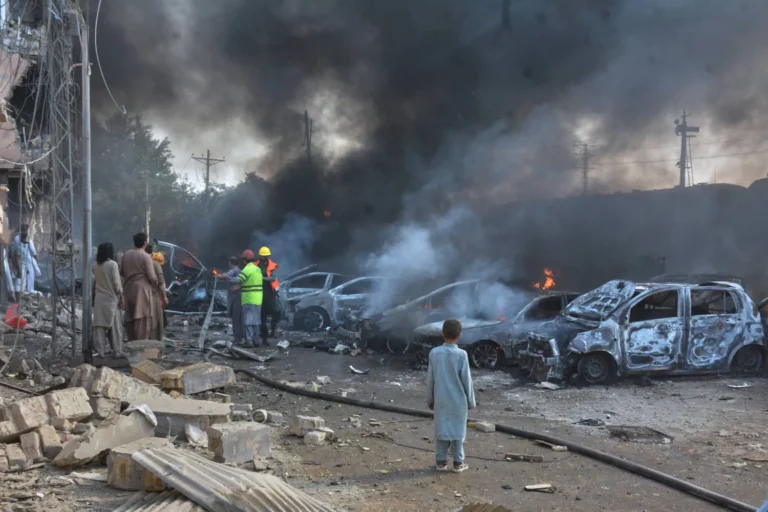
Five years after the February 2021 coup that overthrew Aung San Suu Kyi’s elected government and triggered the most serious nationwide insurgency in Myanmar’s history, the military junta controls less than 40% of the country’s townships. Resistance forces and ethnic armies hold an estimated 42%. The rest is contested. In 2025 alone, over 15,000 people were killed in conflict-related violence. Nearly 5.2 million people are displaced. One in three Myanmar citizens requires humanitarian assistance.
And yet — barely a word in the Western press.
How a Coup Turned a Fragmented Conflict Into a National War
Myanmar’s pre-2021 conflict was, by any measure, already complex. Dozens of ethnic armed organizations — representing the Karen, Kachin, Shan, Chin, Rakhine, Rohingya, and many others — had been fighting the Tatmadaw, Myanmar’s military, for generations. Each group fought largely on its own, in its own corner of the country, over its own territorial and autonomy demands. There was no unified resistance. There was no shared political vision. There was no coordination.
The February 1, 2021 coup changed all of that.
When General Min Aung Hlaing’s Tatmadaw overthrew the National League for Democracy government, detained Aung San Suu Kyi, and voided the November 2020 election results it had unilaterally declared fraudulent, it did something the ethnic armed organizations had never been able to do by themselves: it united the country’s ethnic Bamar majority — historically the military’s own support base — against the generals.
Millions took to the streets in the Civil Disobedience Movement. Doctors, engineers, railway workers, and civil servants walked off the job. The junta responded with live fire. It killed over 700 protesters in the first three months. The message it sent was unambiguous: there would be no peaceful path back to democracy.
So the resistance took up arms.
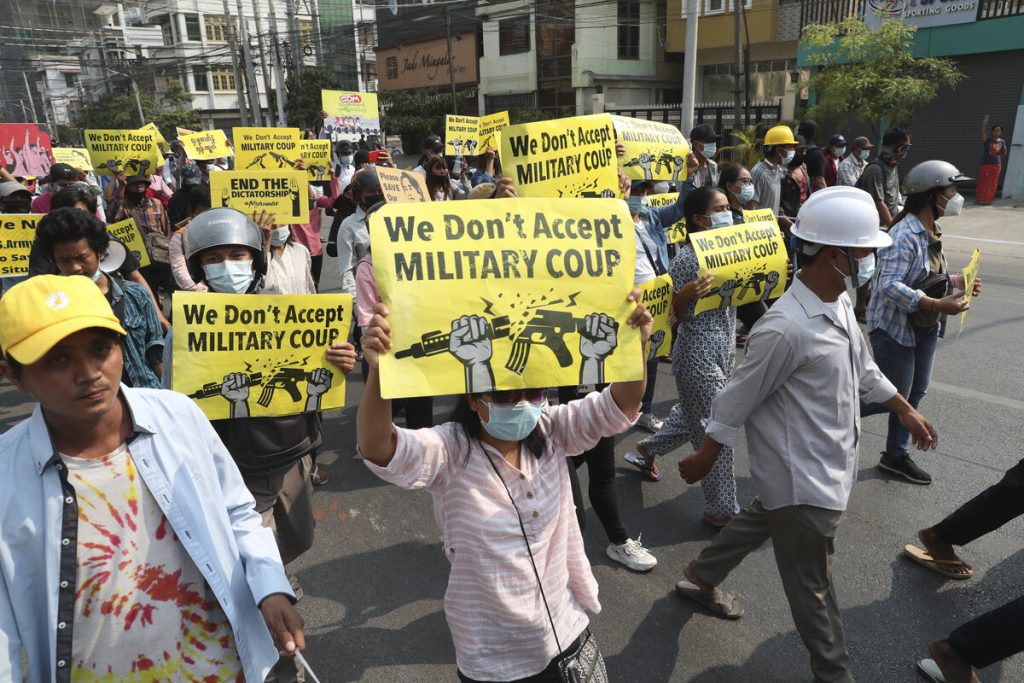
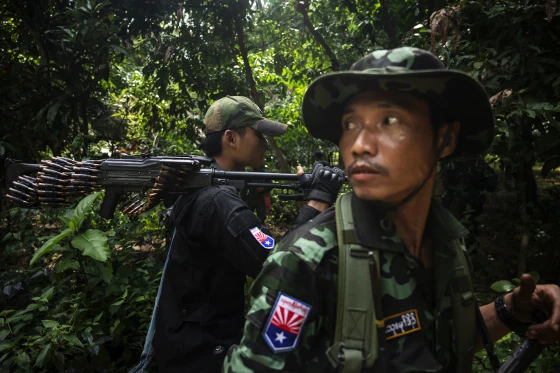
Ousted lawmakers formed the National Unity Government (NUG) — a parallel government in exile drawing in NLD politicians, civil society figures, and ethnic minority leaders. The NUG established the People’s Defence Forces (PDF) as its armed wing, calling in September 2021 for a “defensive war” against the junta. By 2024, the PDF claimed 85,000 fighters. For the first time, ethnic Bamar citizens — historically the backbone of the Tatmadaw — were fighting against the military institution their grandparents had built. The generals had no precedent for this.
Operation 1027: The Offensive That Broke the Junta’s Myth of Control
If there is a single turning point in Myanmar’s post-2021 conflict, it is Operation 1027 — named for the date it commenced, October 27, 2023.
A coalition of three ethnic armed groups in Shan State — the Arakan Army (AA), the Myanmar National Democratic Alliance Army (MNDAA), and the Ta’ang National Liberation Army (TNLA), known collectively as the Three Brotherhood Alliance — launched a coordinated offensive against the junta.
The results were staggering. By January 2024, the MNDAA had captured Laukkaing, the administrative capital of Kokang Self-Administered Zone, forcing the regional military commander to surrender — the first time a major junta outpost had fallen to a coordinated ethnic armed organization assault since the coup.
The Karen National Liberation Army (KNLA) seized the strategic Myawaddy border crossing with Thailand in April 2024, capturing enormous quantities of junta weapons and equipment and briefly cutting a critical trade route.
Operation 1027 shattered the military’s aura of invincibility. It demonstrated that coordinated, well-armed ethnic forces could not just hold territory — they could take it. It emboldened PDF forces across the country. And it triggered a cascade of resistance offensives that, by early 2026, had pushed the junta to its weakest territorial position since independence.
The Battlefield in 2026: A Junta on the Defensive
Five years after the February 2021 coup, the junta controls fewer than 40% of Myanmar’s townships — down from near-total control after the coup. Resistance forces and ethnic armies control an estimated 42% of territory.
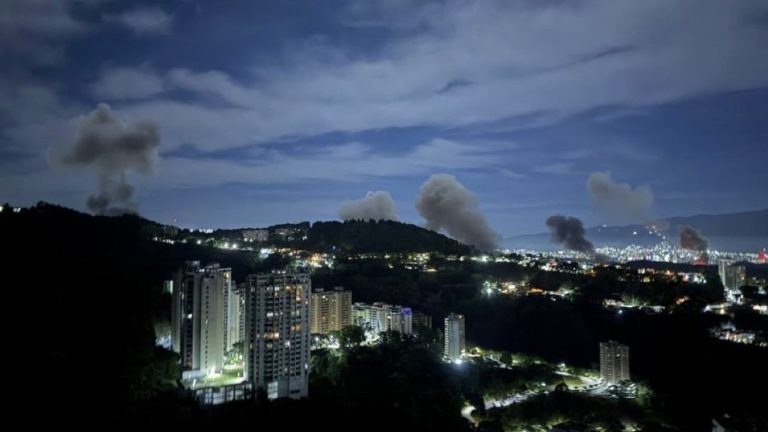
The geography of collapse tells a damning story for the generals. The junta retains control of major urban centers — Naypyidaw, Yangon, and Mandalay — and maintains air superiority, which it uses brutally. But the countryside, the border regions, and large swathes of the states and regions that surround the central plains are no longer under its control.
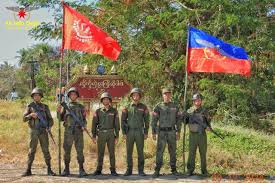
The Arakan Army has effectively established a proto-state along Myanmar’s western coast, controlling most of Rakhine State and establishing direct communication with neighboring Bangladesh. With 40,000 troops, artillery, armored vehicles, and an expanding drone fleet, the Arakan Army is less an insurgent group than a functioning parallel military force with genuine administrative capacity.
Conscription, together with pressure from Beijing on the ethnic armies situated on the China-Myanmar border, has halted earlier rapid advances against the military. Reduced weapons flows to resistance groups, support from armed militias for the military, as well as improved tactics, have helped the military claw back much lost ground. The junta is not finished. But it is fighting a fundamentally different war than it imagined it would be fighting when it launched the coup in 2021.
The Sham Elections of January 2026
The military-backed party won a sweeping victory in sham January 2026 elections; a new military-aligned government is set to take over in April 2026. 170 civilians were verified dead from airstrikes during the election period; 400 were arrested.
The elections were, by every credible assessment, political theater. Major ethnic armed organizations boycotted them. The NUG declared them illegitimate. International observers were not permitted. In areas where the junta does not control the territory, voting was impossible — and in many areas where it nominally does, coercion was the operative mechanism.
The SAC announced a ceasefire from April 2–22, 2026, despite continuing airstrikes — a pattern consistent with previous ceasefire violations.
The elections achieved one thing: they gave the junta a domestic political fig leaf to claim democratic legitimacy. No serious government in the world accepted the result. But the junta does not need international recognition. It needs to keep control of Naypyidaw and Yangon long enough to outlast its enemies. The elections were designed to serve that purpose — nothing more.
The New Resistance Alliance: SCEF and a Federal Vision
The most significant recent development on the resistance side is the formation of the Steering Council for the Emergence of a Federal Democratic Union (SCEF) — announced in April 2026.
The new alliance brings together some of Myanmar’s largest and most capable resistance organizations around the single vision of a federal democracy. Critically, the structure grants operational military authority to the ethnic armed groups, while providing a platform for joint planning and operations. It is an important recognition that genuine federalism must begin now, in how the resistance is organized, not just in the constitutional promises made.
The inclusion of the Arakan Army in SCEF is particularly significant. Rakhine State sits at the terminus of critical Chinese-sponsored Belt and Road infrastructure, including oil and gas pipelines running from the Bay of Bengal to Yunnan Province. Beijing spent years backing the junta to protect its infrastructure investments. Nonetheless, the Arakan Army was able to surround the military at the Kyaukphyu port and special economic zone, demonstrating that Chinese patronage of the junta has limits and well-organized forces with genuine popular support can overcome Chinese pressure — even near China’s most important infrastructure hubs.
SCEF does not guarantee a unified resistance. Myanmar’s ethnic armed organizations, many of them battle-hardened and deeply rooted in their communities, control significant territory but often operate on independent tracks — maintaining separate channels with neighboring states, the NUG and other prodemocracy groups. The history of Myanmar’s ethnic alliances is a history of fragile coalitions that fractured under pressure. But SCEF represents the most serious attempt at unified command the resistance has ever made.
The Earthquake That Made Everything Worse
On March 28, 2025, a 7.7-magnitude earthquake struck central Myanmar — one of the most powerful in the country’s recorded history.
The earthquake killed over 5,000 people and affected 17 million — with the junta conducting 550+ attacks in the two post-quake months while blocking aid to opposition-controlled areas.
Let that sink in. While tens of thousands needed emergency rescue, while hospitals were collapsed, while displaced communities had nowhere to shelter — the junta was launching airstrikes and blocking international aid from reaching areas outside its control.
The earthquake compounded a humanitarian crisis that was already beyond the international community’s capacity to adequately address. And the junta’s behavior in the aftermath removed any remaining doubt about its willingness to use civilian suffering as a weapon.
The Humanitarian Reality: Numbers Too Large to Ignore
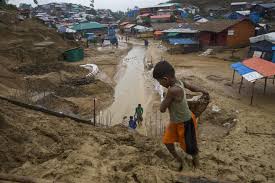
Nearly 5.2 million people are displaced — both internally and across borders into Thailand, India, and Bangladesh. One-third of Myanmar’s population requires humanitarian assistance. The UN’s 2025 humanitarian appeal for Myanmar sought $1.1 billion but has been significantly underfunded.
The consequences of chronic underfunding are visible everywhere in Myanmar’s displacement camps and border settlements. Malnutrition rates in internally displaced communities have reached levels comparable to active famine zones. Medical access in resistance-held areas is extremely limited. Children are out of school in the millions.
Myanmar has become the world’s top producer of opium and a major source of synthetic drugs, with criminal economies proliferating amid state collapse. When governance fails and displacement reaches this scale, criminal networks fill the vacuum. Myanmar’s drug economy is not a side effect of the civil war — it is increasingly a structural feature of it, financing armed groups on multiple sides and embedding itself in the border economies of Thailand, China, and Bangladesh.
China’s Role: The Most Important External Actor
No external actor shapes Myanmar’s conflict more than China — and no external actor is more difficult to characterize simply.
China borders Myanmar to the north and northeast and has enormous economic stakes in the country’s stability, including Belt and Road infrastructure — pipelines, roads, and the Kyaukphyu port — that runs directly through conflict zones. Beijing’s instinct has been to back whoever controls the central government, which has meant backing the junta since 2021.
But China’s support for the Tatmadaw is not unconditional. China and Russia have blocked stronger action at the UN Security Council, with China pursuing its own diplomatic track focused on stability along its border. Beijing has pressured the junta to hold elections — not out of democratic concern, but because a visible political process creates the illusion of stability that Chinese investment requires. It has also brokered multiple fragile ceasefires to protect its economic interests, most of which have not held.
The Arakan Army’s consolidation of Rakhine State, including areas surrounding Chinese infrastructure, has forced Beijing into an uncomfortable position: its client state cannot protect its investments, and the ethnic armies it has long pressured are now functionally more powerful than the junta in parts of the country China cares most about. China is recalibrating. How that recalibration unfolds is one of the key variables in Myanmar’s trajectory.
Key Facts: Myanmar Civil War, May 2026
| Conflict began | 1948 (ethnic insurgencies); escalated February 1, 2021 (coup) |
| Junta territory control | Less than 40% of townships |
| Resistance/ethnic control | ~42% of territory |
| Conflict deaths (2025 alone) | 15,000+ |
| Total ACLED-estimated deaths | 96,000+ since 2021 |
| Displaced persons | 5.2 million internally and across borders |
| Population in humanitarian need | ~19.9 million (one-third of Myanmar) |
| Armed factions | 1,200+ (ACLED’s most fragmented conflict globally) |
| Earthquake (March 2025) | 7.7 magnitude; 5,000+ killed; 17 million affected |
| January 2026 elections | Widely condemned as illegitimate; 170 civilians killed during election period |
| New resistance alliance | SCEF formed April 2026 — most unified resistance structure to date |
Why the World Needs to Pay Attention
Myanmar does not generate the cable news urgency of Gaza or Ukraine. There are no dramatic missile strikes broadcast live. There is no single villain Western audiences are primed to recognize. There is only a grinding, multi-sided, ethnically complex war that has been killing people for three-quarters of a century and that, since 2021, has become catastrophic in scale.
ACLED estimates more than 96,000 people have been killed in Myanmar’s civil war, while the United Nations says at least 3.6 million have been displaced. These are numbers that, in any other context, would command permanent front-page treatment.
The stakes are regional as well as national. India and Thailand, which share long borders with Myanmar, have balanced security concerns with pragmatic engagement with whatever authorities control their border regions. Drug flows, refugee movements, and criminal networks cross every border Myanmar shares. A failed Myanmar is not a contained Myanmar — it is a source of instability that radiates across Southeast and South Asia.
The formation of SCEF in April 2026 offers the first genuine possibility in years that the resistance could present a coherent political and military alternative to junta rule. Whether it holds together — whether the ethnic armed organizations can subordinate their individual agendas to a shared federal vision — will determine whether Myanmar finally has a path out of 78 years of war.
That path is narrow, littered with historical failure, and dependent on international engagement that has so far not materialized in anything close to adequate form.
But it exists. And for a country that has been at war since 1948, that matters.
Sources: ACLED, CFR Global Conflict Tracker, Al Jazeera, Asia Times, Foundation for Defense of Democracies, UK House of Commons Library, UN OCHA, Defcon Level, Wikipedia (Myanmar Civil War 2021–present)
About the Author