For three decades, the global economy operated on a remarkably simple logic: if you needed something manufactured, China made it. Textiles, electronics, automotive components, pharmaceuticals, solar panels, rare earth magnets, steel — China built the infrastructure, trained the workforce, attracted the investment, and became the world’s factory floor at a scale and efficiency no other country could match.
That logic is not dead. But it is being fundamentally challenged for the first time since it was established.
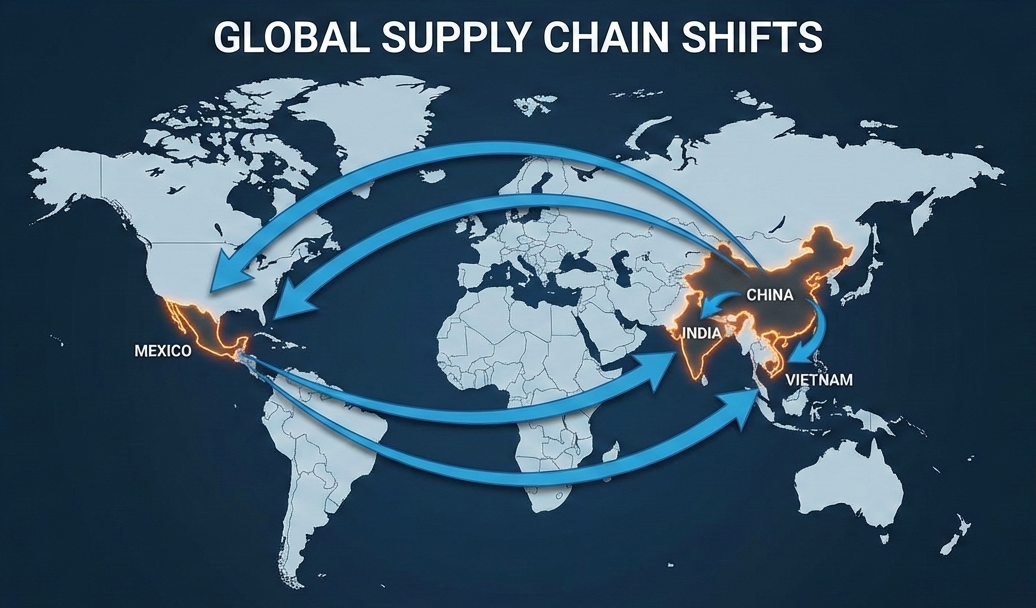
US goods imports from China fell to $308.4 billion in 2025 — down 29.7% from 2024 and the lowest level since the 2009 financial crisis. For North American buyers, the combined share of their top three supplier countries fell from 61% to 54% in a single year. Vietnam’s inspection and audit demand from global buyers rose 30% year-on-year in 2025. Thailand’s rose 44%. Egypt’s jumped 52%. Morocco’s 38%. Mediterranean nearshoring reached a record 14% of EU sourcing.
The supply chain rewiring is not a trend being modelled in consulting presentations. It is happening, documented in real trade flows, real investment decisions, and the real production lines of companies from Apple to Ford to Procter & Gamble. The question is no longer whether the world is diversifying away from China. It is how fast, how deep, how durable — and what it means for the countries winning the business, the companies managing the transition, and the billions of workers whose livelihoods are caught in the middle.
Why Now: The Triggers That Made “China+1” Inevitable
The diversification away from Chinese manufacturing as the sole global supply hub has been discussed since at least 2018, when Trump’s first trade war imposed the first significant tariff increases on Chinese imports. But companies largely talked rather than acted — because China’s advantages in cost, scale, infrastructure, supplier ecosystems, and manufacturing expertise were simply too large to abandon without a compelling reason.
Several compelling reasons arrived in rapid succession.
The COVID shock of 2020 exposed the catastrophic fragility of just-in-time, single-country supply chains when Chinese factories shut down. Pharmaceutical ingredients, semiconductors, personal protective equipment — industries discovered they had no backup. The lesson was visceral and permanent: concentrated supply chains are not efficient. They are fragile.
The 2025 tariff escalation pushed effective rates on Chinese goods to 18.6% — the highest since the Great Depression — and briefly to 145% before the May 2025 truce. At these levels, the cost arithmetic of Chinese manufacturing’s advantages was fundamentally altered. A $200 product made in China at $80 cost, subject to 145% tariffs, costs $196 to import — more than the retail price. The tariff uncertainty alone — rates moving from 10% to 145% and back to 30% within months — made any long-term supply chain planning based on Chinese manufacturing economically incoherent.
China’s weaponization of rare earths and critical inputs in 2025 demonstrated that supply chain concentration was not just a cost risk but a national security risk. Xi twice restricted rare earth permanent magnet exports, nearly shutting down US and allied automotive assembly lines. The message to every company with concentrated Chinese supply chains was clear: this can happen again, with different materials, with little warning.
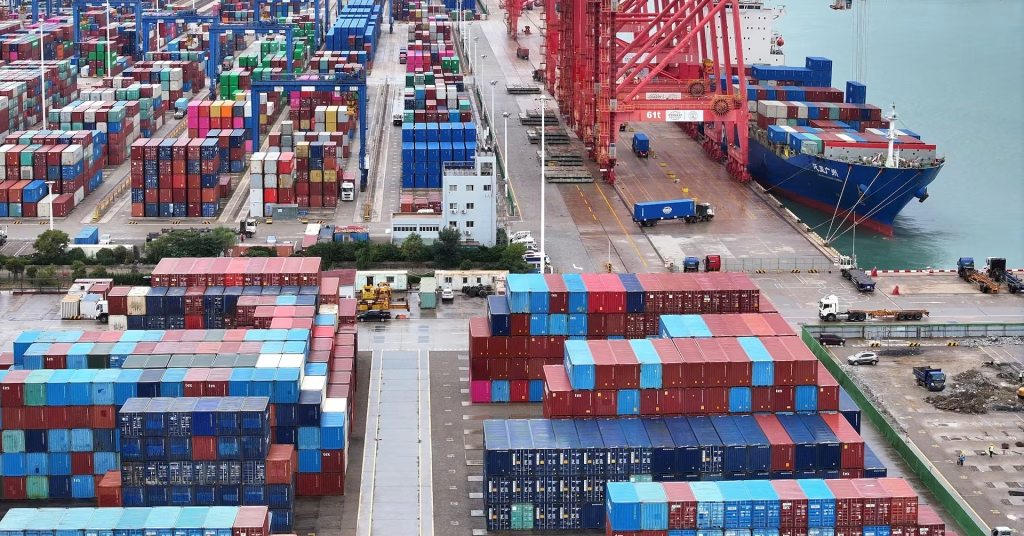
The Iran war of 2026 added a fourth shock: even companies that had successfully rerouted supply chains through Southeast Asia and the Middle East found their newly constructed alternative routes disrupted by the Strait of Hormuz closure. Shipping times from Chinese ports to Europe stretched to 50 days. Freight rates surged. Port congestion at Shanghai and Ningbo reached crisis levels. The lesson was that diversification from China alone is insufficient — supply chains need resilience against multiple simultaneous shocks.

The Winners: Who Is Capturing Displaced Chinese Manufacturing
The restructuring of global supply chains has produced a clear set of beneficiaries — countries that have attracted manufacturing investment diverted from China. Their profiles are instructive.
Vietnam: The Primary Winner — and Its Limits
Vietnam has been the single biggest beneficiary of China supply chain diversification, receiving approximately 80% of shipments to the US from Chinese-owned companies as manufacturers shifted final assembly to avoid tariffs. Its advantages are real: proximity to China (enabling continued use of Chinese components and materials while meeting origin rules for final assembly), a young and growing manufacturing workforce, government incentives for foreign investment, and an existing electronics and apparel manufacturing base built over two decades.
QIMA data shows inspection and audit demand in Vietnam rose 30% year-on-year in 2025, making it the dominant alternative sourcing hub for North American and European buyers across electronics, textiles, and consumer goods. Apple has moved approximately 25% of global iPhone production to Vietnam and India, after incurring around $900 million in tariff-related costs on Chinese-manufactured phones.
But Vietnam’s centrality is becoming a vulnerability. Rhodium Group notes that “Vietnam’s centrality will be a liability in the long run” — electronics suppliers are already being asked by major buyers to diversify manufacturing beyond Vietnam, and the country’s human resources, logistics infrastructure, and energy capacity are under strain from the volume of investment it has absorbed. The Trump administration’s new Section 301 investigation into Vietnam — launched in March 2026 — signals that Washington may eventually target Vietnam as a Chinese tariff evasion hub if the country does not diversify its Chinese ownership concentration.
India: The Long Game
India is the most structurally significant alternative to China — not because it has already captured large-scale manufacturing but because it is the only country with a comparable combination of population scale, technical workforce, and government commitment to manufacturing investment.
Apple has invested more than $1 billion in Indian manufacturing facilities since 2023 and is targeting 15–20% of global iPhone production in India by 2026. The transition has faced challenges — supply chain bottlenecks in India resulted in a 10% increase in lead times for some products — but the direction is clear and irreversible. Apple’s Indian manufacturing serves both the US market (avoiding tariffs) and the Indian domestic market (the world’s largest smartphone market by population).
India’s government has invested heavily in Production Linked Incentive (PLI) schemes — performance-based subsidies for manufacturing in sectors including electronics, pharmaceuticals, textiles, automotive components, and solar panels — designed to make India competitive with China on cost for specific industries. The results are early and uneven, but the trajectory is positive.
India’s limitations are real: infrastructure gaps remain significant, labor regulations are complex, and the supplier ecosystem depth that China built over 30 years cannot be replicated quickly. But India’s long-run trajectory as a manufacturing alternative to China is more credible in 2026 than at any previous point.
Mexico: Nearshoring for North America
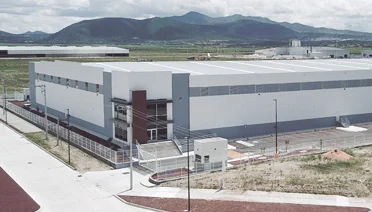
For US and Canadian companies, Mexico has emerged as the nearshoring destination of choice — offering USMCA zero-tariff treatment on qualifying goods, proximity that enables just-in-time delivery impossible from Asia, and rapidly expanding manufacturing capacity in the industrial corridors of Monterrey, Guadalajara, and Querétaro.
Automotive, electronics, aerospace, and consumer goods manufacturing are all expanding in Mexico. Ford has shifted toward Mexican suppliers to lower costs and avoid Chinese tariffs, absorbing savings of $500–$1,000 per vehicle on steel and aluminum. The USMCA agreement, which faces a July 2026 review that has kept business confidence cautious, nonetheless provides a structural advantage that other nearshoring destinations cannot match for North American supply chains.
40% of US companies were expected to relocate at least part of their supply chains to North America by 2026, according to a 2025 Deloitte study — a figure that, even if only partially realized, represents an enormous volume of investment and employment.
The Mediterranean: Egypt, Morocco, and the EU’s Nearshoring Corridor
European buyers have found their own nearshoring alternatives — closer to home and increasingly competitive. Egypt saw a 52% increase in inspection and audit demand from global buyers in 2025. Morocco rose 38%. Tunisia 18%. These countries offer proximity to European markets, improving infrastructure, and labor costs significantly below those in Western Europe or China.
Mediterranean nearshoring reached a record 14% of EU sourcing in 2025 — a number that will grow as investment flows continue and as European companies, facing their own energy cost pressures and supply chain disruption risks, pursue the same resilience logic as their American counterparts.
What China Is Doing in Response
China has not passively watched its manufacturing share erode. Its response has been sophisticated and, in several respects, strategically effective.
The most important response has been a trade pivot — redirecting export volumes away from the US toward other markets. In 2025, China’s exports to the US fell 20%, but exports to Africa rose 25.8%, Southeast Asia 13.4%, the EU 8.4%, and Latin America 7.4%. China is actively building trade relationships with the Global South that reduce its dependence on the US market in parallel with US efforts to reduce dependence on China.
Chinese companies have also led much of the foreign direct investment into the alternative manufacturing hubs. Rhodium Group’s analysis notes that “Chinese firms lead FDI in manufacturing in Southeast Asia and are growing their footprint in Mexico, CEE, and North Africa.” The factories in Vietnam, Thailand, and Mexico that are producing goods now labelled “Made in Vietnam” or “Made in Mexico” are frequently owned, managed, or supplied by Chinese companies. This complicates the “decoupling” narrative — China is not being excluded from supply chains. It is participating in them through different legal entities in different countries.
China is also doubling down on sectors where its dominance is near-absolute and difficult to challenge: solar panels (where Chinese market share continues to increase along most of the supply chain), rare earth processing (where no credible alternative has yet been built at scale), and battery technology (where China’s lead in lithium-ion battery manufacturing is measured in years, not months).
The Hidden Problem: Chinese Components Still Dominate Upstream
The most important thing to understand about the global supply chain shift away from China is what it is not.
It is not a vertical decoupling. The alternative manufacturing hubs — Vietnam, India, Mexico, Thailand — remain heavily dependent on Chinese components, raw materials, and capital equipment. A smartphone assembled in India may contain a screen from South Korea, a processor from Taiwan, but a battery, connectors, cables, housing components, and dozens of other parts from China. The final assembly has moved. The upstream supply chain has not.
Rhodium Group’s research confirms that “diversification from China almost always involves Chinese companies” — either as investors in the new facilities, as suppliers of components, or as providers of the machinery and tooling that the new factories use. The label “Made in Vietnam” may accurately describe where final assembly occurred while obscuring that 70% of the product’s value originated in China.
This creates a persistent vulnerability that tariff policies struggle to address. The Trump administration’s new Section 301 investigations into Vietnam, Taiwan, and Mexico are partly aimed at this transshipment problem — but enforcing origin rules across complex multi-country supply chains requires significant customs infrastructure and technical capability that neither the US nor most trading partners have fully developed.
For companies, the honest reality is that full decoupling from China is neither practical nor economical in most industries within any realistic timeframe. What is practical is reducing the most critical single points of failure — the categories where Chinese monopoly control creates national security or catastrophic operational risk — while maintaining Chinese supply relationships for commodities and components where alternatives do not yet exist.
The Iran War Wildcard: Supply Chain Resilience Put to the Test
The February 2026 Iran war provided the first serious test of the newly restructured supply chains that companies had spent 2024 and 2025 building — and the results were sobering.
Companies that had rerouted supply chains through the Middle East — building relationships with manufacturers in Egypt, Jordan, and the Gulf states as part of their diversification strategy — found those routes disrupted by the Strait of Hormuz closure. Maritime shipping times from China to Europe stretched from 30–40 days to 50+ days. Freight rates soared. Shanghai and Ningbo experienced significant port congestion due to route disruptions and labor shortages.
Bryan Zheng, CEO of Shenzhen cycling helmet maker Livall Tech, found himself relying on costly air freight to reach European customers after maritime delays made sea shipping uncompetitive. His company had diversified its manufacturing — but the logistics infrastructure supporting that diversification had been disrupted by a geopolitical event in a different region entirely.
The lesson is one that supply chain planners are absorbing in real time: diversification from China is necessary but not sufficient. Resilient supply chains require geographic diversification of manufacturing, diversification of transport routes, buffer inventory in regional hubs, and the ability to rapidly switch between logistics modes when primary routes are disrupted.
Key Facts: Global Supply Chain Shift, 2026
| US goods imports from China 2025 | $308.4 billion (down 29.7% from 2024; lowest since 2009) |
| North America top-3 supplier share | Fell from 61% to 54% in one year |
| Vietnam inspection demand growth 2025 | +30% year-on-year |
| Thailand inspection demand growth 2025 | +44% year-on-year |
| Egypt sourcing growth 2025 | +52% year-on-year |
| Morocco sourcing growth 2025 | +38% year-on-year |
| Mediterranean EU nearshoring share | Record 14% of EU sourcing |
| China exports to Africa 2025 | +25.8% year-on-year |
| China exports to SE Asia 2025 | +13.4% year-on-year |
| Apple investment in India | $1 billion+ since 2023 |
| iPhone production moved to India | ~25% of global production |
| US companies moving to North America | 40% expected to relocate part of supply chain (Deloitte) |
What This Means for Business Strategy
For companies navigating this environment, the strategic imperatives are clearer than they have ever been — even if executing them is difficult.
Build a tiered sourcing hierarchy, not a single alternative. The China+1 strategy is insufficient. Companies need China+2 or China+3 — primary, secondary, and tertiary suppliers across different geographies — so that any single disruption (tariffs, natural disaster, conflict, pandemic) triggers a managed transition rather than a supply crisis.
Invest in supply chain visibility. The companies that managed 2025’s tariff chaos best were those with real-time visibility into their supply chains two or three tiers deep. Knowing that your supplier in Vietnam depends on a single Chinese component manufacturer for a critical input — before that manufacturer becomes unavailable, not after — is the difference between a planned response and an emergency.
Distinguish between decoupling and de-risking. Complete decoupling from China is neither achievable nor desirable for most companies in most industries. What is achievable is reducing the number of critical single points of failure where Chinese monopoly control creates catastrophic risk. Prioritize those. Accept continued Chinese sourcing where alternatives are uncompetitive or unavailable.
Build inventory buffers for critical components. The just-in-time philosophy — designed for a stable, predictable supply environment — has been repeatedly exposed as a fragility in a world of tariff shocks, pandemics, and wars. For critical components with long lead times or concentrated supply, just-in-case buffer inventory is not a cost. It is insurance.
Where the Rewiring Goes
The supply chain restructuring of 2025–2026 is a structural shift, not a cycle. It will not reverse when tariffs change — because the drivers go beyond tariffs. National security concerns, COVID lessons, climate supply chain regulations, and the recognition that manufacturing concentration creates catastrophic single points of failure have all become permanently embedded in procurement strategy.
China will remain central to global manufacturing for the foreseeable future. Its cost base, infrastructure, supplier ecosystem, and manufacturing expertise are too large to be rapidly displaced. What is changing is its monopoly status — the assumption that China is the only viable source for entire categories of goods.
That assumption died somewhere between 2020 and 2026. What replaces it — a multipolar manufacturing world with more resilient, more regional, more redundant supply chains — will take decades to fully build. But the rewiring has started. The factories in Vietnam and India and Mexico are not theoretical. The orders are placed. The workers are hired. The containers are moving.
The question is whether the world can build the alternative supply chains fast enough to maintain the efficiency gains of globalization while reducing the fragility that concentrated dependence on any single country creates. Based on the speed of change between 2024 and 2026, the answer is cautiously optimistic — but the work is enormous, the timeline is long, and the shocks keep coming faster than the restructuring.
Sources: QIMA Q1 2026 Supply Chain Barometer, Carra Globe Supply Chain Diversification 2026, Rhodium Group (China and Future of Global Supply Chains), PIIE (Five Takeaways, March 2026), SupplyChainBrain, CNBC (China Exporters, May 2026), EDS International, C.H. Robinson, Deloitte Global Economic Outlook 2026
IMAGE GUIDE
Image 1 — Feature Image (top of article)
- Search: “Vietnam factory workers electronics manufacturing 2025 2026 supply chain”
- Alt text: “Workers in a Vietnamese electronics manufacturing facility — Vietnam has become the world’s primary beneficiary of supply chain diversification away from China, with inspection demand rising 30% year-on-year in 2025”
- Title: “Vietnam Electronics Manufacturing — Supply Chain Shift 2026”
- Caption: “Vietnam has absorbed approximately 80% of Chinese-owned company shipments to the US as manufacturers shift final assembly to avoid tariffs. Inspection demand from global buyers rose 30% year-on-year in 2025. (Photo: Reuters/AFP)”
Image 2 — Place after “the lesson was that diversification from China alone is insufficient” (Why Now section)
- Search: “Apple iPhone India manufacturing plant production 2025 2026”
- Alt text: “Apple iPhone manufacturing workers at an Indian facility — Apple has invested over $1 billion in Indian manufacturing and moved approximately 25% of global iPhone production to India and Vietnam”
- Title: “Apple iPhone Manufacturing India — Supply Chain Diversification 2026”
- Caption: “Apple has moved roughly 25% of global iPhone production to India, investing over $1 billion in local manufacturing facilities. The shift is driven by tariff costs, supply chain resilience, and access to India’s massive domestic market. (Photo: AFP/Getty)”
Image 3 — Place after “a figure that, even if only partially realized, represents an enormous volume of investment and employment” (Mexico section)
- Search: “Mexico manufacturing nearshoring factory industrial 2025 2026 Monterrey”
- Alt text: “A manufacturing facility in Mexico’s industrial corridor — nearshoring to Mexico has accelerated as USMCA zero-tariff treatment makes it the most cost-effective alternative to Chinese manufacturing for North American supply chains”
- Title: “Mexico Nearshoring Manufacturing — USMCA Supply Chain 2026”
- Caption: “Mexico’s industrial corridors in Monterrey, Guadalajara, and Querétaro are expanding rapidly as US companies nearshore production. Ford has shifted toward Mexican suppliers, saving $500–$1,000 per vehicle on steel and aluminum tariff costs. (Photo: Reuters)”
Image 4 — Place after “The lesson is one that supply chain planners are absorbing in real time” (Iran War section)
- Search: “port congestion Shanghai Ningbo container ships freight 2026”
- Alt text: “Container ships backed up at a major Chinese port amid Iran war-related supply chain disruption — the Strait of Hormuz closure stretched shipping times from 30 days to 50+ days and sent freight rates soaring”
- Title: “China Port Congestion — Iran War Supply Chain Disruption 2026”
- Caption: “The Iran war’s closure of the Strait of Hormuz stretched Asia-to-Europe shipping times to 50+ days and caused severe port congestion at Shanghai and Ningbo — demonstrating that supply chain resilience requires more than just geographic manufacturing diversification. (Photo: AFP/Getty)”
About the Author