Sudan's civil war has produced the world's largest displacement crisis, with over 12 million people forced from their homes.
While the world’s attention has been fixed on Ukraine, Gaza, and the US-Iran war, a catastrophe of comparable — and by some measures greater — scale has been unfolding in northeast Africa with minimal international intervention, inadequate funding, and almost no diplomatic momentum.
Sudan’s civil war, now in its fourth year, has produced the world’s largest displacement crisis, a famine worse than any other active conflict zone on earth, documented genocide in Darfur, and a de facto partition of Africa’s third-largest country between two military factions who both stand accused of war crimes. As of May 2026, more than 150,000 people are confirmed dead — with credible estimates suggesting the true toll may be several times higher — and over 28 million people face acute food insecurity.
More people are living in famine conditions in Sudan than in the rest of the world combined.
This is not a background crisis. It is one of the worst humanitarian disasters of the 21st century — and it is being ignored.
How Two Former Allies Tore a Country Apart
Sudan’s current war did not emerge from nowhere. It is the latest and most destructive chapter in a country that has endured 20 coup attempts, prolonged military rule, and two civil wars since independence in 1956.
The immediate origins of the 2023 conflict lie in a power struggle between two men who were, until April 15, 2023, ostensibly allies.
General Abdel Fattah al-Burhan commands the Sudanese Armed Forces (SAF) — the internationally recognized national military. General Mohamed Hamdan Dagalo, known universally as Hemedti, commands the Rapid Support Forces (RSF) — a powerful paramilitary force originally formed from the Janjaweed militias responsible for the Darfur genocide of the 2000s.
The two had jointly orchestrated Sudan’s October 2021 coup, which overthrew a civilian-led transitional government that had emerged from the 2019 popular uprising against longtime dictator Omar al-Bashir. After the coup, they were supposed to oversee a return to democratic governance. Instead, negotiations over the integration of the RSF into the national army — which would have effectively dissolved Hemedti’s independent power base — collapsed. By early April 2023, SAF troops were lining the streets of Khartoum, and RSF soldiers were deployed across the country.
On April 15, 2023, the shooting started.
The War’s Geography: A Country Functionally Split in Two
Three years on, Sudan is effectively partitioned.
The RSF controls most of Darfur in the west, large parts of Kordofan, and stretches of territory through the center and south. The SAF controls Khartoum — retaken from RSF occupation in March 2025 after nearly two years — the east, and much of the north. Central zones remain fluid battlegrounds where control changes week by week.
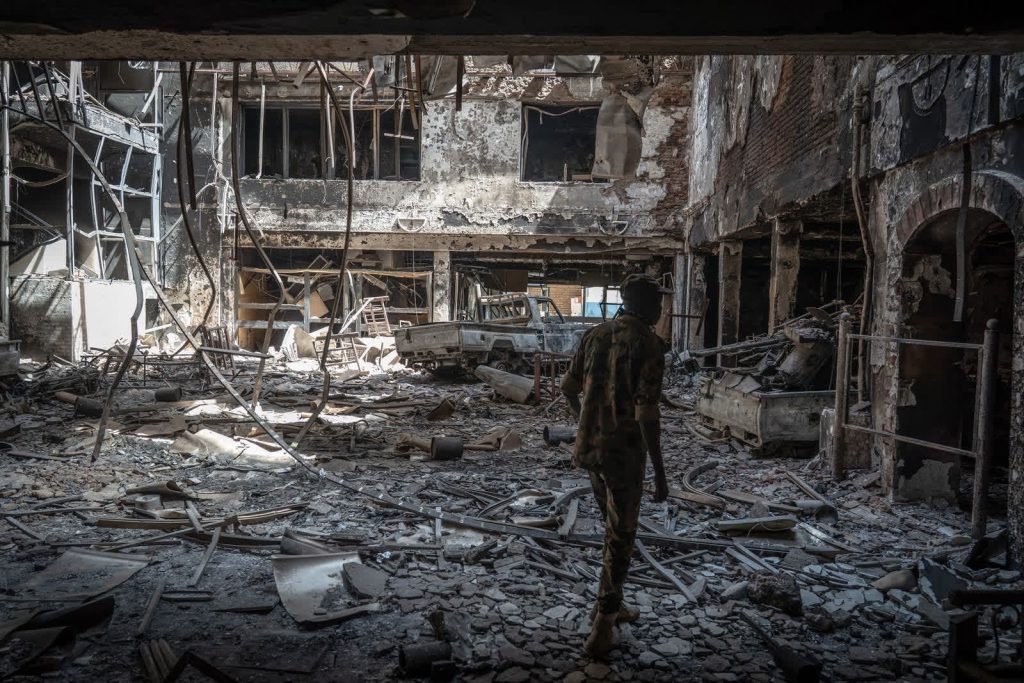
The SAF’s recapture of Khartoum was a symbolic and strategic milestone. Sudan’s military-led government, which had been operating from Port Sudan on the Red Sea coast for nearly three years, returned to the capital in January 2026. The Central Bank of Sudan reopened operations in Khartoum for the first time since the war began. But the city it returned to is a shell — mass displacement, systematic looting, the occupation of civilian homes, and the near-total collapse of basic services have left it devastated.
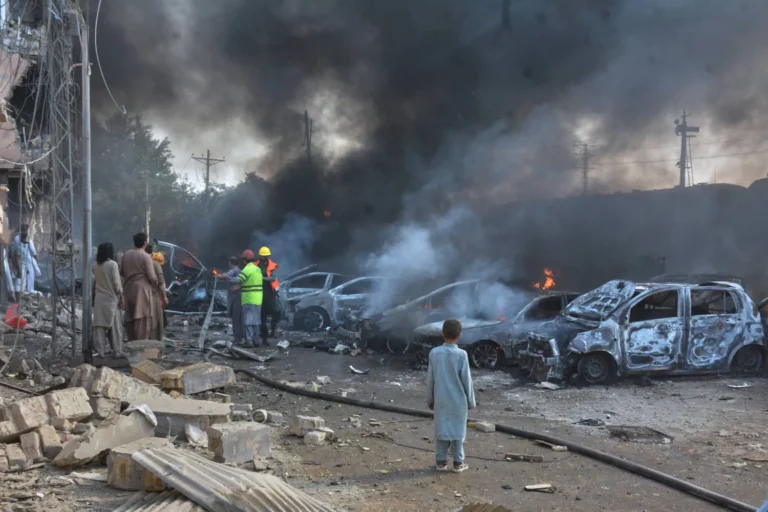
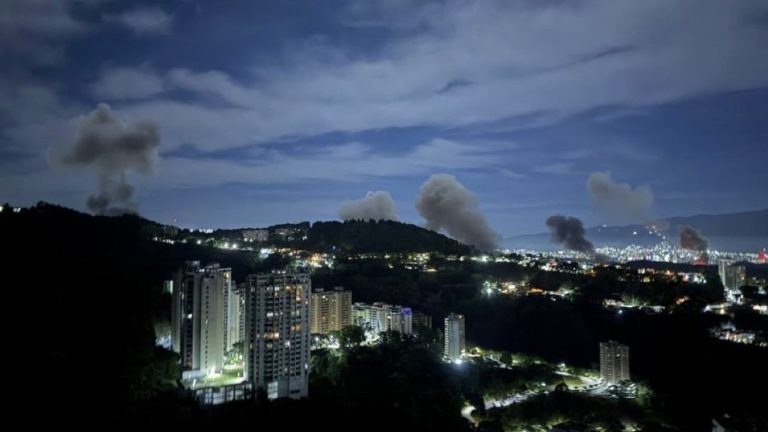
The Kordofan region has emerged as the current epicenter of the war. Almost daily drone strikes — launched by both sides — have struck markets, health facilities, residential areas, and supply convoys. In one RSF drone strike on El-Obeid, a power station was destroyed, leaving the city without electricity. In another, 13 people including 8 children were killed in a house strike. The SAF, for its part, has conducted airstrikes on RSF positions in Darfur that have killed over 100 civilians in single weeks.
This is a war in which both sides target civilians. Neither can claim clean hands.
Darfur: Genocide, Again
The most internationally recognized atrocity of Sudan’s war is what has happened — and continues to happen — in El Fasher, the last major SAF-held city in North Darfur, and across the broader Darfur region.
After a brutal RSF siege, El Fasher fell. A UN fact-finding mission has identified in the events that followed the “hallmarks of genocide.” With low estimates suggesting at least 30,000 civilians massacred in the city alone, and a pattern of ethnically targeted violence against the Fur, Zaghawa, and Masalit communities — the same communities targeted in the Darfur genocide of the 2000s — the RSF and its allied Arab militias have revived one of the defining atrocities of the early 21st century.
The RSF’s ideology in Darfur is not incidental. Many commanders hold explicit beliefs about Arab supremacy and the ethnic cleansing of Darfur’s African communities. The violence in El Fasher was not a byproduct of war — it was a feature of it.
Genocide Watch has formally classified the situation in Darfur at its highest alert levels. The international community’s response has been, by any honest assessment, inadequate.
The Humanitarian Numbers: Catastrophic at Every Scale
The statistics from Sudan are so large they have become difficult to process. Here is the reality, stripped of abstraction.
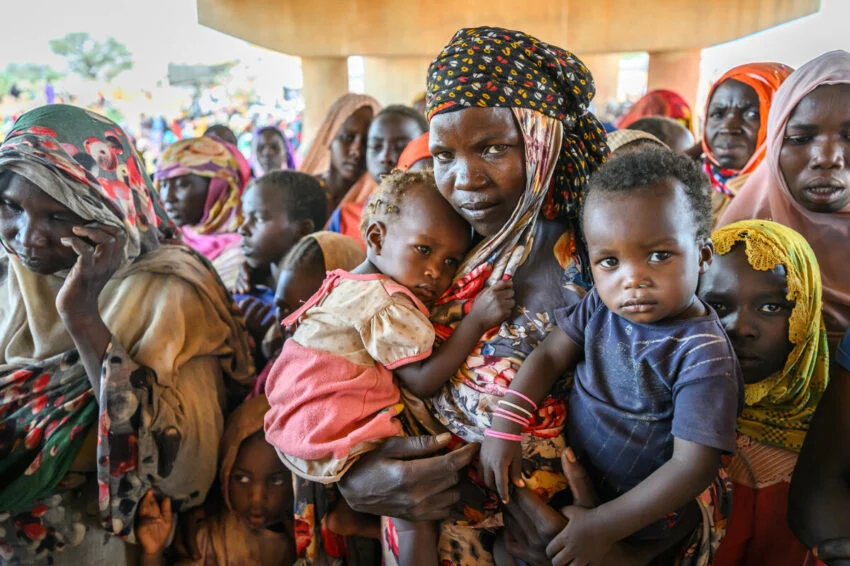
Over 28.9 million people — more than half of Sudan’s entire population — are acutely food insecure. Of those, more than 10 million face severe or extreme hunger. 4 million children are acutely malnourished; 770,000 are at imminent risk of death from starvation. Famine has been confirmed in El Fasher and Kadugli in South Kordofan.
Over 12 million people have been internally displaced. Another 3.5 million have fled across borders to Chad, Egypt, South Sudan, and Ethiopia — making this not only the world’s largest internal displacement crisis but one of the largest refugee crises as well.
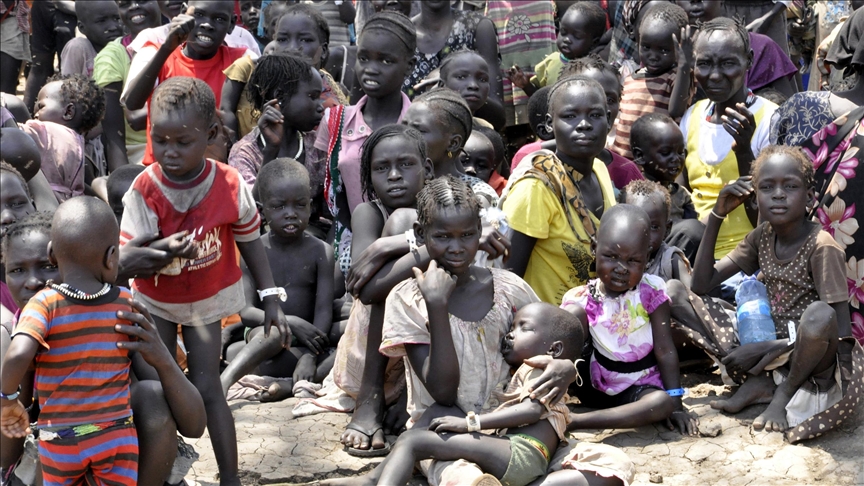
The majority of hospitals in active conflict zones are non-functional. Cholera and measles outbreaks are spreading through displacement camps. More than 20 million children are out of school. Higher education enrollment has dropped by 80%.
International humanitarian funding for Sudan in 2026 stands at just 40% of the amount requested by UN agencies. As a result, over 60% of Sudanese-run emergency food kitchens — many of them funded by USAID before cuts under the Trump administration — have shut down.
The IRC’s Sudan Country Director, Richard Data, said it plainly: “For three years, we have warned that Sudan was on the brink of catastrophe, and those warnings have gone unanswered.”
Who Is Fueling This War — and Why It Won’t End
Sudan’s civil war is not sustained only by internal forces. It is kept alive by a network of external backers with financial interests in its continuation.
The UAE is widely assessed as the RSF’s primary external sponsor — supplying weapons, financing, and political cover. The motivation is not ideological. Hemedti controls significant gold mining operations across Sudan. Gold flows out to Emirati intermediaries. Weapons flow back. The UAE also has ambitions for port development along Sudan’s Red Sea coast, for which RSF goodwill is useful.
Egypt backs the SAF, operating an airbase on its southern border with Sudan and conducting airstrikes on RSF convoys. Cairo views instability in Sudan as a direct national security threat, particularly regarding Nile water security and its own southern border.
Saudi Arabia is aligned with Egypt in backing the army. Turkey has expanded its footprint in Sudan, reportedly selling weapons to both sides in violation of EU and US sanctions. Russian Wagner remnants — now rebranded as Africa Corps — have supplied both factions through Central African Republic networks.
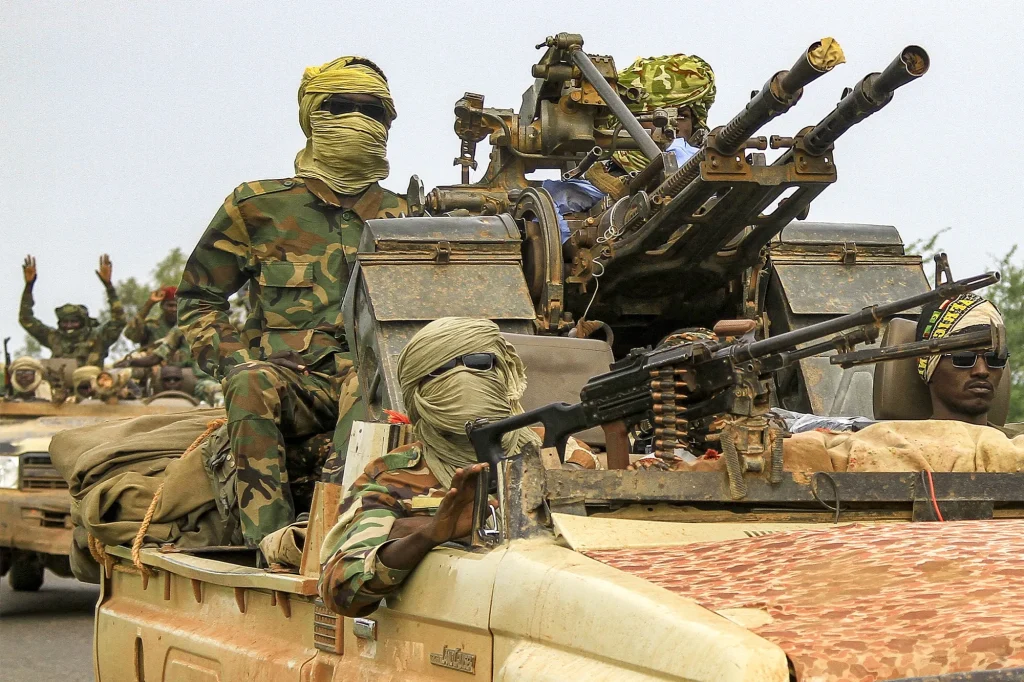
The IRC put it accurately: “Diplomacy is paralyzed as both SAF and RSF leaders have little incentive to do a deal since they and their regional backers continue to profit from Sudan’s war. Large quantities of gold flow out of the country, while increasingly advanced weapons move in the opposite direction.”
Peace has no constituency among those with power. That is why every ceasefire attempt — brokered by the US, the African Union, and Saudi Arabia at various points — has collapsed within hours or days.
The Drone War: A New and Deadly Dimension
One of the most striking military developments of Sudan’s civil war has been the emergence of drone warfare as a primary tool of combat — and civilian terror.
Both the SAF and RSF now deploy cheap unmanned aerial vehicles to strike markets, convoys, command meetings, and residential areas. In one drone strike on a market in Kartala, South Kordofan, five people were killed and 20 wounded. An RSF drone strike on an army base in Singa killed at least 27 people and wounded 73. SAF drones have struck RSF supply convoys carrying staple crops.
The drone war has turned urban areas into kill zones. It has also made the conflict’s geography more fluid and lethal — a relatively small force with UAV access can strike targets far beyond its physical frontlines. Sudan’s war is, among other things, a preview of how cheap drone technology is transforming conflict in under-resourced theaters.
Key Facts: Sudan’s Civil War, May 2026
| War began | April 15, 2023 |
| Warring parties | SAF (General Burhan) vs. RSF (General Hemedti) |
| Confirmed dead | 150,000+ (true toll estimated far higher) |
| Internally displaced | 12+ million |
| Refugees abroad | 3.5+ million |
| Acutely food insecure | 28.9 million (more than half the population) |
| Children acutely malnourished | 4 million; 770,000 at risk of death |
| Humanitarian funding (2026) | ~40% of UN appeal funded |
| Current frontline epicenter | Kordofan region |
| Khartoum status | SAF-retaken (March 2025); government returned Jan 2026 |
| Darfur status | Largely RSF-controlled; genocide documented |
What the World Is — and Isn’t — Doing
The United States pledged $200 million in humanitarian aid at a February 2026 gathering. The UAE committed $500 million. These are meaningful sums. They are also a fraction of what the crisis requires, and they do not address the underlying dynamics — external weapons flows, proxy backing, economic incentives — that keep the war going.
The UN Security Council remains divided. China, Russia, and Pakistan tend to defer to Sudan’s government and resist framing both sides as equally culpable. The US, UK, and France consider both the SAF and RSF responsible for atrocities and push for accountability mechanisms. That division has made effective Council action impossible.
The African Union has attempted mediation repeatedly. Regional bodies like IGAD have convened talks. All have failed to produce a durable ceasefire. Chad has closed its eastern border with Sudan after repeated cross-border incursions and a drone strike that killed 17 Chadians in the border town of Tina.
The EU has imposed sanctions on several individuals involved in fueling the conflict, including Hemedti’s brother. But sanctioning individuals at the margins of a war funded by sovereign states is a gesture, not a strategy.
Why This War Matters Beyond Sudan
Sudan is not an isolated crisis. It sits at a strategic crossroads — bordering Egypt, Libya, Chad, the Central African Republic, South Sudan, Ethiopia, and Eritrea. A failed Sudan is a destabilizing force across the entire northeastern quadrant of Africa.
The RSF’s gold revenues, routed through UAE intermediaries, finance a military machine that has now destabilized the broader Sahel through militia networks and arms flows. The displacement of 12 million people inside Sudan and 3.5 million across borders strains already fragile neighboring states. Disease outbreaks in Sudanese camps — cholera, measles — do not respect borders.
And the precedent being set matters. If the international community watches a genocide unfold in Darfur for the second time in 20 years, with the same UN declarations and the same inadequate response, it sends a clear signal about the limits of the international rules-based order.
Sudan is Africa’s most urgent crisis. It is also, in the hierarchy of global attention, one of its most neglected.
Sources: International Rescue Committee, UN Security Council Report, Wikipedia (Sudanese Civil War 2023–present), CFR Global Conflict Tracker, ACLED, OCHA, Operation Broken Silence, Foundation for Defense of Democracies, Genocide Watch, Britannica
About the Author