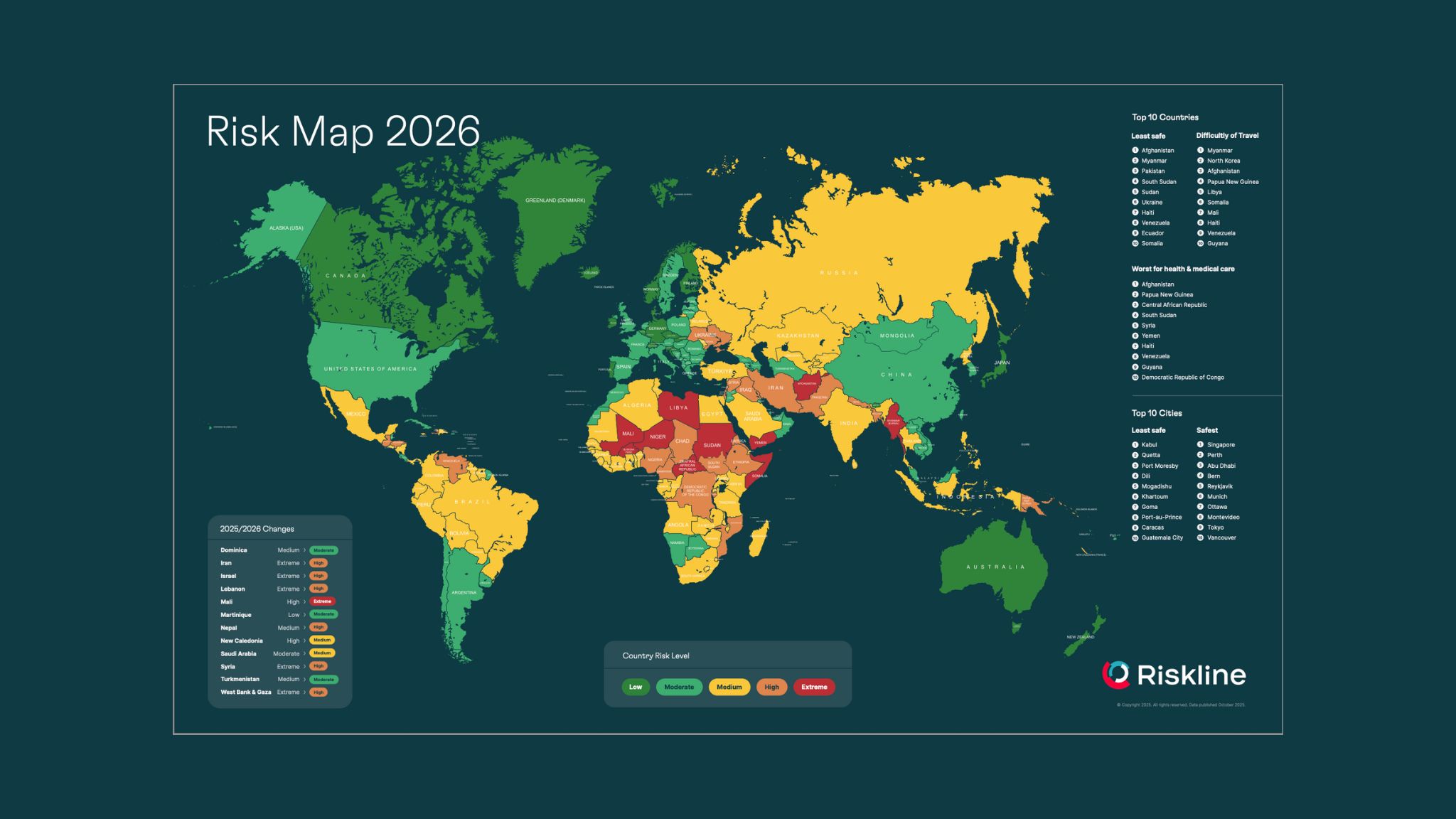
ACLED tracks 46 active armed conflicts in 2026 — a 59% increase since 2018. Combined with nuclear risk, terrorism, economic fragmentation, cyber warfare, and institutional erosion, the convergence of threats defines the most complex global security environment in four decades.
A comprehensive analytical assessment of the six domains shaping global security — military conflict, nuclear risk, terrorism, economic fragmentation, cyber and electronic warfare, and institutional erosion. Data sourced from the DNI 2026 Annual Threat Assessment (March 14, 2026), IMF World Economic Outlook (April 2026), ACLED Conflict Index, SIPRI Military Expenditure Database (April 2026), WEF Global Risks Report 2026, and primary conflict monitoring sources.
Executive Summary
The word Securitas chose for the 2026 global security landscape was “convergent.” It is apt. The threats facing the world in 2026 are not individually unprecedented — great power competition, jihadist terrorism, nuclear proliferation, economic fragmentation, cyber warfare, and institutional erosion have each appeared in previous years’ threat assessments. What is qualitatively new is the degree to which they are occurring simultaneously, reinforcing each other, compressing decision timelines, and leaving governments with fewer viable options across every domain at once.
This report documents that convergence through six analytical domains, each grounded in quantitative data. The statistical charts embedded in the digital version of this report provide visual anchors for the core trends; the analytical sections interpret what those trends mean and where they are heading.
The core finding is this: the world is not on the edge of a Third World War. It is, however, in a period of structural transition from a US-dominated unipolar order to a contested multipolar system, and that transition is occurring faster than the international institutions designed to manage it can adapt. That gap — between the pace of structural change and the pace of institutional response — is where the most serious risks reside.
Domain 1: Military Conflict — The Highest Concentration of Major Wars Since the Cold War
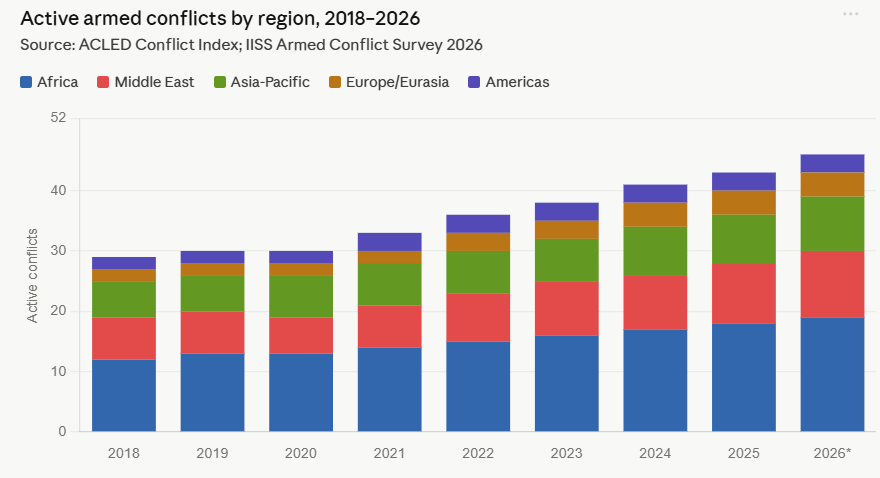
The chart above tells a clear story. Active armed conflicts tracked by ACLED have risen from approximately 29 in 2018 to 46 in 2026 — a 59% increase in eight years. Africa accounts for the plurality, with 19 active conflicts, but every region has seen an upward trend. This is not primarily a statistical artifact of improved monitoring; it reflects a genuine increase in the number and severity of organized armed violence globally.
The major conflicts of 2025–2026 illustrate what “46 active conflicts” actually means on the ground.
Europe: Russia’s war in Ukraine has killed an estimated 350,000+ combatants since February 2022 — making it the deadliest conflict in Europe since World War II. A US-brokered three-day ceasefire in May 2026 failed within hours of its announcement. Peace negotiations remain structurally deadlocked on territorial control, security guarantees, and NATO membership. The conflict has fundamentally reshaped European security architecture, triggering the largest rearmament of the continent since the Cold War.
Middle East: Two rounds of US-Israeli strikes against Iran — in June 2025 (Operation Rising Lion/Midnight Hammer) and February 2026 (Operation Epic Fury) — killed Iran’s Supreme Leader, significantly damaged nuclear infrastructure, and triggered closure of the Strait of Hormuz, through which 20% of global oil supply moves. A Pakistan-brokered ceasefire holds fragilly as of May 2026. Gaza remains under daily Israeli military action more than seven months after a ceasefire agreement was signed, with total Palestinian deaths since October 2023 exceeding 75,800.
South Asia: India and Pakistan fought the worst military confrontation in 50 years in May 2025 — the first drone battle between nuclear-armed states. Pakistan’s air force downed four Indian jets including a Rafale. Pakistan struck 26 Indian air bases in a single campaign. A US-facilitated ceasefire ended the immediate exchange. Kashmir, the Indus Waters Treaty, and the underlying nuclear rivalry remain entirely unresolved.
Africa: Sudan’s civil war — the largest displacement crisis on earth — has killed 150,000+ confirmed and left 28.9 million acutely food insecure. More people face famine conditions in Sudan than in the rest of the world combined. Eastern Congo’s M23 conflict saw Goma and Bukavu fall to Rwanda-backed rebel forces. Jihadists attacked Bamako itself in April 2026. The Sahel insurgency involving JNIM and ISGS continues its geographic expansion.
Americas: The US capture of Venezuelan President Maduro on January 3, 2026 — the first military assault on a South American capital since Panama 1989 — has destabilized the region’s security architecture and triggered the formal operationalization of the “Trump Corollary” to the Monroe Doctrine.
The US Intelligence Community’s 2026 Annual Threat Assessment states plainly: “Strategic competition and regional and smaller powers becoming more willing to use force to pursue their interests heightens the risk of conflict.” The data above validates that assessment. The trajectory is toward more conflict, not less.
Domain 2: Nuclear Risk — The Most Dangerous Threshold Since the 1980s
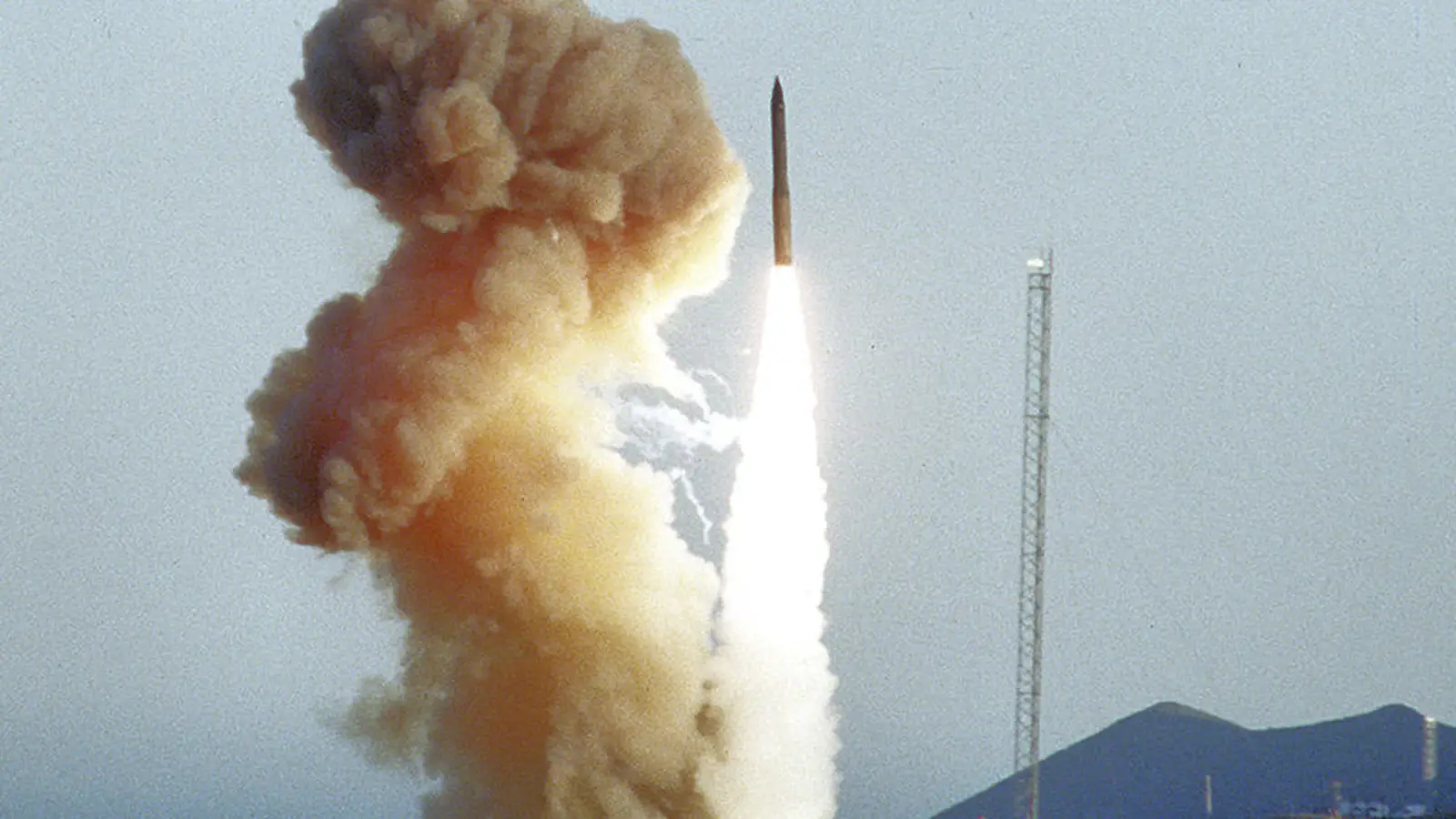
The nuclear risk environment of 2026 is the most dangerous in four decades, driven by four simultaneous trends: more nuclear actors and expanding arsenals; a collapsed arms control architecture; closer proximity to nuclear thresholds in actual ongoing conflicts; and the emergence of a genuine three-way nuclear competition for the first time in history.
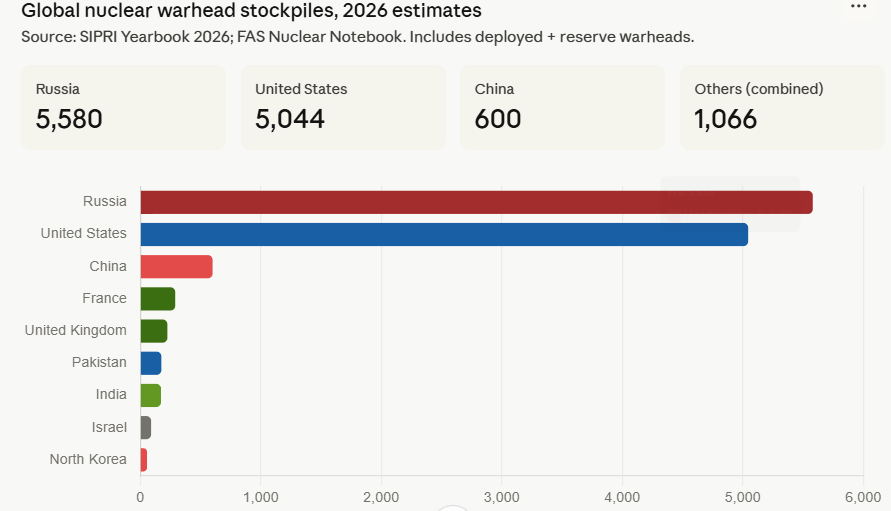
Arsenal expansion and diversification. As the chart shows, Russia maintains the world’s largest arsenal at approximately 5,580 warheads, followed by the United States at 5,044. What is analytically significant is the directional trend: Russia and the US are modernizing rather than reducing, China is expanding rapidly, and North Korea continues developing both warheads and delivery systems. The Pentagon’s latest assessment projects China moving toward 1,500 warheads by 2035 — a threefold increase from current estimated levels — with a full nuclear triad of land, sea, and air delivery systems under development. North Korea is assessed at 50–60 operational warheads with ICBMs capable, if current trajectories continue, of threatening the continental United States.
The collapse of arms control architecture. The New START treaty — the last major US-Russia nuclear arms control agreement, limiting deployed strategic warheads to 1,550 per side — expired in February 2026. Russia had suspended participation months before expiry. There is no successor agreement, no active negotiation for one, and no diplomatic channel through which such a negotiation could plausibly begin given the current state of US-Russia relations. The Intermediate-Range Nuclear Forces Treaty was abrogated in 2019. The Open Skies Treaty is defunct. The nuclear verification and transparency architecture that managed superpower competition for 50 years has been effectively dismantled over the past decade.
Proximity to thresholds in active conflict. The most alarming development is not what nuclear powers have said but what they have done. India’s strikes on Nur Khan air base in Rawalpindi during the May 2025 confrontation brought kinetic action within kilometers of Pakistan’s nuclear command authority. Russia’s nuclear threats throughout the Ukraine war have been the most explicit by a nuclear-armed state since the Cold War. The February 2026 strikes on Iran — which the US framed as targeting nuclear infrastructure — struck a country assessed to be within 12 months of weapons-grade enrichment capability, raising questions about the relationship between conventional and nuclear thresholds that have no established precedent in post-Cold War crisis management.
The Belfer Center’s assessment — that “nuclear deterrence does not guarantee strategic stability when both sides are simultaneously experimenting with drones, precision missiles, and cyber capabilities that compress decision-making time” — is validated by both the India-Pakistan confrontation and the Iran strikes. Both pushed into territory previously considered off-limits. Neither triggered a nuclear exchange. The margins were, by credible assessments, narrower than post-event official statements acknowledged.
Domain 3: Terrorism — Decentralized, Technology-Enhanced, and Geographically Expanding
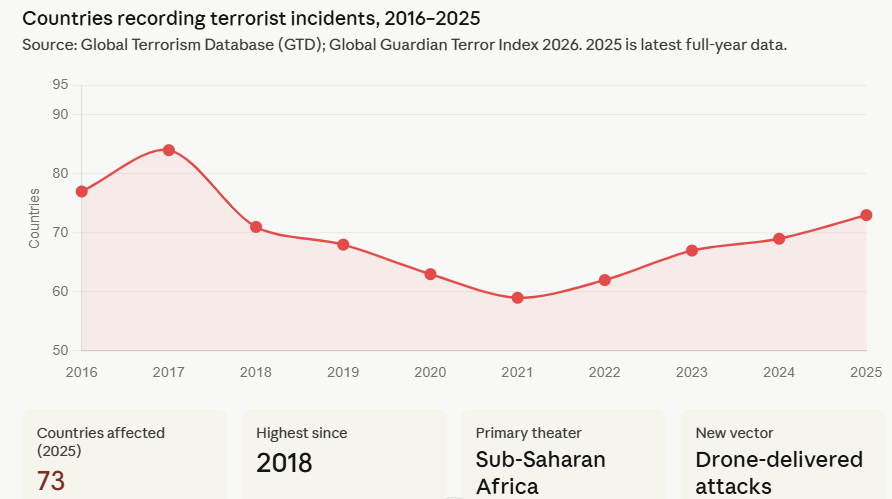
The chart documents a clear and concerning trend: after dipping to 59 countries in 2021, the geographic spread of terrorism rose to 73 countries in 2025 — the highest since 2018 and the highest number of civilian-target attacks in the post-2018 period. This is not the same phenomenon as the post-9/11 terrorism landscape. The structure, geography, and technology of terrorist violence have all changed significantly.
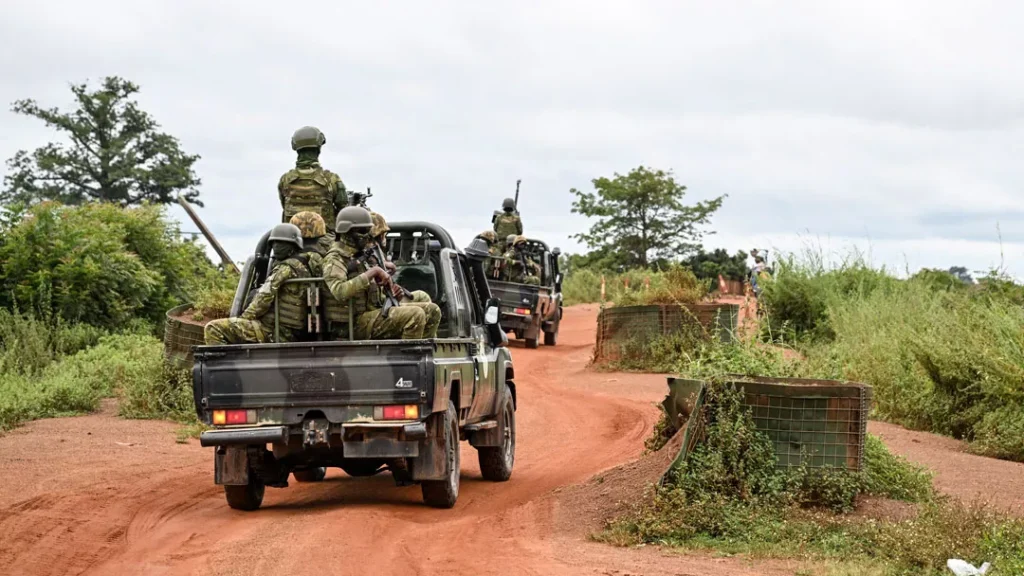
Geographic shift to Africa. The continent has become the primary theater for the global Sunni jihadist movement. JNIM (Jama’at Nusrat al-Islam wal-Muslimin) and ISGS (Islamic State Greater Sahara) together control territory across Mali, Burkina Faso, and Niger that exceeds the combined area of the UK and France. Al-Shabaab remains entrenched in Somalia and expanding into Kenya and Ethiopia. Boko Haram remnants operate across the Lake Chad basin. ISIS-Mozambique is expanding in southern Africa. The total territory, financing, and personnel of jihadist organizations in Africa now substantially exceeds what existed in the Middle East at the peak of ISIS in 2014.
Technology adoption. The integration of drone technology into terrorist operational capability is the most significant new threat vector of 2025–2026. In the Sahel, jihadist groups are using commercially available and modified drones to strike markets, military convoys, and power infrastructure at ranges previously requiring state military capabilities. The Global Guardian 2026 Threat Assessment notes that “new tactics such as drone strikes, coupled with online radicalization, are making it easier for individuals and small groups to carry out deadly operations.” The technology barrier to mass-casualty attacks has fallen significantly.
AI-enabled radicalization. Large language models capable of generating personalized propaganda content at scale, deepfake videos of leaders, and algorithmically targeted recruitment messaging have expanded the pipeline for extremist radicalization in ways that human intelligence services cannot track at the speed of production. The Janes 2026 Global Security Assessment notes that “the widespread use of Large Language Models will provide almost instant points of reference thereby compressing decision-making timelines” for extremist actors as much as for state military planners.
Counter-terrorism capacity diluted. Global intelligence services facing great power competition — China, Russia, Iran — have diverted resources from counter-terrorism to state-on-state threat monitoring. The DNI 2026 ATA explicitly acknowledges that ISIS in Syria “is likely seeking to rebuild its ranks, expand support networks and solicit funds” following the collapse of the Assad government, while at the same time noting that the intelligence community’s primary focus has shifted toward state actors. The combination of expanding jihadist ambition and diluted counter-terrorism attention is the most concerning near-term terrorism dynamic.
Domain 4: Economic Security — Fragmentation as a Structural Condition, Not a Cycle
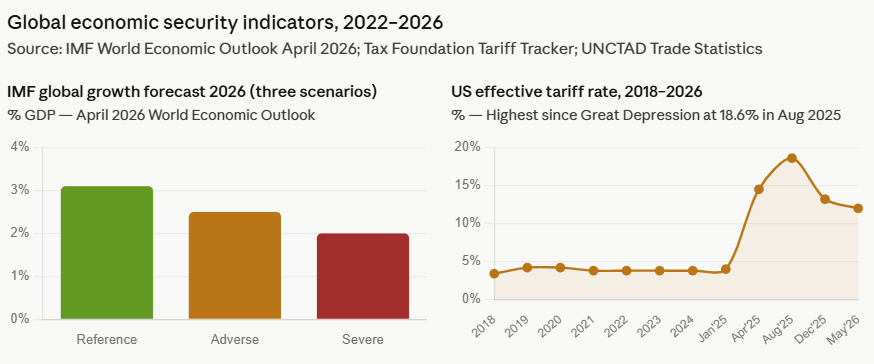
The charts in this section document three interlocking economic security trends: a growth outlook significantly degraded by the Iran war energy shock; a trade policy environment that has fundamentally restructured global commerce; and a China export pivot that is reshaping trade flows at a scale not seen since China’s accession to the WTO in 2001.
The Iran war energy shock and IMF scenarios. The IMF’s April 2026 World Economic Outlook — titled “Global Economy in the Shadow of War” — presents three growth scenarios. The reference scenario assumes a short-lived conflict and moderate energy price increases, projecting global growth at 3.1%. The adverse scenario assumes further disruption, projecting growth at 2.5%. The severe scenario — extended energy supply dislocation through 2027 — projects growth at 2.0% for both 2026 and 2027, with inflation exceeding 6%. As of May 2026, the ceasefire is fragile and the Strait of Hormuz remains effectively closed to full commercial traffic. The risk of the adverse scenario materializing is not negligible.
The tariff revolution. The US effective tariff rate chart tells a striking story. From a baseline of 3.4% in 2018, rates rose gradually through Trump’s first term, stabilized during the Biden administration, and then exploded to a peak of 18.6% in August 2025 — the highest level since the Great Depression — before partially receding following the May 2025 US-China truce and the February 2026 Supreme Court ruling striking down IEEPA-based tariffs as unconstitutional. The Tax Foundation estimates these tariffs cost American households approximately $1,500 per year in increased prices. They have fundamentally altered the economics of global supply chains — driving the supply chain diversification away from China that is documented in the China export pivot chart.
China’s trade pivot. The bottom chart documents one of the most significant restructurings of global trade flows since World War II. China’s exports to the United States fell 20% in 2025 as tariffs bit. But China did not simply absorb that loss. It redirected with remarkable speed: exports to Africa rose 25.8%, to Southeast Asia 13.4%, to the EU 8.4%, and to Latin America 7.4%. Combined with China’s Third Policy Paper on Latin America (released January 2026) and its continued Belt and Road expansion, this represents a deliberate strategic expansion of Chinese commercial relationships precisely as the US attempts to reduce them. The WEF Global Risks Report 2026 ranked “geoeconomic confrontation” as the top near-term global risk — the first time a geo-economic variable has displaced environmental concerns at the top of the ranking.
The debt vulnerability. Running beneath these cyclical dynamics is a structural vulnerability receiving less analytical attention than it deserves. Public debt levels across advanced and emerging economies are at historic highs following COVID-19 spending. The transition from near-zero to significantly positive interest rates has dramatically increased debt servicing costs. The fiscal space available to absorb the Iran war energy shock is smaller than it was when the Ukraine war oil shock hit in 2022. Each successive shock arrives with a reduced buffer.
Domain 5: Cyber and Electronic Warfare — The Opening Move in Every Modern Conflict
Key statistics: Cyber and electromagnetic threat landscape, 2026
| Indicator | Data | Source |
|---|---|---|
| GPS jamming incidents (Poland, Jan 2025) | 2,732 in one month | Polish Civil Aviation Authority |
| Ships affected by GPS/AIS disruption (Iran war Day 1) | 1,100+ in Gulf region | ACCINTEL/maritime tracking |
| Iranian hacktivist groups activated (Feb 28, 2026) | 60+ within hours | CloudSEK threat report |
| US industrial control systems publicly exposed | 40,000+ | Forescout/Shodan |
| CISA budget anticipated reduction | $707 million | CBO appropriations analysis |
| Ukraine drone accuracy under heavy jamming | Below 10% | Ukrainian General Staff |
| Targets struck in Operation Epic Fury (Day 1) | 1,000+ (AI-assisted) | CENTCOM |
| AI-assisted targeting rate (peak, Iran war) | 5,000 targets/day | Defense One reporting |
| Projected future AI targeting rate | 1,000 targets/hour | Pentagon planning documents |
The Iran war of 2026 provided the largest real-world demonstration of AI-integrated military targeting in history, and established electronic and cyber warfare as the unambiguous opening phase of modern state-on-state conflict — not a supporting capability but the first operational move.
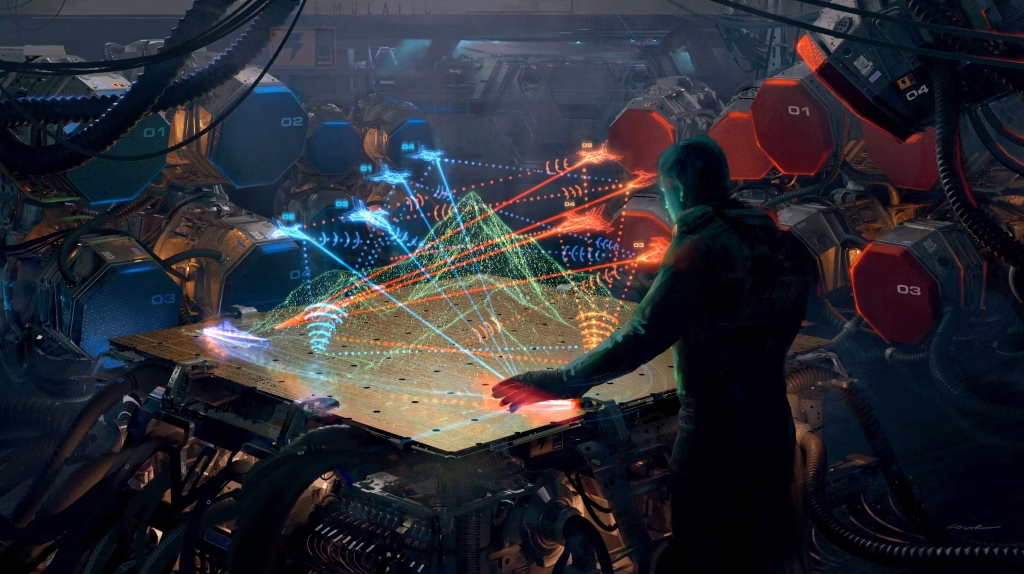
US Space Force and cyber forces were explicitly described by Pentagon leaders as “first movers” in the February 28, 2026 strikes — creating electromagnetic corridors, blinding Iranian radar networks, and disrupting command-and-control infrastructure before a single conventional weapon was released. The AI-assisted Maven targeting system processed over 1,000 targets on the operation’s first day, compressing a process that previously required hours of human intelligence analyst time into seconds of machine-generated targeting packages. That rate reached 5,000 targets per day at the conflict’s peak. The Pentagon’s stated future trajectory is 1,000 targets per hour — a tempo at which meaningful human authorization of individual strikes becomes structurally impossible.
Iran’s cyber retaliation was the most extensive mobilization of state-linked hacktivist activity ever documented in a single conflict event. Within hours of the February 28 strikes, over 60 Iranian-aligned groups activated on Telegram under a coordinated “Electronic Operations Room” — targeting US industrial control systems, Israeli infrastructure, Western corporations, and cloud computing infrastructure. CISA’s formal advisory of April 7, 2026 confirmed that Iranian-affiliated actors had disrupted Programmable Logic Controllers across US energy, water, and government infrastructure sectors. Stryker Corporation — a US medical devices manufacturer with no direct connection to the conflict — had thousands of computers wiped by Iranian hackers.
The GPS warfare dimension affects every military and civilian system that relies on satellite positioning. Polish authorities recorded 2,732 GPS jamming incidents in January 2025 alone. Russian jamming has been documented continuously across Ukraine, the Baltic region, and Finland since 2022. In December 2024, GPS spoofing near Chechnya contributed to an Azerbaijan Airlines crash killing 38 people — a demonstration that electronic warfare casualties extend beyond active combat zones. Ukraine’s response — developing AI-powered visual navigation systems that allow drones to navigate without GPS — represents the leading edge of a technology race in which the defense lags the offense by years.
The governance gap in this domain is as alarming as the capabilities themselves. No binding international legal framework governs AI-assisted targeting, autonomous weapons engagement rules, or cyber attacks on civilian critical infrastructure. The UN Convention on Certain Conventional Weapons Review Conference was scheduled to examine AI in warfare in November 2026, with over 120 countries supporting negotiation of new legal instruments. The United States is not among the strongest advocates for a binding framework.
Domain 6: Institutional Erosion — The Rules-Based Order Under Maximum Strain
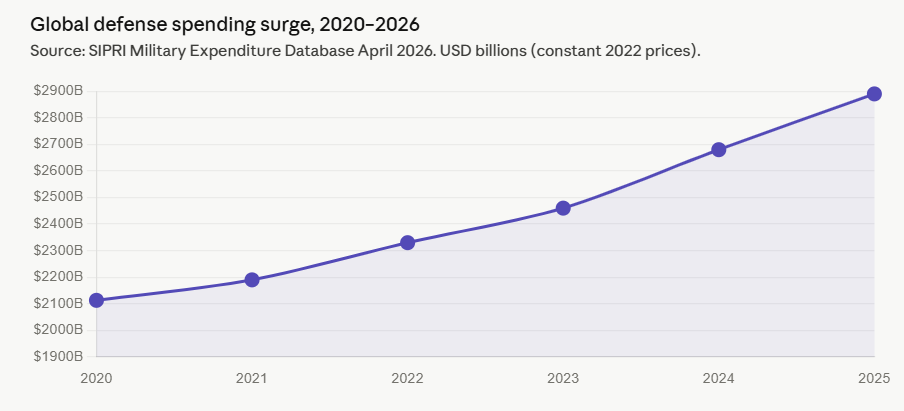
The defense spending chart in this section documents something important: as institutions weaken, military spending rises. The relationship is not coincidental. When states cannot rely on multilateral frameworks to manage disputes and guarantee security, they invest in unilateral military capacity. The $2.89 trillion in global military spending in 2025 — an all-time record — is partly a consequence of institutional failure, not just a cause of geopolitical tension.
The institutional erosion scorecard captures the operational status of the key multilateral frameworks that were supposed to provide the rules-based architecture of post-1945 international relations. The assessment is sobering:
WTO Appellate Body: Effectively non-functional since 2019, when the United States blocked appointments to its final remaining panel member. Without a functioning appellate body, WTO dispute rulings cannot be enforced against major economies that choose to ignore them. The system designed to manage exactly the kind of tariff conflicts currently reshaping global trade has been paralyzed at the precise moment of maximum need.
New START: Expired February 2026 with no successor in negotiation. The last major US-Russia nuclear arms control treaty is gone. No verification regime, no warhead limits, no inspection protocols. The nuclear competition between the world’s two largest arsenals is now entirely unregulated.
UN Security Council: Gridlocked on every major conflict — Sudan (China/Russia veto), Myanmar (China veto), Gaza (US veto), Congo (competing interests). The veto mechanism that was designed to prevent the Security Council from being used against great power interests has been used by every permanent member to protect client states and block accountability.
NATO cohesion: Under its most acute strain since the alliance’s founding. Trump’s explicit statements questioning Article 5 reliability, the withdrawal of 5,000 US troops from Germany, tariffs on NATO allies for exercising in Greenland, and the “absolutely considering withdrawal” statement of April 2026 have introduced genuine uncertainty about US alliance commitments for the first time in NATO’s 75-year history.
Outer Space Treaty (1967): Completely unprepared for the realities of 2026. Prohibits weapons of mass destruction in orbit but says nothing about conventional interceptors, co-orbital attack satellites, directed energy weapons, anti-satellite missiles, or the militarization of commercial constellations. Golden Dome’s planned 7,800 space-based interceptor satellites exist in a legal vacuum.
The most revealing single data point on institutional erosion: in January 2026, the White House announced US withdrawal from 66 international organizations and agreements, including 31 UN agencies and 35 other multilateral structures. The United States is simultaneously the architect of the post-1945 multilateral order and the most aggressive dismantler of it.
The Hungarian Institute of International Affairs frames the central paradox precisely: “How multipolar can a world order be considered when a single superpower maintains more than 125 military bases in some 50 countries around the world and is capable of extracting the leader of the country with the world’s largest oil reserves in a matter of hours?” The US simultaneously withdraws from multilateral institutions and demonstrates unprecedented unilateral military capacity. American power has not declined. The normative framework that constrained and legitimized its use has.
Synthesis: Six Domains, One Trajectory
The six domains analyzed in this report are not independent phenomena. They are mutually reinforcing components of a single structural transition: the breakdown of the post-Cold War unipolar order and the contested emergence of what comes after it.
Military conflict and nuclear risk are interconnected: more conflicts mean more opportunities for nuclear-armed states to test escalation thresholds, as India and Pakistan did in May 2025. Terrorism and cyber warfare are interconnected: jihadist groups adopting drone technology are exploiting the same capability proliferation that state actors use for electronic warfare. Economic fragmentation and institutional erosion are interconnected: as the WTO fails, states use tariffs as geopolitical weapons; as institutions weaken, the economic coercion that those institutions were designed to prevent becomes normalized.
The convergence that Securitas identified is better understood as a feedback loop. Institutional weakness enables geopolitical aggression. Geopolitical aggression drives military competition. Military competition drains resources from development and governance. Poor governance creates the conditions for terrorism and internal conflict. Internal conflict weakens states, reducing their capacity to maintain institutional commitments. The cycle continues.
Three developments in 2026 stand out as potentially significant inflection points:
The AI targeting threshold. Operation Epic Fury demonstrated AI-assisted targeting at a scale and speed that makes meaningful human authorization structurally impossible at operational tempo. This is not a future concern. It is a present operational reality being contested in US courts, debated at the UN, and being adopted at scale by multiple military powers simultaneously. How the international community resolves the question of accountability in AI-assisted killing will shape the legal and ethical framework of warfare for generations.
The arms control vacuum. The expiry of New START without a successor creates a nuclear environment more unregulated than any period since the early Cold War. With US-Russia relations at historic lows and China expanding its arsenal rapidly, the absence of any verification or transparency framework increases the risk of miscalculation and misread signals in ways that are genuinely difficult to model.
The institutional rebuilding challenge. The multilateral institutions under greatest strain — the WTO, the UN Security Council, arms control frameworks — were designed in a specific historical moment for a specific geopolitical configuration. That configuration no longer exists. The question is not whether these institutions can be restored to their previous function. They cannot. The question is whether new frameworks — bilateral, regional, or multilateral in different configurations — can emerge quickly enough to manage the transition period before the absence of rules produces a catastrophe that imposes its own brutal resolution.
The world of 2026 has survived the convergence of these domains without a systemic collapse. That resilience should not be mistaken for stability. It reflects the continued power of nuclear deterrence, the economic interdependence that makes large-scale state conflict extremely costly, and the capacity of governments and militaries to manage crises below the threshold of catastrophic escalation. Those buffers remain. But they are being tested more frequently, at shorter intervals, with higher stakes and with less robust institutional backup than at any previous point in the post-Cold War era.
That is the state of the world in 2026.
Summary Statistics Table
| Domain | Key Metric | 2020 Value | 2026 Value | Trend |
|---|---|---|---|---|
| Military conflict | Active armed conflicts (ACLED) | 33 | 46 | ↑ +39% |
| Nuclear risk | Countries with nuclear weapons | 9 | 9 | → Stable (but arsenals growing) |
| Nuclear risk | Active arms control treaties (US-Russia) | 2 | 0 | ↓ −100% |
| Terrorism | Countries with terrorist incidents | 63 | 73* | ↑ +16% |
| Economic security | Global military spending ($B) | $2,113B | $2,890B | ↑ +37% |
| Economic security | US effective tariff rate | 3.8% | ~12% | ↑ +216% |
| Economic security | IMF global growth forecast | 5.4% (2021) | 3.1% | ↓ |
| Cyber/EW | GPS jamming incidents (Poland/month) | N/A | 2,732 | New threat |
| AI targeting | Targets processable/day (Maven) | <100 | 5,000 | ↑ 50x |
| Institutional | US multilateral withdrawals | Ongoing | +66 orgs (Jan 2026) | ↓ Accelerating |
*2025 full-year data; 2026 projected higher
Sources: DNI 2026 Annual Threat Assessment (March 14, 2026); IMF World Economic Outlook April 2026 (“Global Economy in the Shadow of War”); SIPRI Military Expenditure Database April 2026; ACLED Conflict Index 2026; WEF Global Risks Report 2026 (21st Edition); Securitas Annual Intelligence Estimate 2026; Global Guardian 2026 Worldwide Threat Assessment; Crisis24 Global Risk Forecast 2026; Janes Global Security Threats 2026; CISA Advisory AA26-097A (April 7, 2026); Eurasia Group Top Risks 2026; Belfer Center Nuclear Security Program; HIIA (Future of US Global Power, March 2026); Countercurrents (Iran Conflict and Multipolar Order, May 2026); Tax Foundation Tariff Tracker; CloudSEK Iran Cyber Threat Report.
About the Author
