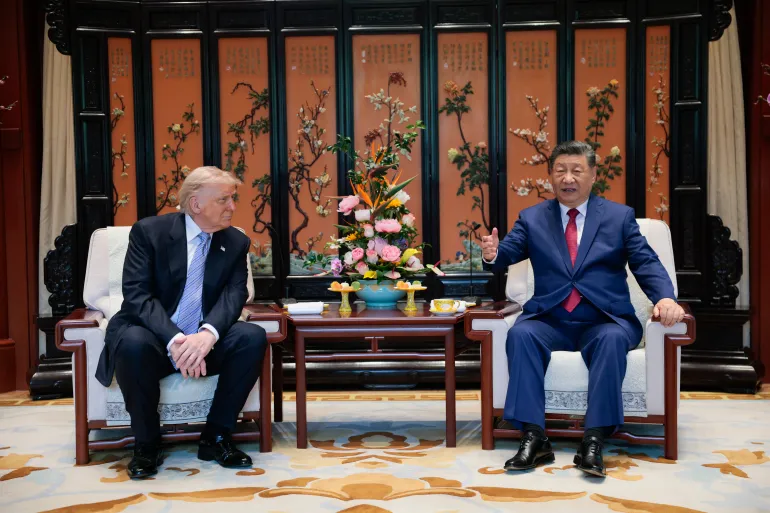
Trump and Xi met in Beijing on May 13–14, 2026, discussing trade de-escalation, rare earths, Taiwan, and the Iran war. It was their first summit since 2017 — convened in the shadow of a trade war that has restructured global supply chains
On May 13, 2026, Donald Trump landed in Beijing for the first face-to-face meeting with Xi Jinping since his first term in office back in 2017. The meeting was two months delayed — originally planned for March, it was pushed back after the US and Israel launched strikes on Iran in late February. The agenda was heavy: trade de-escalation, a proposed bilateral “Board of Trade,” Taiwan, the Iran war, AI governance, and the future of rare earth exports.
Experts went in with low expectations. They were probably right to.
The US-China trade relationship that greeted these two leaders is one of the most tortured in modern economic history — a nine-year spiral of tariffs, retaliations, court rulings, truces, and escalations that has restructured global supply chains, cost American consumers thousands of dollars per household, and left both economies simultaneously dependent on and hostile toward each other. Understanding where it stands in May 2026 requires going back to where it began — and tracing the extraordinary sequence of events that brought it here.
How It Got Here: From Liberation Day to the Supreme Court
Trump’s second trade war began within days of his return to the White House in January 2025. By April 2, 2025 — a date his administration branded “Liberation Day” — he had declared a national economic emergency and imposed sweeping tariffs on over 90 countries, pushing the average effective US tariff rate to 18.6%, the highest level since the Great Depression.
China was the primary target. The sequence of escalations that followed in April 2025 was almost comically rapid. Trump announced 34% tariffs on all Chinese imports. China retaliated with matching 34% tariffs on all US exports. Trump raised to 104%. China raised to 84%. Trump raised to 145%. China raised to 125%. Within two weeks, two of the world’s largest economies had effectively declared a near-total trade embargo on each other.
The economic consequences were immediate and severe. US imports from China in June 2025 fell to their lowest level since the 2009 financial crisis — roughly half the year-earlier volume. China weaponized two critical inputs: rare earth permanent magnets and certain semiconductors, both of which flow into the US automotive supply chain. Xi twice came close to bringing the US automobile industry to a standstill by cutting off access to components for which there are no readily available American substitutes.
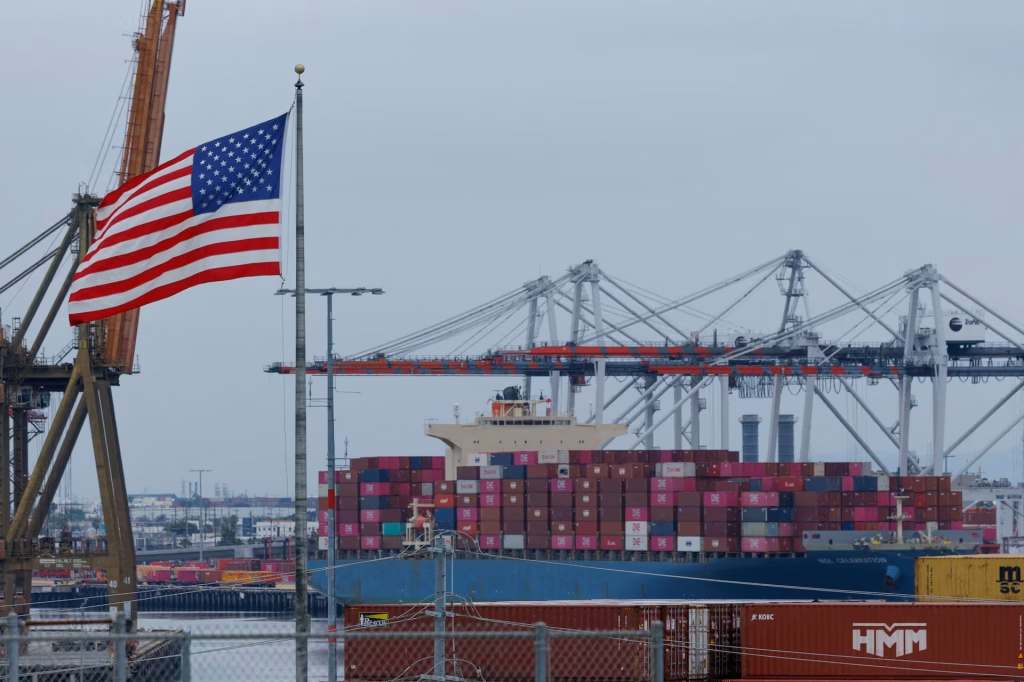
By May 12, 2025 — after 40 days of mutual economic destruction — both sides agreed to a truce at talks in Geneva. The US reduced tariffs on Chinese goods to 30%. China reduced tariffs on US products to 10%. The trade war paused. It did not end.
The truce held through the rest of 2025. Then came the Supreme Court.
On February 20, 2026, the US Supreme Court ruled in Learning Resources v. United States that tariffs imposed under the International Emergency Economic Powers Act (IEEPA) were unconstitutional without explicit congressional authorization — declaring them an unlawful form of taxation. The ruling invalidated the legal basis for many of Trump’s most expansive tariff measures, opening the door to importer refunds and forcing the administration to rebuild its trade policy architecture from scratch.
Trump’s response was swift. The IEEPA tariff program was ended. A new 10% global tariff was immediately imposed under Section 121 of the Trade Act of 1974. The administration announced plans to raise it to 15% and launched new Section 301 investigations into alleged unfair trading practices by China, Vietnam, Taiwan, Mexico, Japan, and the EU — laying the groundwork for a new round of targeted tariffs once the investigations conclude.
The Supreme Court changed the legal basis. It did not change the direction.
The Numbers: What the Trade War Has Actually Cost
The trade war’s economic costs are documented and substantial — though distributed unevenly between the two sides and among different economic actors.
For American households, the Tax Foundation estimates Trump’s tariffs amount to an average tax increase of approximately $1,500 per household in 2026. Some of this shows up directly in higher prices for consumer goods — electronics, clothing, household items. Some is absorbed by corporate margins. Some is avoided through supply chain rerouting. But the aggregate cost is real: Procter & Gamble raised prices on 25% of its products due to a $1 billion annual tariff impact. GM paid $3.1 billion in tariff costs in 2025 alone. Constellation Brands absorbed a $20 million hit on aluminum for its beer cans.
For Chinese exporters, the impact has been severe but survivable — because China has aggressively redirected its trade flows. In 2025, China’s exports to the US fell 20%, but its exports to Africa rose 25.8%, Southeast Asia 13.4%, the EU 8.4%, and Latin America 7.4%. China did not lose its manufacturing edge. It found new customers.
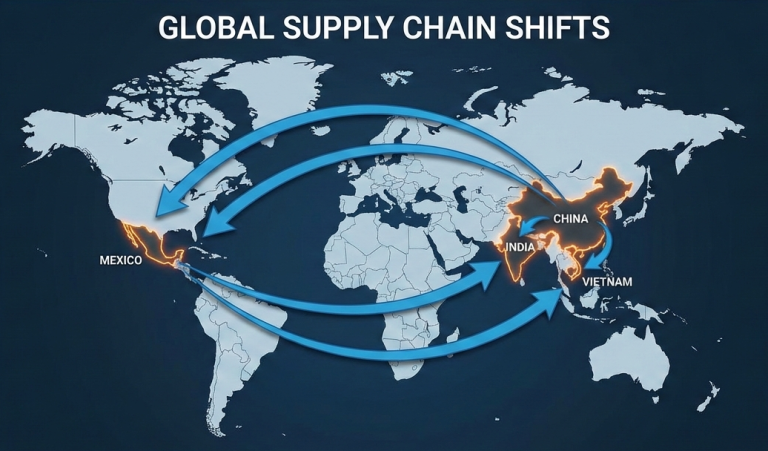
The most important structural consequence may be what happened to supply chains in countries that were neither the US nor China. Vietnam emerged as the single biggest beneficiary — receiving approximately 80% of shipments to the US from Chinese-owned companies as manufacturers shifted final assembly operations out of China to avoid tariffs while retaining Chinese-origin components and ownership. India captured about 25% of global iPhone production as Apple shifted manufacturing away from China. Mexico benefited from USMCA-exempt status. Thailand, Malaysia, and Indonesia all saw significant manufacturing investment inflows.
The trade war’s intended outcome — reshoring production to the United States — has largely not materialized. What has materialized is a restructuring of where final assembly happens, while upstream components and raw materials continue to flow from China through intermediary countries before reaching American consumers. The tariffs have mostly added a layer of complexity and cost rather than genuinely moving production home.
Rare Earths: China’s Most Dangerous Economic Weapon
The most alarming dimension of the US-China trade war in 2026 is not tariffs. It is rare earths.
China controls approximately 60% of global rare earth mining and an even larger share — estimated at over 85% — of rare earth processing capacity. Rare earth elements are essential for electric vehicle motors, wind turbines, jet engines, precision-guided missiles, radar systems, and virtually every advanced electronics product. There is no near-term substitute for many of these materials. There is no viable American source for most of them.
In 2025, Xi twice restricted exports of rare earth permanent magnets and certain semiconductors as retaliation against US tariffs. Both times, the restrictions threatened to shut down US and allied automotive assembly lines. Both times, the threat was enough to change US negotiating behavior.
In early 2026, the Trump administration convened two separate ministerial meetings on critical minerals, bringing together dozens of countries to begin building alternative supply chains. The meetings were an important acknowledgment of vulnerability. They were not a solution — building the mining capacity, processing infrastructure, and supply chain logistics to compete with China’s rare earth monopoly takes years and requires sustained policy commitment that the US has repeatedly started and abandoned.
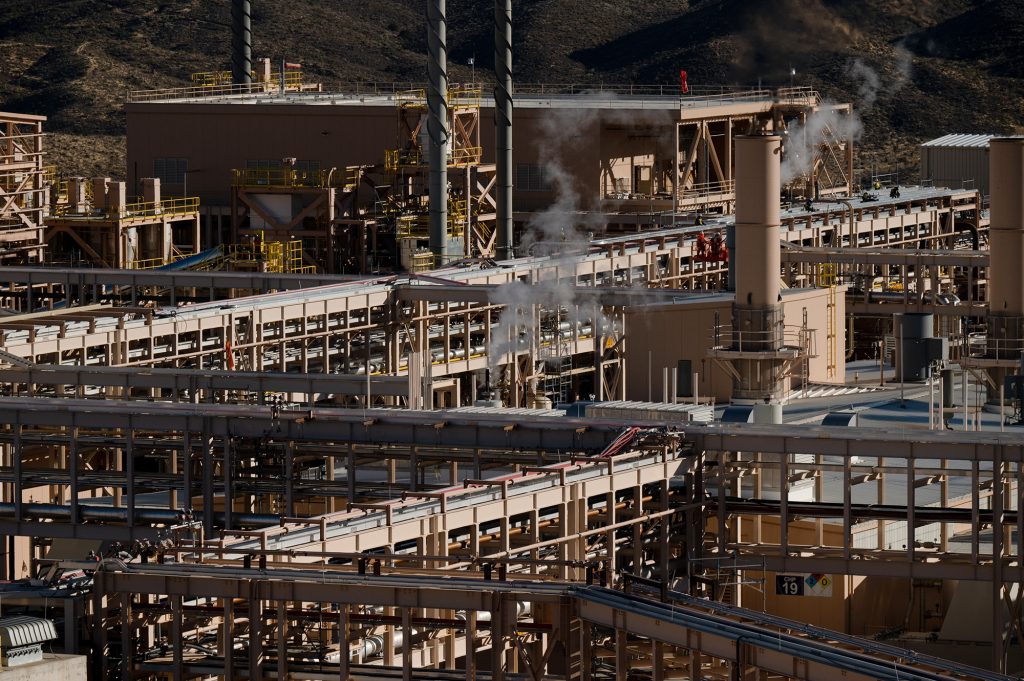
China’s rare earth leverage represents a structural asymmetry in the trade war that tariffs cannot address. The US can impose tariffs on Chinese goods. China can restrict exports of minerals that American factories cannot operate without. These are not equivalent tools.
The Peterson Institute for International Economics has argued clearly: solving the rare earth vulnerability requires the US to simultaneously lower tariffs on allies and partners while working with them to develop alternative supply chains. Asking countries to do the hard work of building rare earth supply alternatives — while also hitting them with US tariffs — is diplomatically and economically incoherent. This is the central contradiction the Trump administration has yet to resolve.
The Beijing Summit: What Happened, What Didn’t
Trump’s May 13–14 visit to Beijing was the first US-China presidential summit in nearly a decade. The symbolism was significant. The outcomes were modest.
The two sides discussed a proposed bilateral “Board of Trade” — a mechanism for regular high-level economic dialogue that would provide a more structured forum for managing disputes than the ad hoc summits and tweets that have characterized the relationship. Whether it materializes into an actual institution with staffing, authority, and a track record of resolving disputes is to be determined.
On tariffs, experts had low expectations and those expectations appear to have been met. The current framework — US tariffs on Chinese goods at approximately 30% under the post-Supreme Court structure, with ongoing Section 301 investigations pending, and China’s retaliatory tariffs at 10% — remained broadly in place. No announcement of significant tariff reductions emerged from the summit.
On rare earths and tech export controls, both sides appear to have acknowledged the issue without resolving it. China has not lifted its rare earth export restrictions. The US has not lifted semiconductor export controls on Chinese companies. The technology decoupling that both sides publicly resist and privately accelerate continued.
Taiwan was discussed. The details were not made public. No agreement was reached. This is the normal outcome for Taiwan discussions between the US and China — which is to say, the topic was raised, both sides restated their positions, and nothing changed.
The Iran war was discussed — given that China is a major importer of Iranian oil and has significant economic stakes in Middle Eastern stability. Whether Beijing’s influence over Iran’s calculus was brought to bear in any meaningful way through this channel is unclear.
The most consequential thing that happened at the Beijing summit may have been the meeting itself — a signal that both governments believe managed competition is preferable to unmanaged confrontation. After 2025’s near-economic catastrophe at 145%/125% tariff rates, both sides appear to have internalized that the extremes are too destructive to sustain. That is a floor, not a ceiling — it constrains how bad things can get without establishing a path to how good they might become.
The WTO: Effectively Sidelined
One of the quieter but more consequential dimensions of the US-China trade war is what it has done to the World Trade Organization.
The WTO’s dispute resolution mechanism — the primary multilateral tool for adjudicating trade conflicts under international law — has been effectively paralyzed since the Trump administration blocked appointments to the WTO Appellate Body during his first term. Without a functioning appellate body, WTO rulings cannot be appealed, which has made the dispute resolution system functionally inoperable for major economies.
China has filed numerous WTO complaints against US tariffs. The US has ignored the rulings. The WTO cannot enforce compliance. The system designed to manage exactly this kind of trade conflict has been sidelined at precisely the moment it is most needed.
The longer-term implication is that the rules-based multilateral trading system is being replaced, de facto, by bilateral power negotiations between the largest economies. Countries that benefited from WTO rules as a constraint on powerful nations’ behavior — which includes most of the world’s smaller and developing economies — have less protection than they had a decade ago. The geopolitical logic pushing toward fragmentation is defeating the economic logic that built globalization.
What Chinese Companies Are Actually Doing
Away from the diplomatic summits and tariff trackers, Chinese companies are executing a supply chain strategy that has proven remarkably adaptive.
The front-loading of exports before each tariff deadline created unusual patterns in 2025 trade data. But the structural shift is more permanent. Chinese manufacturers have established or expanded assembly operations in Vietnam, Mexico, Thailand, Malaysia, and increasingly India — not abandoning China as the manufacturing hub but adding final-stage operations elsewhere to meet “Made in Vietnam” or “Made in Mexico” origin rules.
This strategy has been called “tariff evasion” by the Trump administration, which has responded with investigations into transshipment — the practice of routing Chinese goods through third countries to claim non-Chinese origin. The Commerce Department’s new Section 301 investigations into Vietnam, Taiwan, and Mexico are partly aimed at closing these gaps.
The Iran war has added a new complication. Chinese exporters who had carefully rebuilt supply chains to route through the Middle East are now facing 50-day shipping delays to Europe as maritime routes around the Strait of Hormuz are disrupted, with freight rates surging and port congestion worsening across Asia. Some have shifted to rail freight — only to find their products classified as sensitive dual-use goods blocked from transiting conflict zones.
For Chinese exporters, 2026 has meant navigating tariff uncertainty and war-driven supply chain disruption simultaneously. Those that survive are becoming extraordinarily resilient, adaptable businesses. Those that don’t are accelerating an industrial consolidation that may ultimately strengthen China’s most capable manufacturers.
Key Facts: US-China Trade War, May 2026
| Peak US tariff on Chinese goods | 145% (April 2025) |
| Peak Chinese tariff on US goods | 125% (April 2025) |
| Current US tariff rate on China | ~30% (post-truce, post-Supreme Court) |
| Current Chinese tariff rate on US | ~10% (post-truce) |
| Average US effective tariff rate (Aug 2025) | 18.6% (highest since Great Depression) |
| Tariff cost per US household 2026 | ~$1,500 (Tax Foundation) |
| GM 2025 tariff cost | $3.1 billion |
| China’s exports to US (2025) | Down 20% |
| China’s exports to Africa (2025) | Up 25.8% |
| Supreme Court IEEPA ruling | February 20, 2026 — tariffs struck down as unconstitutional |
| Trump-Xi summit | May 13–14, 2026, Beijing — first since 2017 |
| New Section 301 investigations | China, Vietnam, Taiwan, Mexico, Japan, EU (March 2026) |
Where This Goes
The US-China trade relationship in 2026 is in a state of managed antagonism — neither the catastrophic decoupling that the most extreme tariff rates of April 2025 suggested, nor the integrated globalization of the pre-2018 era.
Complete decoupling is, as most economists and the CFR agree, neither likely nor, in the near term, possible. The two economies are too intertwined — in supply chains, capital markets, technology supply, and consumer markets — for a clean separation. Companies that have moved final assembly out of China continue to depend on Chinese components, Chinese rare earth inputs, and Chinese processing capacity for dozens of critical materials.
But the trajectory is toward managed separation — not decoupling but fragmentation, with more restricted trade, more deliberate diversification of supply chains, and a gradual building of parallel systems that reduce mutual dependence over decades.
The Beijing summit was the latest in a long series of meetings between US and Chinese leaders that acknowledged the necessity of the relationship while doing little to repair it. The tariff architecture remains in place. The Section 301 investigations will produce new tariff proposals. The rare earth vulnerability remains unresolved. And the fundamental competition over technology leadership, military power, and geopolitical influence that sits underneath the trade dispute has not softened at all.
The trade war is not over. It is in a managed phase. That is better than the alternative. It is not good enough to call it stable.
Sources: CFR (May 13, 2026 update), CNBC (May 13, 2026), LSE Business Review (May 2026), Peterson Institute for International Economics, Wikipedia (China-United States Trade War), Tax Foundation Tariff Tracker, CLA Tax Analysis (February 2026), PIIE Five Takeaways (March 2026)
About the Author