The IMF's April 2026 World Economic Outlook titled its report 'Global Economy in the Shadow of War' — projecting growth at 3.1% under its reference scenario and as low as 2.0% if the Iran conflict escalates.
At the start of 2026, the global economy looked like it might finally be getting its act together. The inflation shock of 2022–2023 had been largely tamed. Interest rates were coming down. The AI investment boom was generating genuine productivity gains. Despite the trade war mayhem of 2025 — when US-China tariffs briefly reached 145% on one side and 125% on the other — the global economy had absorbed the shock with surprising resilience. The IMF’s January 2026 forecast had been optimistic enough to project global growth at 3.3–3.4%, a number that would have represented a credible recovery.
Then Iran happened.
The US-Israeli strikes on Iran that began February 28, 2026, and the subsequent closure of the Strait of Hormuz — through which approximately 20% of global oil supply moves — changed the economic picture overnight. Energy prices surged. Shipping routes were disrupted. Supply chains that Chinese exporters had spent all of 2025 carefully rebuilding were thrown into chaos again. And the IMF’s April 2026 World Economic Outlook, titled bluntly “Global Economy in the Shadow of War,” downgraded global growth to 3.1% and raised the inflation forecast to 4.4% — with scenarios for severe disruption projecting growth as low as 2% and inflation above 6%.
The global economy is not in recession. But it is under a set of simultaneous pressures — war, energy shocks, trade fragmentation, debt vulnerabilities, and policy uncertainty — that it has not faced in this combination since the 1970s.
The Iran War Energy Shock: Three Scenarios
The single biggest new variable in the global economic outlook is the energy shock triggered by the closure of the Strait of Hormuz and damage to critical Middle Eastern energy infrastructure during the US-Iran conflict.
The IMF has laid out three scenarios with stark clarity.
In the reference scenario — assuming a short-lived conflict and a moderate 19% increase in energy commodity prices — global growth holds at 3.1% and inflation rises to 4.4%. This is manageable but painful, particularly for energy-importing developing economies already under fiscal strain.
In the adverse scenario — assuming further disruption, higher energy prices, elevated inflation expectations, and tighter financial conditions — global growth falls to 2.5% and inflation rises to 5.4%. This begins to look like a stagflationary squeeze, echoing the 1970s oil shock dynamics that tormented central banks for a decade.
In the severe scenario — energy supply dislocations extending into 2027, with inflation becoming markedly less anchored — global growth falls to 2.0% for both 2026 and 2027, while inflation exceeds 6%. This is the scenario that keeps finance ministers awake. A synchronized global slowdown of this depth, combined with high inflation, leaves central banks with no good options: cutting rates would fuel inflation; raising them would deepen the recession.
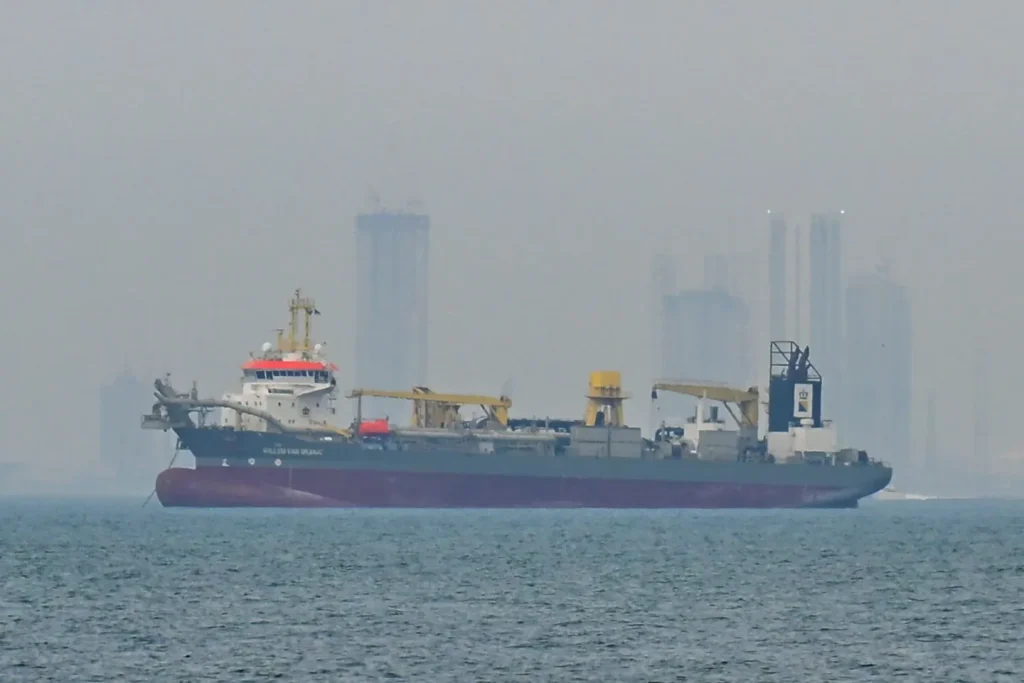
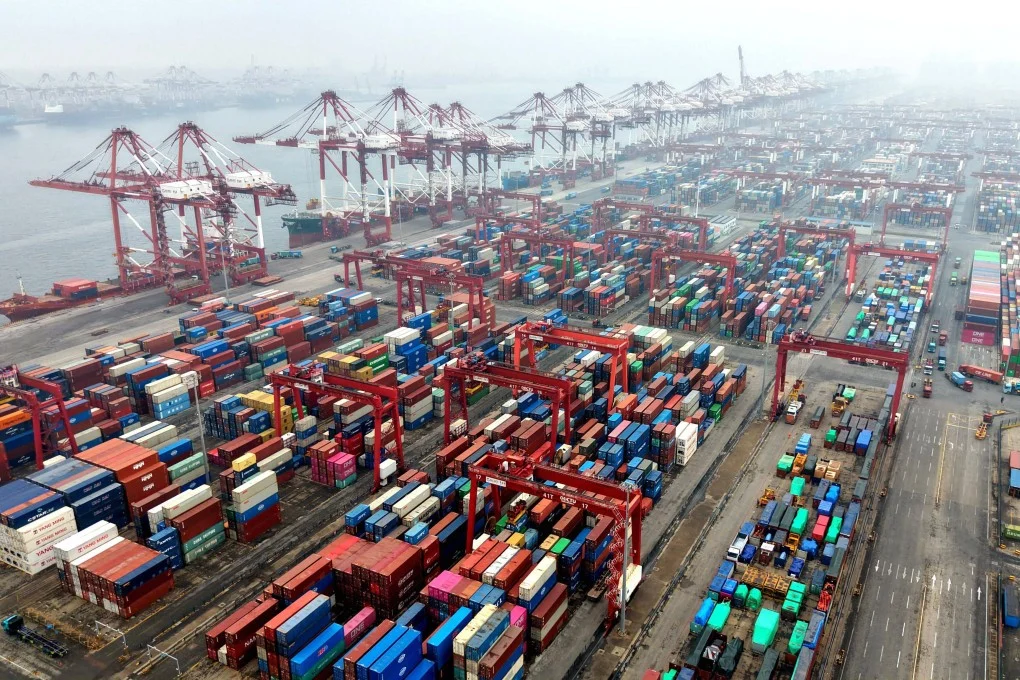
Oil and gas prices have risen sharply since February. Diesel and jet fuel, fertilizer, aluminum, and helium — all products with significant Middle Eastern supply chains — have seen price surges. Port congestion across Asia, particularly at Shanghai and Ningbo, has sent freight rates soaring. For Chinese exporters already navigating US tariffs, the Iran war has added a second layer of disruption that is, according to Shanghai-based supply chain consultant Cameron Johnson, “a whole global thing, a much bigger issue than tariffs.”
What 2025 Actually Looked Like — Before the War
To understand how much the Iran war has changed things, it helps to understand how unexpectedly well 2025 went.
Despite “Liberation Day” on April 2, 2025 — when Trump declared a national economic emergency and imposed sweeping tariffs on over 90 countries, pushing the average effective US tariff rate to 18.6%, the highest since the Great Depression — the global economy showed remarkable resilience.
Several factors buffered the shock. US tariffs came in lower than initially announced for many countries. Fiscal stimulus in various economies offset some demand destruction. Financial conditions remained relatively accommodating. The private sector adapted faster than models predicted — companies rerouted supply chains, front-loaded inventory, and found alternative suppliers with impressive speed. And the AI investment boom provided a genuine demand boost, particularly in the United States, as data center construction, semiconductor procurement, and cloud infrastructure spending surged.
By December 2025, the Trump-Xi meeting on the sidelines of APEC in Busan had produced a trade truce that reduced the most extreme tariff levels. Equity markets rallied. Hong Kong reclaimed its position as the world’s top IPO market. China’s A-share market reached a 10-year high.
Then came February 28, 2026.
The US Supreme Court Ruling: The Tariff Floor Shifts
One of the most consequential economic events of early 2026 went somewhat underreported amid the Iran war news: the US Supreme Court’s February 20, 2026 ruling that tariffs imposed under the International Emergency Economic Powers Act (IEEPA) are unconstitutional without clear congressional authorization.
The ruling declared IEEPA-based tariffs an unconstitutional form of taxation — a landmark decision that opened the door to refunds for importers who had paid duties under these measures and forced the Trump administration to recalibrate its entire trade strategy.
Trump responded with characteristic pragmatism: the administration ended the IEEPA-based tariff program and immediately imposed a new 10% global tariff under Section 121 of the Trade Act of 1974, with an announced intention to raise it to 15%. In March 2026, the administration launched new Section 301 investigations into alleged unfair trading practices by China, Vietnam, Taiwan, Mexico, Japan, and the EU — setting the stage for another round of tariffs once investigations conclude.
The Supreme Court ruling did not end the tariff era. It forced the administration to use different legal authority to continue it. The net result for businesses — still facing significant tariffs, still operating under policy uncertainty, still managing supply chains built around assumptions that keep changing — is that the legal architecture has shifted while the economic reality has remained broadly similar.
For China specifically, the ruling helped modestly. The IMF’s April 2026 upward revision for China’s growth reflected partly the reduction in tariff rates that followed. China’s economy is now projected to grow at approximately 4.5% in 2026 — slower than its pre-pandemic average but considerably better than the scenario that would have materialized if 145% tariffs had been maintained.
The Global Growth Picture: Uneven at Every Level
Below the headline global growth number of 3.1%, the picture is sharply uneven — by region, by income level, and by commodity dependence.
United States: Despite being the source of much of the trade disruption, the US economy has continued to show relative strength — supported by a tech investment boom, fiscal spending, and a labor market that, while softened from its post-pandemic tightness, remains fundamentally healthy. The tariff war has imposed real costs — the Tax Foundation estimates they amount to an average tax increase of $1,500 per US household in 2026 — but those costs have not yet tipped the economy into recession.
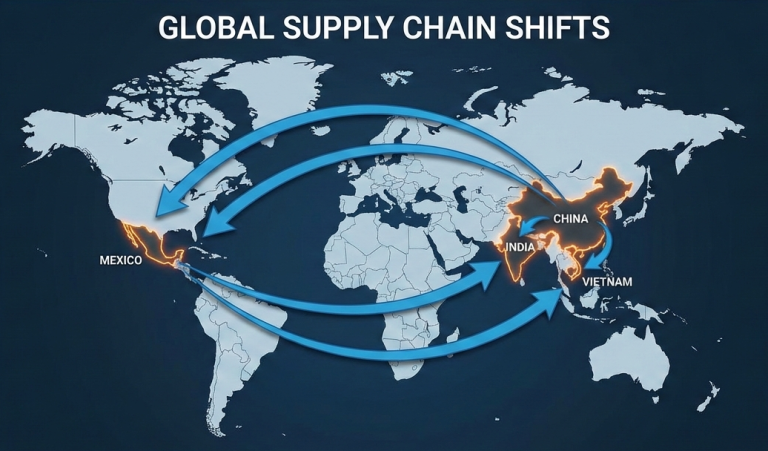
China: After a strong end to 2025, China’s economy is moderating toward 4.4–4.5% growth in 2026. Domestic demand remains subdued — weighed down by a struggling property market and cautious consumers — but exports have defied expectations. China’s exports to the US fell 20% in 2025, but exports to Africa rose 25.8%, Southeast Asia 13.4%, the EU 8.4%, and Latin America 7.4%. China’s trade pivot to non-US markets is one of the more significant structural shifts in global trade flows in decades.
Eurozone: Moderate growth, avoiding recession but not thriving — constrained by weak domestic demand, the energy implications of the Iran conflict, and the competitive pressure of Chinese goods seeking new markets in Europe. The EU’s announcement of the SAFE rearmament fund (€150 billion) and increased defense spending provide some demand stimulus but also crowd out social investment.
Emerging Markets and Developing Economies: The most exposed to the Iran war shock. Low-income energy importers face a simultaneous squeeze: higher energy import costs, declining foreign aid (bilateral aid cuts of 16-28% in 2025 are projected to continue), and weakening export demand from slowing advanced economies. Sub-Saharan Africa, which had genuine growth momentum heading into 2026, now faces median inflation rising from 3.4% to 5% and meaningful growth downgrades.
The Recession Risk: More Likely Than It Was
McKinsey’s March 2026 survey of global economic conditions found that for the first time since December 2022, the share of respondents expecting global conditions to worsen over the next six months is larger than the share expecting improvement.
More starkly: nearly 70% of McKinsey’s survey respondents now rank a recession scenario as the most likely outcome for the world economy in 2025–2026 — up from 53% just one quarter earlier. The dominant scenario, chosen by 61% of respondents, is a demand-led recession: rising uncertainty causes consumer confidence to drop, spending falls, and a self-fulfilling contraction follows.
Trade policy changes are cited by roughly six in ten respondents as one of the greatest risks to global growth — making tariff uncertainty the single most commonly cited risk. Geopolitical instability and conflicts come second.
The McKinsey data is opinion, not forecast. But it matters: if businesses and consumers believe recession is coming, they change their behavior in ways that make recession more likely. Capital investment is deferred. Hiring slows. Consumption is cut back. The expectation of recession can be a partial cause of the recession it anticipates.
The IMF’s baseline is not a recession — but the IMF has been explicitly clear that “downside risks are decisively elevated” and that a longer or broader Middle East conflict could “significantly weaken growth and destabilize financial markets.” The scenario space below the baseline is more populated than usual.
The Debt Problem: The Vulnerability Nobody Is Talking About
Running under all of these cyclical pressures is a structural vulnerability that receives less attention than it deserves: the state of public debt globally.
The COVID-19 pandemic triggered an extraordinary expansion of public spending financed by borrowing. Interest rates that stayed near zero for a decade made that debt cheap. The inflation shock of 2022–2023 and the subsequent interest rate rises changed the math dramatically. Governments that borrowed heavily in the zero-rate era are now rolling that debt over at significantly higher rates — a process that will squeeze public finances for years.
The IMF’s April 2026 World Economic Outlook specifically flags “elevated public debt and eroded institutional credibility” as factors that “further heighten vulnerabilities.” Countries with limited fiscal space — which includes many emerging market economies and some advanced ones — have limited ability to respond to the Iran war energy shock with the kind of fiscal stimulus that cushioned the 2025 tariff shock.
This means the global policy toolkit is smaller in 2026 than it was in 2025. And the shocks are larger.
What Central Banks Are Doing — and the Limits of What They Can Do
The Iran war energy shock puts central banks in a deeply uncomfortable position.
In 2022, when energy prices surged following Russia’s invasion of Ukraine, central banks raised interest rates aggressively and successfully brought inflation down without triggering a global recession. The IMF notes this as “widely seen as a major policy success.” Can the same thing happen now?
The IMF says: “There are reasons to doubt it.” In 2022, inflation pressures were already elevated. Today, while labor markets have softened and balance sheets have normalized, inflation has not fully returned to target in several major economies — particularly the United States. The “last mile” of disinflation has proven sticky.
If the Iran war shock is modest and short-lived, central banks may be able to look through the energy price spike without raising rates — as they occasionally do with temporary commodity shocks. If it is sustained, they face the same dilemma as the 1970s: raise rates to fight inflation and risk recession, or tolerate elevated inflation and risk losing credibility.
The IMF’s advice — “ensure near-term measures are time-bound and targeted at the most vulnerable, and maintain focus on medium-term development objectives” — is correct in principle and politically difficult in practice.
Key Facts: Global Economy, May 2026
| IMF global growth forecast 2026 | 3.1% (reference) / 2.5% (adverse) / 2.0% (severe) |
| Global inflation forecast 2026 | 4.4% (reference) / 5.4% (adverse) / 6%+ (severe) |
| Pre-war IMF forecast (January 2026) | 3.3–3.4% |
| US average effective tariff rate (Aug 2025) | 18.6% (highest since Great Depression) |
| Average tariff cost per US household 2026 | ~$1,500 (Tax Foundation estimate) |
| China growth forecast 2026 | 4.4–4.5% |
| China exports to US (2025) | Down 20% |
| China exports to Africa (2025) | Up 25.8% |
| McKinsey recession probability (respondents) | ~70% rank recession as most likely |
| Sub-Saharan Africa inflation forecast | Rising from 3.4% to 5% in 2026 |
What to Watch
The global economy’s trajectory in the second half of 2026 depends on three variables more than any others.
First, the Strait of Hormuz. Whether commercial shipping fully resumes — and whether the US-Iran ceasefire of April 2026 holds and deepens into a more durable political arrangement — will determine whether the energy shock is a brief spike or a sustained drag. Every week the strait remains effectively closed is a week of compounding economic cost.
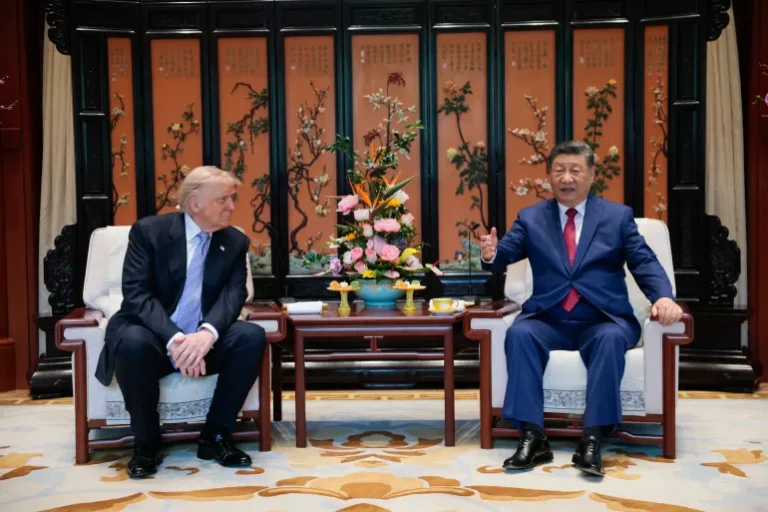
Second, the Trump-Xi summit outcomes. Trump and Xi met in Beijing on May 13–14, 2026 — the first bilateral summit since Trump’s first term in 2017. The agenda covered trade de-escalation, a proposed bilateral “Board of Trade,” Taiwan, the Iran war, and AI. Experts entered with low expectations. Any meaningful reduction in tariffs — particularly on the rare earth and critical minerals restrictions that China has used as economic weapons — would provide significant relief to supply chains still built around Chinese inputs.
Third, AI productivity. The global economy’s resilience in 2025 was partly driven by AI investment creating genuine demand. If the productivity gains from AI materialize at scale — if the technology starts visibly increasing output per worker across multiple sectors — it could provide a sustained positive growth impulse that offsets some of the geopolitical drags. If the AI productivity boom disappoints, or if elevated asset valuations in the tech sector correct sharply, that itself becomes a new source of instability.
The global economy has surprised forecasters with its resilience repeatedly since 2020. It may do so again. But the combination of war, energy shock, trade fragmentation, debt vulnerability, and policy uncertainty it faces in 2026 is more demanding than anything it has navigated in that period.
The shadow over growth is real. The only question is how long it lasts.
Sources: IMF World Economic Outlook April 2026 (“Global Economy in the Shadow of War”), IMF Spring Meetings Press Briefing Transcript (April 14, 2026), McKinsey Global Economic Conditions Survey (March 2026), World Bank Global Economic Prospects, LSE Business Review (May 2026), CNBC, Tax Foundation, Deloitte Insights 2026 Global Economic Outlook
About the Author