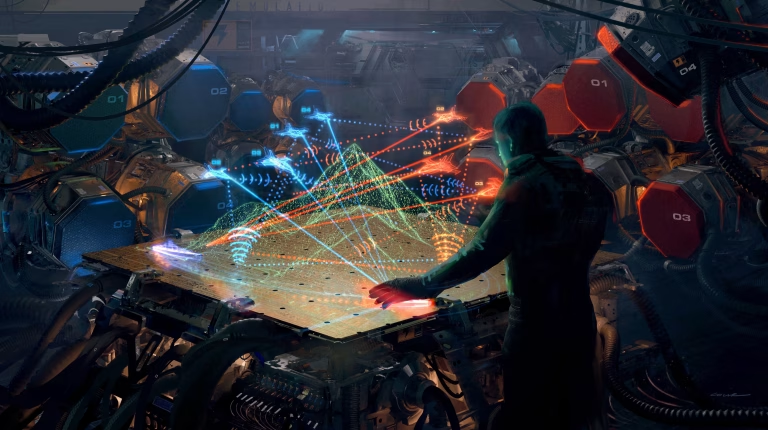
The CBO estimates Golden Dome could cost $1.2 trillion over 20 years, requiring 7,800 interceptor satellites in low Earth orbit. Congress has appropriated $38.4 billion in first-phase funding.
Space has been militarized since the first reconnaissance satellite flew in 1959. GPS guides missiles. Satellites provide early warning of nuclear launches. Communications constellations link every element of modern warfare from the infantryman’s radio to the carrier strike group’s targeting network. None of that is new.
What is new in 2026 is the explicitness, scale, and operational urgency of what is happening above the atmosphere.
The US Space Force — founded just seven years ago — now has a dedicated orbital warfare unit practicing offensive satellite maneuvers using live spacecraft. China’s operational satellite fleet exceeded 1,060 by mid-2025, with hundreds dedicated to intelligence, surveillance, and reconnaissance. Russia has deployed anti-satellite missiles, co-orbital attack satellites, and ground-based laser systems capable of blinding Western optical sensors. The US Congress has appropriated $38.4 billion for Golden Dome in its first two funding rounds. The Congressional Budget Office estimates the full system could ultimately cost $1.2 trillion over 20 years.
Space has always been where war is enabled. It is rapidly becoming where war is fought.
Golden Dome: America’s $1.2 Trillion Missile Shield
No defense program in 2026 has generated more attention, more money, more controversy, or more engineering ambition than Golden Dome for America — Trump’s proposed national missile defense architecture designed to protect the United States from ballistic missiles, hypersonic glide vehicles, advanced cruise missiles, and drone swarms.
The program’s cost estimates span a range that tells you everything about the uncertainty involved. The White House puts it at $175 billion. The Congressional Budget Office’s May 12, 2026 analysis estimates $1.2 trillion over 20 years. The American Enterprise Institute’s highest estimate is $3.6 trillion. The first two funding rounds — $25 billion in the reconciliation bill and $13.4 billion in the FY2026 defense appropriations act — represent the program’s down payment.
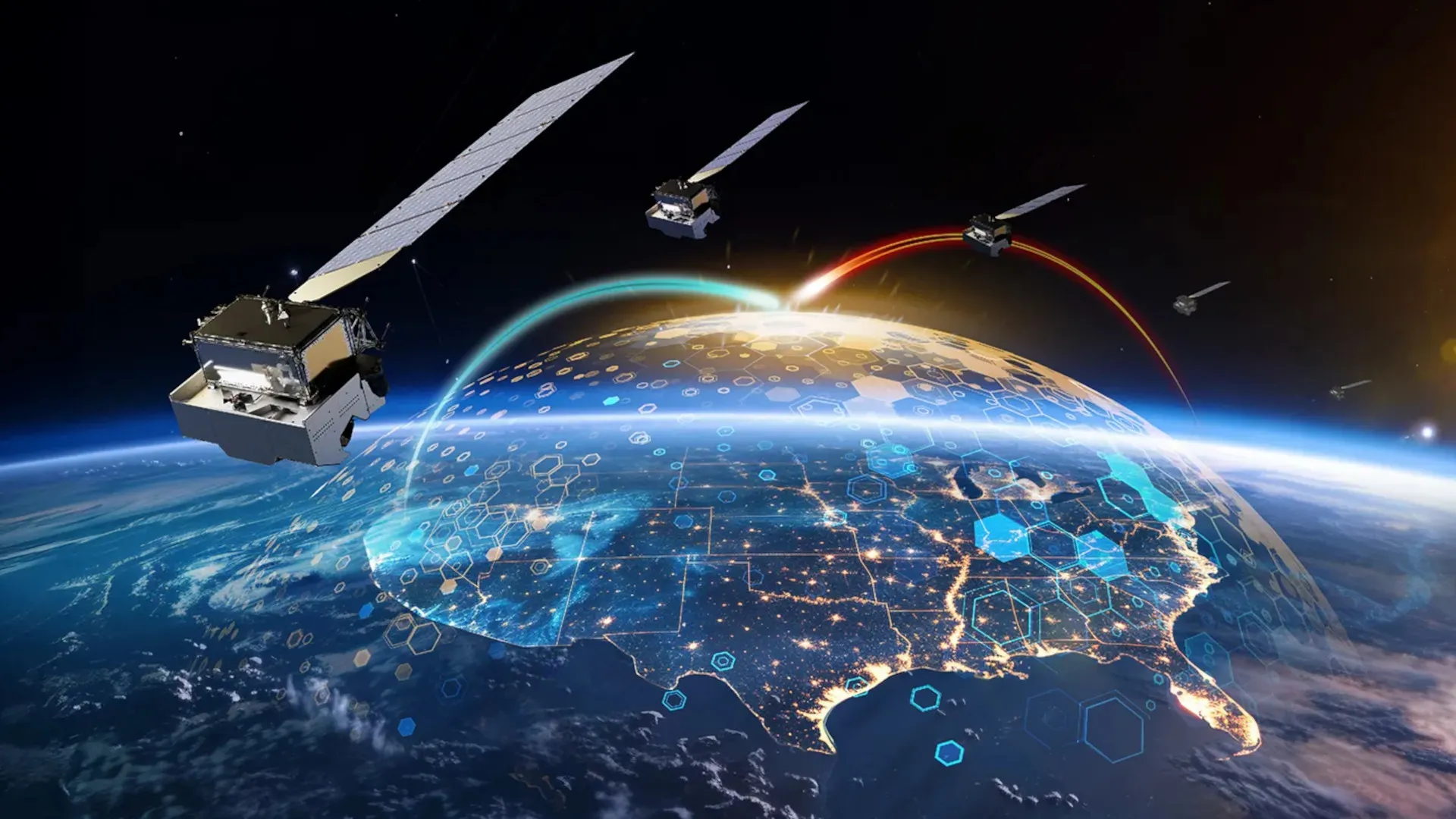
The architecture centers on three layers working simultaneously. Space-based sensors — proliferated satellite constellations providing persistent global coverage — detect launches early and provide fire-control quality tracking data that ground-based radar cannot consistently deliver against low-flying hypersonic threats. Space-based interceptors (SBIs) — the most technically ambitious element — would fly in low Earth orbit and attempt to destroy enemy missiles during their boost phase, before warheads separate and decoys deploy, giving the defense a clean shot at a single object rather than a cloud of vehicles and countermeasures. Ground-based systems — existing GMD, Aegis, THAAD, and Patriot batteries — form the terminal defense layer against whatever gets through.
The Space Force awarded $3.2 billion in Other Transaction Authority agreements to 12 companies in late 2025 and early 2026 to develop SBI prototypes — including Anduril, Lockheed Martin, Northrop Grumman, Raytheon, SpaceX, and True Anomaly. Golden Dome czar General Michael Guetlein has pledged to demonstrate an “initial capability” for space-based interceptors before the end of Trump’s term.
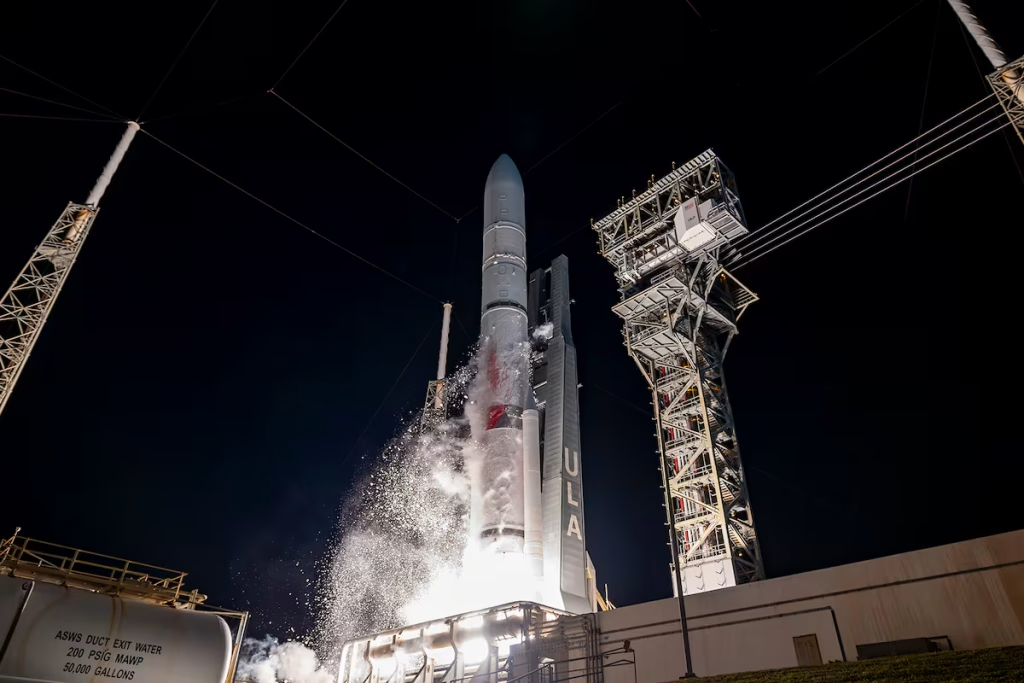
The physics problem is formidable. The CBO’s model requires 7,800 SBI satellites in low Earth orbit to intercept a raid of 10 ICBMs simultaneously — with two shots per target to improve kill probability. Because low Earth orbit satellites are not stationary, they decay quickly. 30,000 satellites over 20 years would be needed to sustain 7,800 in orbit — replacements for those falling out of orbit due to atmospheric drag every five years. For comparison, Starlink’s entire constellation currently numbers approximately 7,600 satellites, and SpaceX replaces about 1,800 of those annually.
Golden Dome’s most serious critic — the Bulletin of the Atomic Scientists — argues bluntly that the executive order promises “things that will be impossible anytime soon.” MIT physicists have made the same mathematical argument. But the Space Force remains publicly confident it can demonstrate capability before 2028, and the money is flowing regardless.
The Orbital Ambiguity Problem: When Defense Looks Like a First Strike
The most strategically dangerous aspect of Golden Dome is not its cost or its engineering challenges. It is a problem called orbital ambiguity.
A Starshield satellite carrying defensive interceptors is indistinguishable on radar from a commercial Starlink satellite — or from one carrying offensive hypersonic gliders. Adversaries observing a US constellation of thousands of LEO satellites cannot determine which are defensive, which are commercial, and which carry offensive payloads.
Strategic theorists Forrest Morgan at RAND and James Acton at the Carnegie Endowment have both argued that this “warhead ambiguity” creates a “reciprocal fear of surprise attack” — incentivizing China and Russia to execute massive “blinding strikes” against the constellation at the onset of any crisis, before those satellites can be used against their missiles. The logic is identical to the Cold War’s hair-trigger nuclear posture: use them or lose them.
In other words: a system designed to reduce the threat of nuclear war could, by creating ambiguity about whether US satellites carry offensive weapons, actually incentivize the adversary to strike first and strike early — turning a regional crisis into an immediate strategic confrontation.
Canada’s ambassador to the United Nations drew international attention to the political dimension of this problem after Trump suggested Canada either pay $61 billion to join Golden Dome or accept annexation as a free alternative. The ambassador called it “a protection racket.” It was a characterization that landed sharply at the UN General Assembly.
The Space Force at War: Mission Delta 9 and Orbital Warfare
The US Space Force — at just seven years old the youngest branch of the American military — is transitioning from organizational buildup to operational warfighting with notable urgency in 2026.
Mission Delta 9, the Space Force’s dedicated orbital warfare unit, received a significant capability upgrade in February 2026: a live satellite that operators use to practice offensive and defensive maneuvers in actual orbital space, not simulation. The distinction matters enormously — maneuvering a real satellite in orbit, approaching another satellite, practicing evasion from a co-orbital threat — is categorically different from running through scenarios on a screen.
Chief of Space Operations General B. Chance Saltzman has publicly outlined six categories of counterspace weapons the Space Force is developing: three space-based and three ground-based, including jammers, directed energy systems, and kinetic kill vehicles. The Space Force’s budget for FY2026 is approaching $40 billion — a record level reflecting the administration’s prioritization of space as a warfighting domain.
The Space Force’s role in actual combat was confirmed publicly for the first time during the February 2026 strikes on Iran. Pentagon leaders described US space and cyber forces as the “first movers” in the operation — creating electromagnetic corridors and disabling Iranian command and control systems before a single conventional weapon was released. More than 1,000 targets were struck in the first 24 hours, a tempo impossible without space-based targeting, tracking, and communications. Space is not support. Space is now the opening move.
China’s Space Strategy: 1,060 Satellites and Counting
China’s operational satellite fleet exceeded 1,060 by mid-2025 — with hundreds dedicated to intelligence, surveillance, and reconnaissance of US military assets, installations, and carrier strike groups. The US-China Economic and Security Review Commission’s 2025 report states bluntly that “China is aggressively positioning itself as a global leader in space technology and exploration, seeking to reshape international governance, influence standards, and displace the United States as the world’s premier space power.”
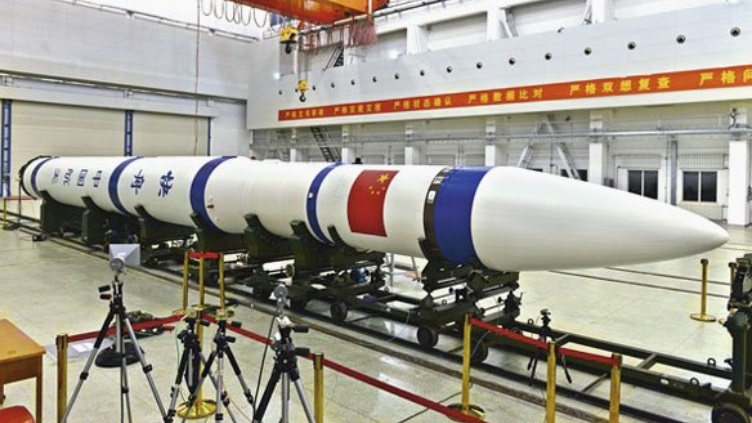
China’s anti-satellite capabilities are the most documented threat to US space assets. The 2007 ASAT missile test — which destroyed a Chinese weather satellite and created thousands of debris pieces still orbiting today — demonstrated both capability and willingness. Since then, China has developed more sophisticated counterspace capabilities: co-orbital satellites that can approach and disable other satellites; ground-based laser systems that can dazzle or blind optical sensors; electronic warfare that jams satellite communications; and what US officials assess as directed energy weapons capable of damaging sensitive satellite hardware.
China is also building its own proliferated LEO satellite constellation — a military Starlink equivalent — that would give the PLA reliable communications with forces operating in the far seas, even under electronic warfare conditions. In a Taiwan contingency, US cyber and electronic warfare operations would attempt to degrade PLA space-based communications. A resilient Chinese LEO network would provide backup links the US cannot easily cut.
Russia’s Space Weapons: The Tested Arsenal
Russia’s counterspace capability is the most immediately mature of the three major military space powers.
The 2021 ASAT test — which destroyed a defunct Russian satellite and scattered more than 1,500 debris pieces into orbits used by the International Space Station and commercial satellites — drew international condemnation. It also demonstrated that Russia retains a fully operational kinetic kill ASAT missile system, deployable against LEO targets on short notice.
Beyond kinetic kill, Russia operates co-orbital attack satellites — spacecraft that can approach other satellites and disable them through physical contact, electromagnetic pulse, or directed energy. Russia has also deployed ground-based laser systems that have been used to dazzle and potentially damage Western optical reconnaissance satellites. GPS jamming from Russian military systems has been detected across Ukraine, the Baltic region, Finland, and the Middle East — not as an occasional occurrence but as a persistent operational capability used routinely in active military operations.
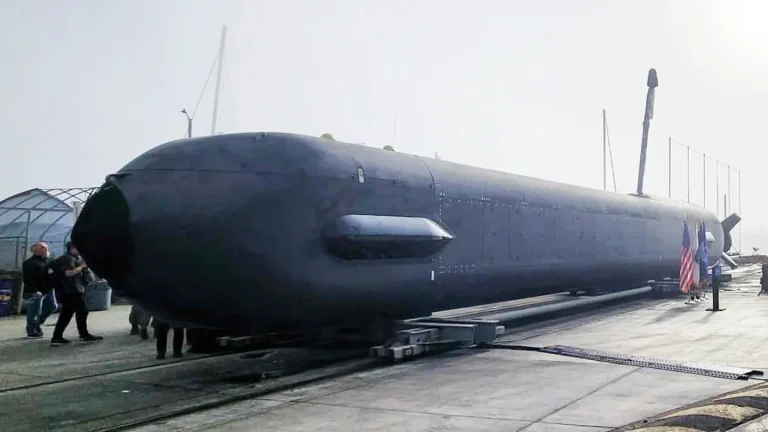
Russia’s Khabarovsk nuclear submarine — launched in November 2025 — is designed to carry the Poseidon nuclear-armed underwater drone, capable of traveling intercontinental distances autonomously and detonating a nuclear warhead near coastal cities or carrier strike groups. While not a space weapon, the Poseidon represents the same philosophy that drives Russia’s counterspace strategy: developing capabilities specifically designed to hold US strategic assets at risk in ways that existing defense systems cannot reliably intercept.
GPS Vulnerability: The Achilles Heel of Modern Warfare
Every US weapons system that uses GPS for navigation, targeting, or coordination — which means virtually all of them — shares a common vulnerability: GPS signals are extraordinarily weak by the time they reach the Earth’s surface, making them relatively easy to jam or spoof.
Russia has repeatedly jammed GPS across Ukraine, the Baltic region, and the Middle East. Iran deployed GPS spoofing in the Persian Gulf during the 2025–2026 conflict. China has demonstrated GPS disruption in the South China Sea and Taiwan Strait. In April 2026, reports emerged that Ukrainian F-16 pilots were being trained by the Royal Air Force to operate in GPS-denied environments — practicing low-altitude visual navigation and terrain-based orientation as backup methods because GPS cannot be assumed reliable in any conflict with a sophisticated adversary.
The Pentagon’s PNT (Positioning, Navigation, and Timing) vulnerability report identifies the GPS constellation’s 31 satellites in medium Earth orbit as targets for anti-satellite weapons, jamming, and electronic warfare effects. The Space Force launched an experimental Navigation Technologies Satellite-3 (NTS-3) in geosynchronous orbit to test whether a multi-orbit PNT architecture can boost resilience against attacks on the MEO constellation.
The long-term answer — quantum inertial navigation, which doesn’t depend on external signals at all — is in development across several programs. None are ready for operational deployment at scale. Until they are, GPS vulnerability remains the most exploitable weakness in US military operational capability.
The Commercial Space Reserve: Wartime Starlink
One of the most consequential and least-discussed elements of US space strategy in 2026 is the Commercial Augmentation Space Reserve — a program transitioning from pilot phase to full-scale operations in 2026, targeting 20 contracts by year-end.
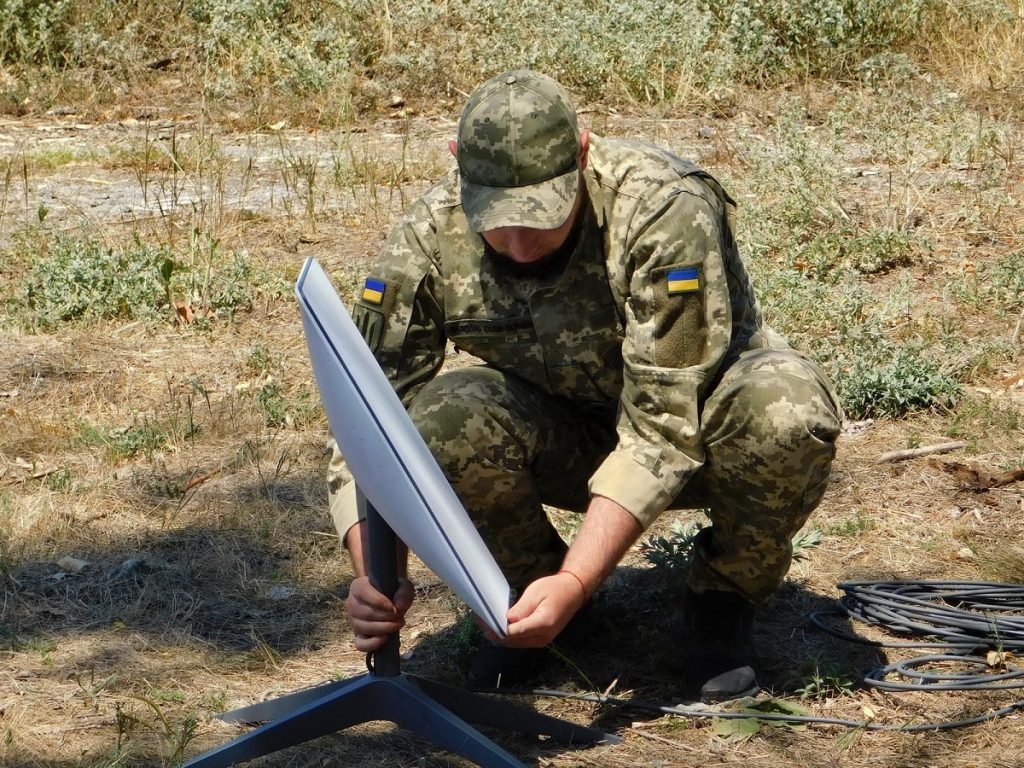
The program gives the US military wartime access to commercial satellite communication networks — effectively treating Starlink, Viasat, and other commercial constellations as reserve military infrastructure that can be activated when military satellites are jammed, damaged, or destroyed. Ukraine’s experience has been the proof of concept: Starlink provided the communications backbone for Ukrainian drone operations, distributed command and control, and battlefield coordination throughout the war — even as Russian electronic warfare systems attacked military frequencies.
The strategic implication is significant. A US adversary contemplating attacks on military satellites must now factor in a commercial constellation of thousands of additional spacecraft that would fill the gaps. Destroying military GPS doesn’t work if Starlink provides backup positioning. Jamming military communications doesn’t work if commercial broadband takes over. The blurring of military and commercial space creates resilience — and new targeting dilemmas for adversaries.
Key Facts: Space Warfare Technology, May 2026
| Golden Dome cost estimates | $175B (White House) / $1.2T (CBO) / $3.6T (AEI) |
| Golden Dome first-phase funding | $38.4 billion (reconciliation + FY2026 defense bill) |
| SBI prototype contracts | $3.2B OTA to 12 companies incl. SpaceX, Lockheed, Anduril |
| SBIs needed (CBO model) | 7,800 in orbit; ~30,000 over 20 years |
| Initial Golden Dome capability target | 2028 |
| US Space Force FY2026 budget | ~$40 billion (record) |
| China’s operational satellite fleet | 1,060+ (mid-2025); hundreds ISR-dedicated |
| Russia ASAT test debris | 2021 test: 1,500+ debris pieces |
| Mission Delta 9 upgrade | Live satellite for orbital warfare training (February 2026) |
| Iran war space role | Space/cyber forces struck 1,000+ targets in first 24 hours |
| Commercial Space Reserve | 20 contracts targeted by end of 2026 |
Where the Orbital Arms Race Leads
The trajectory of 2026’s space militarization points toward a future that strategic planners find genuinely alarming — not because of any single capability, but because of how all the capabilities interact.
Golden Dome’s SBI constellation creates orbital ambiguity that incentivizes adversary first strikes against satellites. China’s ASAT capability can blind US reconnaissance and early warning in the opening hours of any conflict. Russia’s GPS jamming has already degraded US weapons accuracy in active combat theaters. The commercial constellation that provides resilience also creates ambiguity about what is military and what is civilian — complicating international law, escalation management, and crisis communication.
The 1967 Outer Space Treaty was written before any of this existed. It prohibits weapons of mass destruction in orbit but says nothing about conventional interceptors, co-orbital maneuvering vehicles, directed energy systems, or the military use of commercial constellations. Its legal architecture has not kept pace with the capabilities now being deployed.
Space was supposed to be the province of science, exploration, and peaceful competition. It remains all of those things. But in 2026, Mission Delta 9 is practicing offensive satellite maneuvers on live spacecraft. The Space Force is building weapons it won’t publicly describe. China is mapping the Pacific from orbit. And the program designed to defend America from missiles may itself become the trigger for the conflict it is meant to prevent.
The final frontier has become the most contested one.
Sources: Defense News (January 2026), Defense One, Breaking Defense, Air and Space Forces Magazine, Washington Times, Bulletin of the Atomic Scientists, Wikipedia (Golden Dome Missile Defense System), CSIS, US-China Economic and Security Review Commission 2025 Report
About the Author